by Barbara & Dan Gleason
Spring is when most birds court, breed and raise young, and they must find — or build — a safe place for eggs and nestlings. Nearly all birds use a nest of some kind, but construction varies widely and is species-dependent.
A clutch of eggs needs protection, but requires placement enabling the parent birds to sit on and incubate them, with good heat retention. Once the youngsters hatch, a nest may be used as a temporary home, but only until the young fledge.
The simplest nest construction is a shallow scrape on the ground where eggs are placed, like those of shorebirds: Killdeer or avocets may place small twigs or dried grasses around their scrape, often in a gravelly or rocky area. Their mottled eggs blend into the surroundings, hidden from predators. For killdeer, black-necked stilt or other shorebirds, a nest only holds eggs until hatching; within an hour or so, these tiny babies follow their parents away from the nest, ready to learn what to eat.
Even simpler is no nest at all! A female common nighthawk simply finds a place on the ground to lay her eggs, relying on surrounding vegetation to hide both herself and her eggs. Common murres on our Pacific Coast find a bare spot on offshore rocks to lay their single egg, which is shaped to turn in a circle.
Ground-nesting birds, like dark-eyed juncos or spotted towhees, make a neatly woven, well-hidden nest for their eggs on the ground.
A wide variety of nest materials are used, from soft, downy plant materials wrapped with spider silk and bits of lichen, like in a hummingbird nest, to loosely arranged twigs, such as those made by doves and pigeons, where eggs can sometimes be seen through the nest from below.
Mud often helps bind nest materials together: Robins’ deep mud-and-dried-grass cup-shaped nests, like other bird species, are lined with soft plant matter. Soft, dry grass and animal fur provide a cozy place for adults sitting on eggs, and later cushion and retain heat for the young after hatching.
Some tree-nesting birds’ nests are quite elegantly constructed: The bushtit’s beautiful hanging nest of soft plant materials resembles a soft, long slipper, toe at the bottom and the opening on the side near the top. Orioles also construct a hanging sock nest, but its entry is an open top. Marsh wrens weave a tight nest of soft reeds and cattails, attached to emerging marsh vegetation, and the male makes several dummy nests (usually with no entrance hole) to mark territory, and his mate builds a similar-looking nest, but with a useful entry hole on the side.
Nest sizes range from a hummingbird’s tiny, two-inch diameter nest to the world’s largest, that of a bald eagle, sometimes exceeding eight feet in diameter and 10 to 12 feet deep!
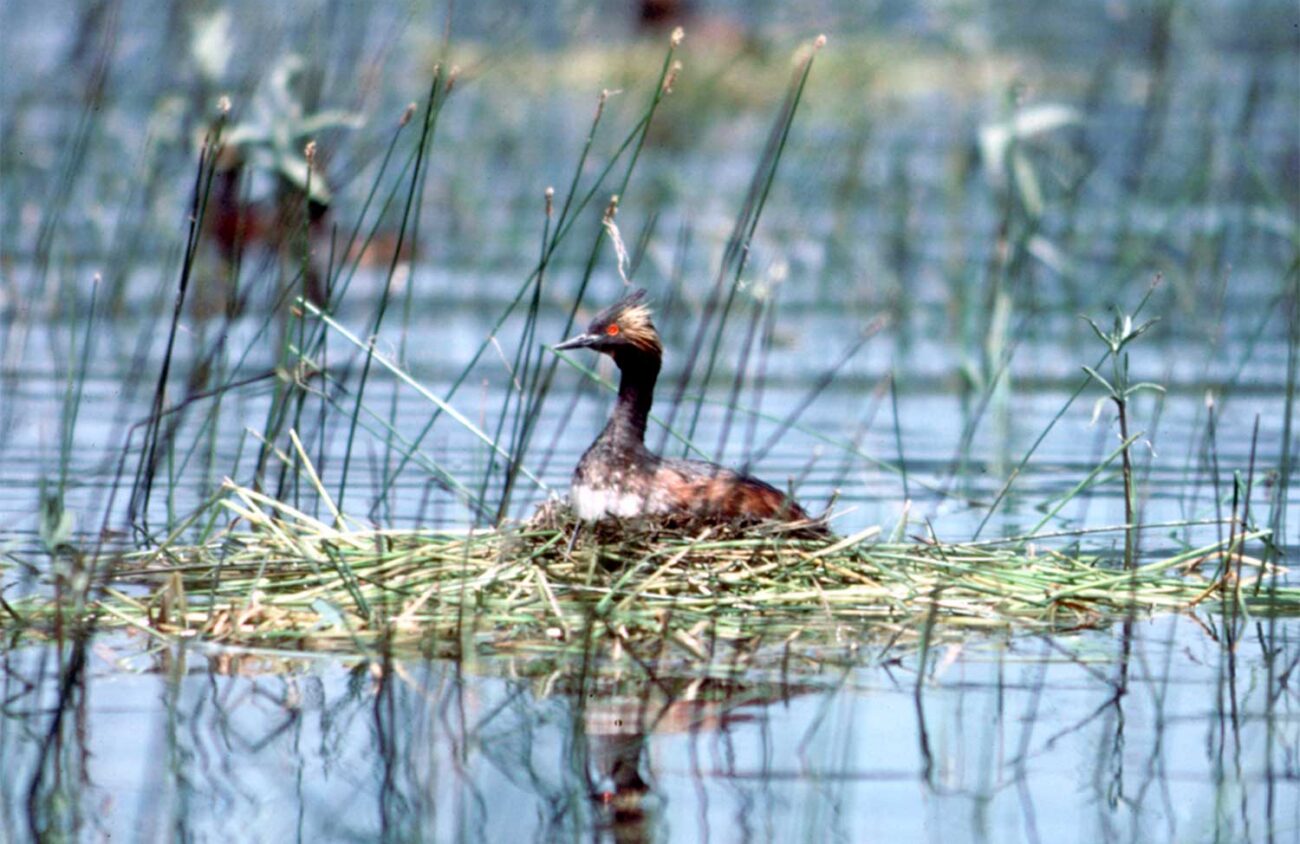
Nests can be found in surprising places: Consider the black swift that builds its nest behind waterfalls at places like Salt Creek Falls, or grebes whose nest is built on floating grasses and reeds on a lake. Grebes’ feet are placed so far back on the body that land access is unmanageable, so their floating nest provides easy access and predator deterrence.
Cavities are also used by many bird species: Woodpeckers excavate tree cavities, as do chickadees, who add soft wood or plant materials. Chickadees will take a nest box if it meets their specifications, as will Western bluebirds or swallows. Only certain species take nestboxes, but if one is properly designed for that species, it is more likely to bring the birds to your yard.
Carefully watch birds in your yard; if they are carrying grasses or other nest materials, they are likely building a nest nearby. And, if they are gathering food, like caterpillars, carrying it to a nearby bush or tree, watch where they go — but from a good distance.
Keeping your distance prevents your attention from alerting a predator to the nest, putting the wee babies at risk.
The nests of birds are marvelous in their diversity, with nearly as many designs, sizes and shapes as bird species to build them, and the time of year to enjoy watching them is approaching!
(Note from Kim: Birds need nesting areas and insects to eat. Be careful how you handle weeds because insects are everywhere — always best to pull weeds and refrain from using commercial poisons.)
Barbara and Dan Gleason are local owners of Wild Birds Unlimited, at 2510 Willamette Street and Green Acres Road, Suite 104 in the Delta Oaks Shopping Center. EugeneWBU@gmail.com or 541-603-9294. Kim Kelly edits The Garden Palette. Send your garden questions to Gardening@EugeneWeekly.com.