By Alby Thoumsin
Even if my favorite time of year to plant is late fall through the winter, it appears that the mood to plant for Oregonians is in the spring — I don’t blame them, since it is more pleasant to plant on a nice spring day blessed with the songs of birds and daffodils and tulips emerging from the ground.
As we inch towards that beautiful season, here are a few hints and crucial tips before you head out to your favorite nursery.
Whether you plan on planting a tree or shrub, you must consider climate change. Coming from someone who has observed nature for his entire life, the climate is getting hotter and some trees are no longer recommended by arborists because of the heavy water requirements.
Unless you live in a fertile, well-drained area and have good access to water, stick to species of trees and plants that are more resistant to climate change. A quick example of a tree I never recommend anymore is the katsura, due to their enormous thirst. An Oregon white oak or a Chinese pistache is preferable. The nursery you choose should have a list of suitable trees and bushes for this area.
Doing your homework first will save much aggravation. Take time to look at your yard and see if the soil type matches the tree preference. Avoid planting in very poorly drained soils unless you choose a tree or plant that will tolerate that. You might fall in love with a plant, but make sure it will work in the location. It’s a common occurrence to plant a large shade tree right under the primary power lines! That can be expensive to correct. (Note from Kim Kelley: Yes, we have all made a mistake like this.)
We are blessed to live in a valley where the weather is relatively clement, so the risk of a hard freeze is pretty rare; nonetheless, checking the zone preference is key to having a successful planting. The Willamette Valley generally falls into USDA Hardiness Zones 8a to 9a and most nurseries buy stock for this.
Also, look at the course of the sun if you are looking for a tree that will shade your house or your deck. Is the tree you want notorious for littering? Are you interested in attracting wildlife, or are you into very formal and manicured landscapes? All those small details are important.
Assuming you have your champion in mind, it is time to go shopping. Trees come three different ways: bare root, B&B (Ball and Burlap) and in containers. All three have pluses and minuses that can be explained this way.
| Tree Type | Good | Not as Good |
|---|---|---|
| Bare Root | Very light, roots mass and flare are visible | Limited to winter and early spring |
| Ball and Burlap | Available almost all year long | Heavy with burlap, twines and often metal cage — not always dug out properly, roots mass is not visible and root flare sometimes hidden |
| Container | Lots of choices and available year around | Very often root bound and potted too deep in container, burying the root flare |
Most people will buy a tree or plant in a container so it is important to follow some guidelines. First, avoid buying the largest tree you can find in hopes of getting ahead of the game. A larger tree not only costs more but notoriously will have a much slower start than a smaller tree of the same species, so stick to 1.25” to 1.75” trunk diameter. It will already be taller than you, anyway!
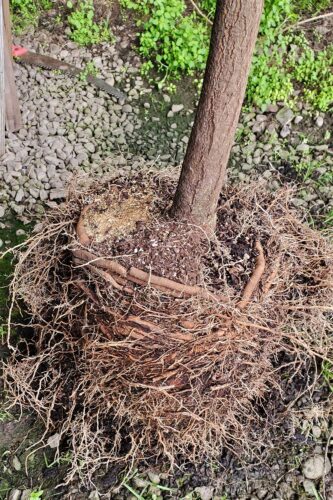
Larger trees are often kept in containers too long and become root bound. If you see bulges on the exterior walls of the container, move on.
Next, you should be able to see the flare of the trunk (natural widening of the base of the trunk as it leads to the main roots) right above the level of the soil in the container or the ball and burlap. If not, it is likely buried and will often lead to the formation of girdling or circling roots. If the tree easily slides off the container so you can inspect the root ball, you are good. If the tree doesn’t slide easily and the root ball already shows roots circling as they hit the inside of the container, it is not a death sentence, but definitely something you will need to deal with before planting.
Finally, it is OK to decline the sale, even if you ordered the tree — the nurseries know that.
Once home and ready to plant, dig a hole that will be wider than the root ball but never deeper. Measure the height of the root ball to make sure the flare will be above grade, remove or cut any circling and girdling roots and install the tree/plant in the hole. Mix about 10 percent of compost with the native soil and backfill around the root ball and water thoroughly to eliminate air pockets.
Stake the tree, tie the knots on the stake at your hip level and the same level on the tree, not around the trunk. The stake and ties should be removed after one full growing season. Watering should start when the temperatures are climbing quickly above 75 degrees and last until the first serious rains of November for the first two growing seasons. Consider providing 15 gallons of water per week per inch of diameter. The tip for success is slow, deep and infrequent. If you give two gallons each day by spraying from a distance for 5 minutes, it will not work. An easy way is to have three 5 gallon buckets that you drill a 1/4 inch hole in the bottom of, place them around the tree on a certain day of the week (morning is best) and fill the bucket with water, the holes will drip the water slowly.
Apply less water if the soil has a tendency of draining slowly; no need to drown your new tree. If the temperatures rise above 90 degrees for a while, either increase the amount of water or water twice a week. Start weaning the tree after two full seasons.
Have fun and enjoy planting Life!
Alby Thoumsin is a ISA certified arborist, RCA registered consulting arborist and TRAQ qualified through the International Society of Arboriculture. He can be reached at Alby@SperryTreeCare.com or 541-461-1737. Kim Kelly edits the Garden Palette and can be reached at Gardening@EugeneWeekly.com.