
Jill Christman’s latest memoir, The Heart Folds Early, brings the reader directly to the epicenter of reproductive justice. The writing is raw and vivid, and Christman’s candor illustrates that while abortion has become a political issue, the right to choose is deeply personal. Ultimately, her story is about love, fear, tragedy, grief — unavoidable truths of the human condition.
Christman is a professor at Ball State University and senior editor of River Teeth: A Journal of Nonfiction Narrative and Beautiful Things. She’s a 1992 graduate of the University of Oregon Honors College and the English Department.
We spoke recently via Zoom, and our conversation has been edited for length and clarity.
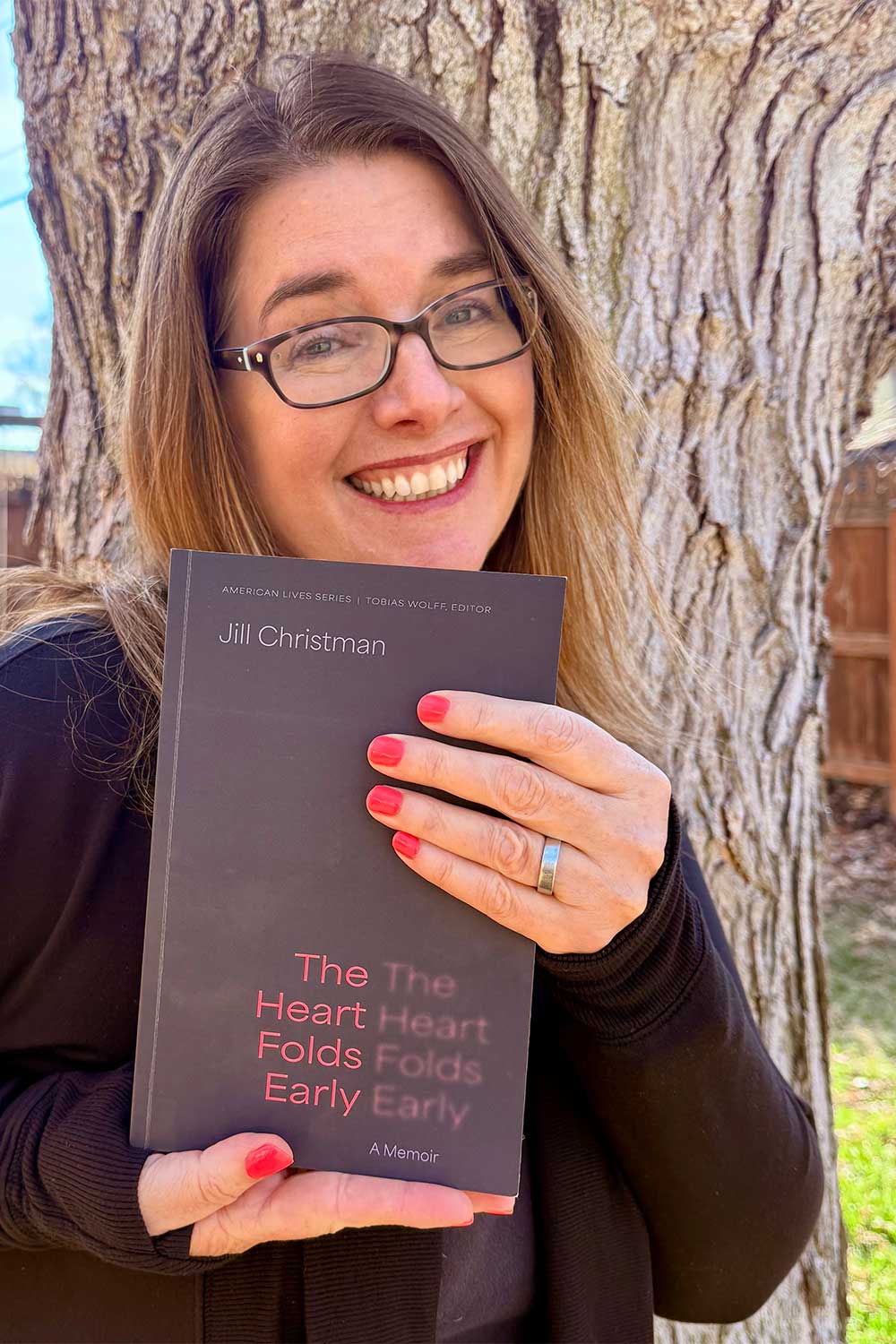
Your book is about a woman’s right to make reproductive health choices. What do you hope readers take away from your book?
The Heart Folds Early is about choice, and particularly the idea that an imagined choice or a speculative choice is not really a choice. A choice is only a choice when we’re actually making it. I don’t want my book to be read as judgment of anybody else’s choice. That’s really important to me, because I respect all choices. In our personal stories, we open up opportunities for empathy. I hope that we can move away from rhetoric that flattens out the issue. I would like for our human stories to be allowed to be as complicated as possible.
When we got the diagnosis at nearly 19 weeks of pregnancy that our baby had only half a heart, I hadn’t even known that was something that could happen. The doctor who performed the abortion said, “Sometimes it’s best not to know all the things.” But if I had imagined it, I wouldn’t have known what I was going to do. I only knew when I was in it. The truth is that I was wildly in love with our baby — this was our son. I wanted to show that I could make a choice and then still grieve. And grieve I did.
You’ve said that writing Darkroom, your first memoir, saved you. How? Do you feel that same way about his new book?
I believe secrets hurt us. That’s part of this. I’ve never met a secret that helped anybody, except perhaps a perpetrator. At the time, I was carrying the shame of childhood sexual abuse. I was carrying the shame of my eating disorder. I had all of these dark corners in my brain, and I turned on a light. Going so deeply into memory and pain and grief helped me come out of the other side and move forward. That’s what we do when we make art, and that also helped me to heal as a human.
The Heart Folds Early is different because I’d already saved myself. I had this experience, and I needed to put this story down in a way that made sense. I wanted to very clearly say, “I chose this abortion.” I loved this baby, but I made this choice because we couldn’t choose to let him suffer the way he was going to suffer. This book felt like a responsibility. I’m a writer. I know how to do this. I had the skills. I had the privilege. And after June 24, 2022 [when the U.S. Supreme Court overturned Roe v. Wade], I knew I had to finish this book.
In the book you write, “Even in fantasy I was an overthinker.” How do we turn overthinking into a strength?
I have two fundamental learning objectives for my students: Pay attention and be curious. These are good tools for living, too. I tell my students to look more closely than they can imagine looking. Then, as soon as you find yourself thinking, “Oh, that thing over there, that’s the pain that is unimaginable.” But we use the word “unimaginable” to protect ourselves. Instead, look closely and stay curious. As we move through that process, we can make art.
What do you most remember from your education at UO?
The Honors College showed me that a life in books was possible. It was a top-notch liberal arts experience with small, beautifully designed classes and invested professors. Dennis Todd was a marvel of a man — he taught the intro science class with such energy. We started with the Big Bang, and it was then I started thinking closely about curiosity. Frances Cogan was a literature professor. I remember going into her office, and she’d sit back and talk to you about books like Frankenstein in a way that was amazing. Monza Naff taught a women’s autobiography, Shakespeare and a Black women’s literature class. I followed her around, and she’s really the one whose classes shaped my everything. Their Eyes Were Watching God, I Know Why the Caged Bird Sings — these books gave me permission to tell my story.
You’re a literary journal editor and a writing teacher. What’s your most unique piece of writing guidance?
I just wrote a craft essay about “tacking,” which is a sailing term. It’s philosophical advice I give for writing difficult material. The idea is that we cannot sail directly into the wind, right? And this is true for all of us when writing difficult material. In order to move towards the difficult thing and understand it and navigate it, we have to tack right. So we go a little this way, we go a little that way, and we go a little this way again. So what does it mean to you and your story? Tacking helps you make gradual progress towards the place that you want to be.
Your writing is often witty. Why do you think it’s important to include humor in a book about such a serious subject?
Just because we’re going through something serious and hard doesn’t mean everything we are disappears. And my family is full of smart, funny people. I always say, “When you can laugh, laugh, the rest of it will be waiting for you, I promise.”
With suffering, we are actually able to go more deeply into the hard stuff when we throw open the doors and let in the light. And so that’s what I think humor does. That’s not a device. That’s the way I try to live my life. I will cry and laugh many, many times today. I like having the space to feel all those feelings. Nothing makes me happier than when a reader reaches out to talk about something that happened to them. My writing made a space for them to have an experience, and that’s my job.
Nicole Dahmen is a professor at the University of Oregon’s School of Journalism and Communication and Clark Honors College. The Heart Folds Early: A Memoir ($26.95) published March 1 and is available through Nebraska Press and your local bookstore.