For Oregon Public Broadcasting documentarian Jessie Sears, the Klamath River has been a pivotal part of her life — though she hasn’t always been aware of it.
Sears experienced a typical Oregon upbringing in Portland, but it’s southern Oregon, where the Klamath River winds toward the Pacific Ocean, where her heart ultimately lies.
A member of the Karuk Tribe, Sears says her connection to the river runs generations deep. For as long as anyone could remember, the Klamath River had been dammed. Copco No.1 Dam, the oldest of the four removed, was constructed in 1918.
That changed on Oct. 2, 2025, when four dams were removed: Copco No. 2 Dam, Copco No. 1 Dam, J.C. Boyle Dam and Iron Gate Dam, marking a turning point and allowing most of the river to flow freely for the first time in more than a century. Only Keno Dam and Link River Dam remain. The effort became the largest dam removal project in U.S. history.
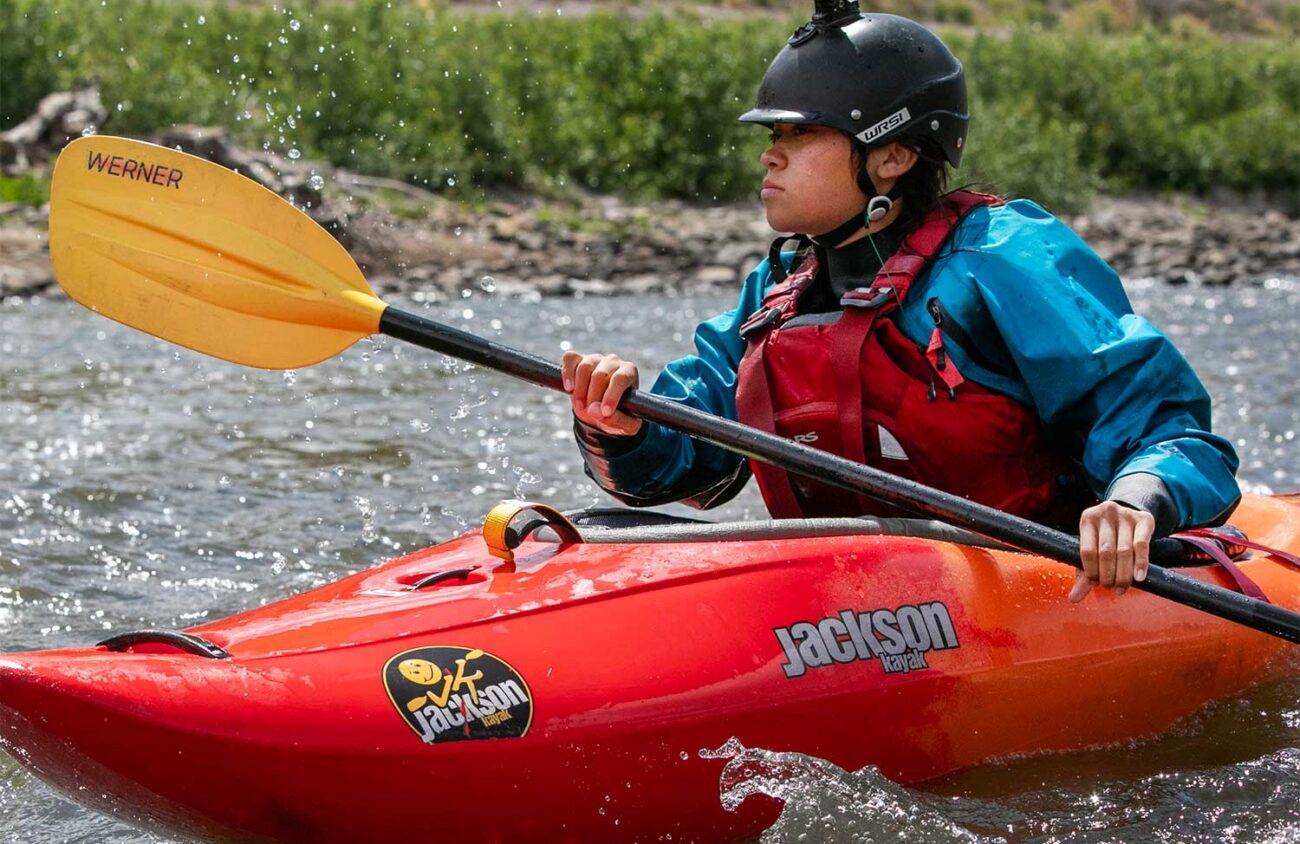
For the tribes, the moment was historic. To celebrate the river’s restoration, Native youth partnered with Paddle Tribal Waters — a program and initiative focused on Indigenous youth, river restoration and cultural reconnection tied to the removal of the dams — to kayak 300 miles of the Klamath to the ocean, over the course of 30 days.
Tasia Linwood, one of the teen kayakers who took the journey, is of Karuk, Ojibwe, Okanagan, Wampanoag and Tohono O’odham. We first see her in the documentary talking about the advice her uncle gave her before the trip. “Before leaving for this trip, my uncle said, ‘Go be historic. This is history. We are currently creating history,’” Linwood says.
At the time, Sears was finishing Undammed, a Patagonia Films-produced documentary about the removal of the dams. When she learned that a group of Native youth was preparing for a commemorative descent of the Klamath, she knew immediately she wanted to document it. That impulse became the catalyst for First Descent: Kayaking the Klamath, produced for OPB’s Oregon Field Guide.
“The documentary found me,” Sears said. “I always knew I wanted to be a filmmaker, but I thought I’d be more into thrillers. I found myself using documentary as a channel to reconnect with my Indigenous roots — and then as a way to be of service to other Indigenous communities.”
Sears and her crew were present for 10 of the 30 days the group spent on the Klamath. But her involvement began long before filming started. Relationship-building became her first priority.
No one appreciates a camera thrust into their face with an expectation to share deeply personal experiences. Sears had seen that approach before, and she was determined not to repeat it. “You can’t force people to tell you their traumas and their histories. It takes connection,” she says.
For First Descent: Kayaking the Klamath, Sears wanted to capture not only the journey itself, but the years leading up to it. That included the teens’ training in Chile, where they spent two semesters preparing for the descent. The tribes have known since 2019 that the dams would be coming down under the Klamath Basin Restoration Agreement. Footage provided by Rios to River — a nonprofit dedicated to protecting rivers and empowering Indigenous youth to be environmental stewards — and River Roots, a production company, provided essential context for the commitment behind the journey.
When the trip started in June 2025, Sears and her team were there. Karuk tribal member Jeff Mitchell opened the first day with a group prayer.
Filming just 10 days of a 30-day journey posed logistical challenges. Sears and her team chose to document the beginning, middle and end of the trip, which meant repeatedly leaving and rejoining the group. “We would have to go home and then try to find them again on the river and out of service,” Sears says. Tracking kayakers without cell service is no simple undertaking.
The crew relied on a mix of digital cameras, drones and GoPros. Sears and her team filmed from canoes — significantly slower than kayaks. “Canoes are slow,” Sears says. “Luckily, we had the drones. They got what we couldn’t.”
During the journey, Linwood, 15 at the time of filming, reflects on the weight of the experience: “It feels so young when I say it, but I feel so old.”
The Klamath is not a fast-moving river, forcing paddlers to work harder. The teens endured constant discomfort — wet clothes, long days and physical exhaustion.
During training, Linwood flipped her kayak in a rapid. Panicked, she forgot her safety training and kicked herself out of the boat. She walked away with a large bruise — and a renewed sense of resolve. “Not gonna lie, like, I almost quit kayaking,” she said. “But I didn’t. So, like, hell yeah.”
At one point, conditions on the river became too rough to safely secure the cameras. “I had to make the decision that we were turning around,” Sears said, noting the situation could have quickly spiraled out of control.
Beyond the physical challenges, Sears was acutely aware of the responsibility that came with telling Native stories. Indigenous communities, she said, have long been misrepresented — or exploited — by the media. “It’s always tragic. It’s always a tragic thing,” Sears says. “And I also think people easily fall into stereotypes. Indigenous people are not there to be used for views.”
Sears found joy in filming the teens. She says the group reminded her to loosen up. “Teenagers are doing cool things,” Sears says. “They are the next generation. We need to let them do their thing and applaud them. They’re speaking up for the river. They’re speaking up for their people. The work’s not done.”
At the end of the journey, Sears and her crew captured emotional reunions between the youth and their families — moments that nearly brought her to tears.
For Linwood, the journey was transformative — but the kayaking itself wasn’t the ultimate victory. “We won a war,” she says. “The war against the river and our people and the dams and all these companies and colonization,” she says. “The kayaking was the side thing — the plus side to getting the dams taken out.”
After filming wrapped, Sears arrived at her own realization. “The Klamath River has always been like a home to me that seemed very far away,” she says. “But I found my way back and realized I wasn’t that far away after all.”
First Descent: Kayaking the Klamathis available to watch on YouTube, OPB.ORG and JessieSears.com.
This story has been updated.