It’s 1960, and Otto Poticha and his wife, Sharon Scott East Poticha, are driving around the country, and even into British Columbia, to, as he calls it, “interview cities.” Their Volkswagen Beetle racks up miles as the couple spends three months looking for a city they want to call home. In the backseat sits their 1-year-old daughter, Shelley.
The trip began in Denver, then through the Southwest, and eventually up to Canada. “I’d barge into an architect’s office and talk to the principal and say, ‘What’s this town really about?’” Poticha recalls.
They decided on Vancouver, British Columbia, but soon found out that Canada didn’t recognize a U.S. architect’s license. The couple considered Portland or Seattle, but Eugene turned out to be where Poticha would spend most of his life and career.
At the age of 91, Poticha refuses to retire. He has spent nearly 66 years designing thoughtful, artistic architecture in Eugene, including a two-bedroom house near the University of Oregon called the “Love Nest,” also described as a mid-century treehouse, that recently sold for more than $1 million. He has designed or remodeled three theaters in Lane County, including Springfield’s Richard E. Wildish Theater, Lane Community College’s Ragozzino Performance Hall and Eugene’s Very Little Theatre.
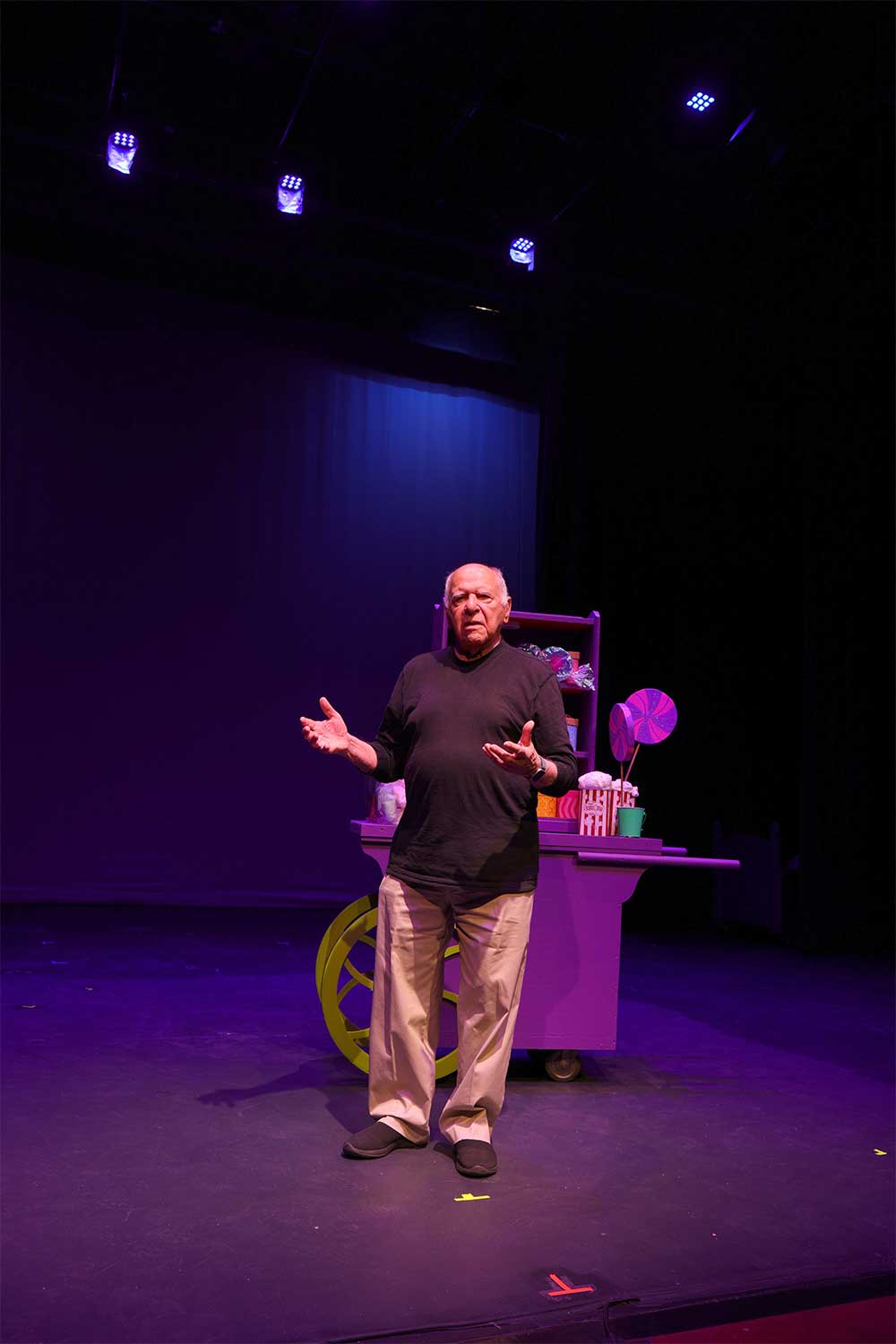
He’s worked on buildings in London, Japan and several states across the U.S. Poticha estimates he’s done a total of 400 projects in his career. And he probably holds a record as the most senior adjunct professor at the UO, where he taught for 62 years, starting in 1962.
With Vancouver out of the picture, Poticha says, “I came back to Eugene.” He was attracted to the geographic opportunities the Pacific Northwest offered. “In a 100-mile radius, I can do buildings on the coast and the Coast Range, the valley, the Cascades and the desert. And I’ve done buildings in all of those.”
The architects he met in Eugene had a true passion for their work. They were “dealing with architecture in Eugene as an art form, not something that just keeps you out of the rain. That was impressive for me,” he says.
Abraham Kelso, an assistant teaching professor at the University of Oregon and the board president of the Northwest Center for Architecture, says Poticha’s buildings tend to reflect the Pacific Northwest. Poticha doesn’t have a distinct style. Instead, he designs each building to fit the site it occupies, often using materials common to the area.
The two men met in 2016 when Kelso took a studio architecture class Poticha taught.
The UO had offered Poticha a tenure-track position, which Poticha declined, taking a job as an adjunct professor instead. When other faculty asked him why he turned down the tenured job, Poticha would say, “What I want to do is, I want to come to school, play with the students for four hours in the afternoon, and go back to my practice.” Poticha had no interest in “playing patty cake with committees.”
Poticha brought a new energy to the School of Architecture and Environment, Kelso says, one that some students were not prepared to handle. “He had a reputation as being one of the only studio professors who would fail students,” Kelso recalls. “But he just wants the profession to be good.”
“I am nasty as a teacher,” Poticha admits. “I would say, ‘There’s a lot of bad architects in the world and I’m not gonna train any more bad architects.’ So I’ve had students cry.” He says he’s heard people say, “Watch out for Otto!”
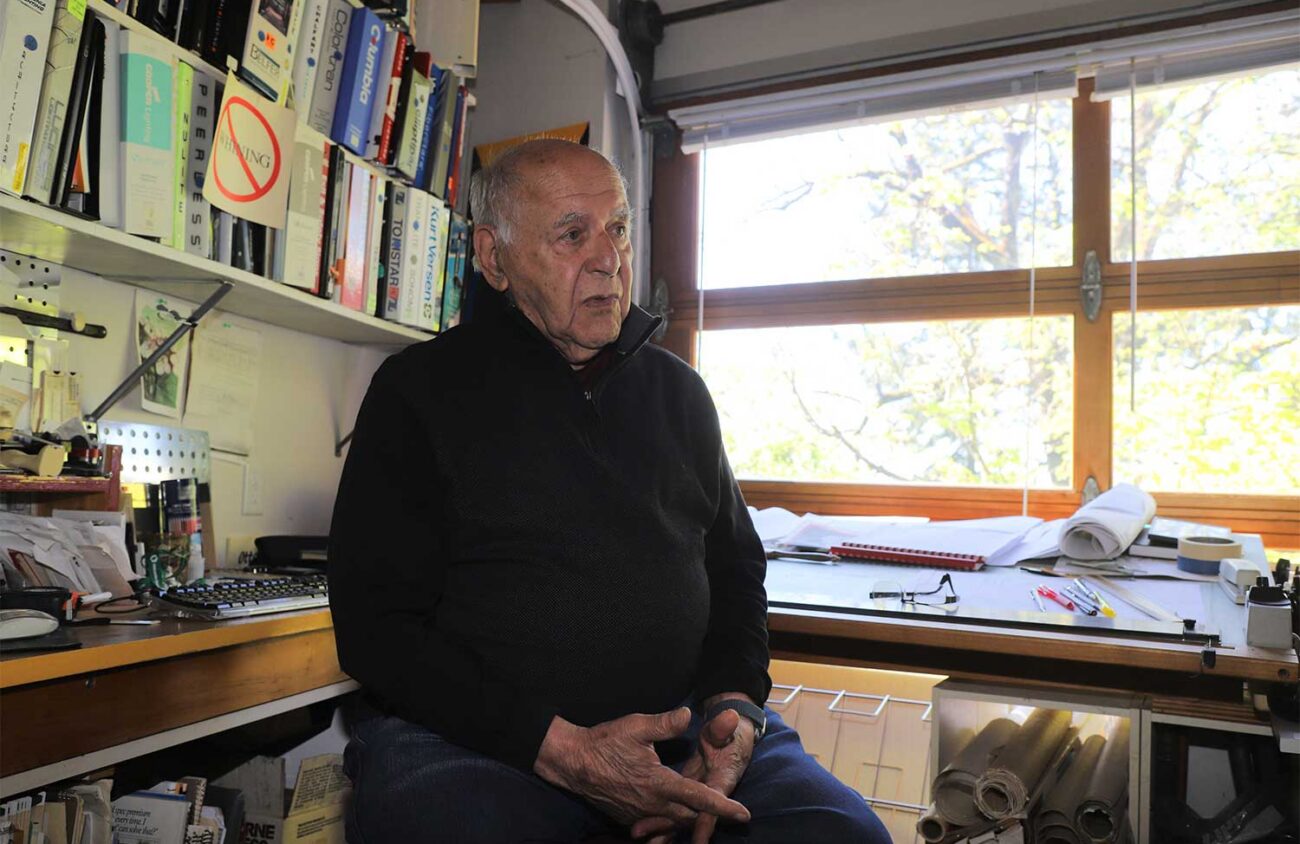
In an interview in his cluttered home office in Eugene, Poticha calls Eugene “butt-ugly” and leans back with a loud cackle. He believes Eugene’s new generation of architects “don’t have the same energy. But I think we’re at fault, because we’re not as critical.”
The office, part of a home he designed for himself and his family near Hendricks Park, is littered with countless design plans, even ones from the start of his career. A sign over his desk warns, “No whining.” Poticha says he has kept everything, including scribbles of ideas on the backs of napkins. The space looks over the trees of Eugene, with a window-paneled garage door as an artistic touch.
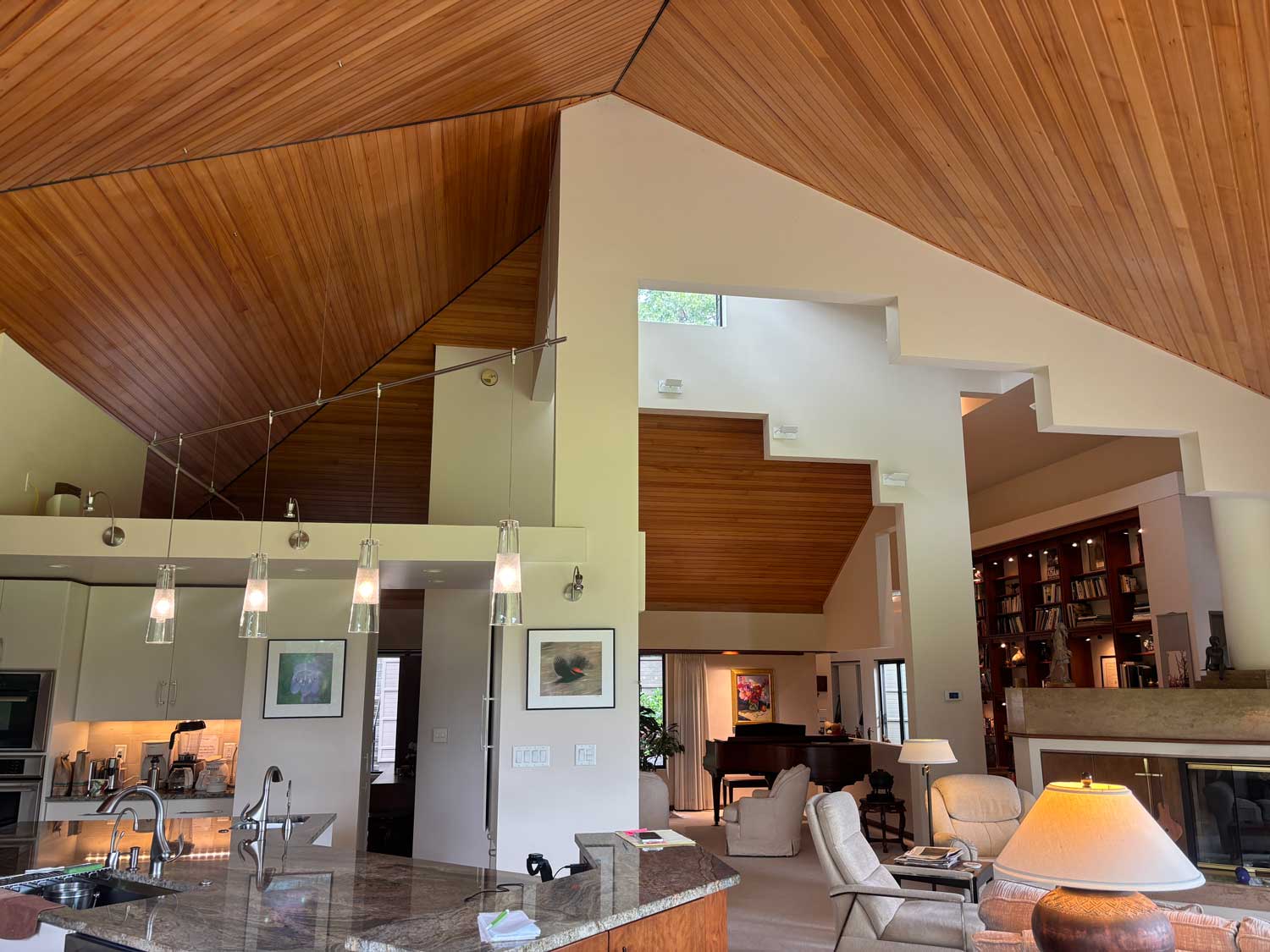
Lynn Frohnmayer, the widow of former Oregon Attorney General and UO president David Frohnmayer, has lived in a Poticha house since 2009. The home was designed for previous owners, and according to Kelso, construction finished in 1989. When originally designed, it had two bedrooms. The house offers a view of the Eugene Country Club, and golfers walk by outside as Frohnmayer works on the charitable Fanconi Anemia Research Fund in memory of her three daughters who died of the rare cancer. “It’s a very peaceful place,” she says.
She has come to appreciate the details Poticha included in the design that, to others, might go unnoticed. They include a gutter system that causes water to fall down in one place, right next to a window. Behind the front door, a wooden floor-to-ceiling bookshelf is fixed into the wall. Nearly every room has a wood feature, creating a space that feels unique.
Despite living alone in the large home, Frohnmayer, 83, has no plans to move. The incorporation of fir and cedar woods and attention to detail have become things she could not live without. She says every bedroom looks out on the trees.
Poticha was born in Chicago on Sept. 9, 1934, to a Russian father and an Austrian mother. His childhood was defined by change and new environments. The family moved about every six to eight months to an unfamiliar town. He describes his father as a “wanderer.” Poticha says his father was shipped to the U.S. from Russia at age 13 without contact to family, possibly contributing to his constant on-the-go lifestyle. “We lived in New Orleans for a while, then we lived in El Paso, Texas. Then we lived in Phoenix, Arizona and then we finally got to L.A.”
One year, in the midst of moving and constantly being on the go, Poticha’s father told him, “We forgot to enroll you in school.” So, to keep his son on track, Poticha’s father “took out some ink eradicator and eradicated my report card,” Poticha recalls, “so I never went to third grade.”
Poticha’s father was Jewish, and the family engaged in Orthodox practices around the holidays. However, it was difficult for Poticha to stick with the faith, because “we moved so damn much, that whenever I got to what was called Hebrew school, I got the same training. So I never got very far.”
He attended the University of Cincinnati College of Applied Arts, studying architecture in the 1950s, eventually graduating from the six-year co-op program in 1958. He was drawn to architecture after his mother recommended it, noting he was good at drawing and math.
“I said, ‘I don’t even know what architects do,’” Poticha recalls.
There, Poticha found his passion. “It turned out to be an incredible school.” The degree had students jumping back and forth between working in an architect’s office and attending class. “The offices would pay me, which meant I could earn my way through school.”
While in school, he made friends with classmates Michael Graves and Bob Frasca, both of whom would later have an impact in Oregon architecture. Graves became a professor of architecture at Princeton and the principal of his own firm. He also designed the Portland Building, an iconic postmodern landmark. (His name is perhaps most associated with a whistling bird teakettle — including one for Target — with over 2 million units sold.) Frasca also became well known for his role in defining Portland’s skyline.
When he took studio classes at Cincinnati, Poticha often saw a woman at her locker outside the classroom. “I got up enough nerve to go meet her,” he says. The woman turned out to be Sharon Scott East, his future wife.
Their path to marriage was far from simple. When the two met, Sharon was in a different relationship. She was studying fine arts and practicing her painting and sculpture work. Sharon was a catch, but Otto couldn’t hook her. “Finally, I did ask her out, and she turned me down.”
Otto was persistent, and after Sharon and her previous partner broke up, “she went out with me. And that was the beginning of this adventure.” In the years to come, Otto would eventually propose to Sharon, who once again told him no. In response, he told her, “I want you to reconsider, and I’m going to ask you every month for the next six months.” In the sixth month, she agreed to marry him. The two were wed in Cincinnati and began their life together. They went on to have two children, Shelley and Corbin. Otto and Sharon were married for 67 years, until Sharon’s death in June 2025.
The family settled down after a few years of traveling. Once they had decided on Eugene, Poticha returned to the firm he had popped into during their visit, Wilmsen Endicott & Unthank.
At the firm, he was interviewed by DeNorval Unthank, his soon-to-be partner and best friend. Unthank was the first African American to earn an architecture degree at the UO. He was the victim of a hate crime at the university as a result of his romantic relationship with a white woman. There was little interracial dating at the time, and a group of men burned a cross outside of his girlfriend’s sorority because of their partnership.
Unthank became a prominent figure in Eugene. He was involved in designing McKenzie Hall at the UO, Thurston High School and the Lane County Courthouse, among several other projects. He was 10 years older than Poticha, and the two worked together at Wilmsen Endicott & Unthank for about a year.
Poticha left the practice and worked elsewhere for a couple years until he felt ready to get back into “a broader scale of building design.” He mentioned to Unthank and one of his best friends, architect Grant Seder, that he would like to be hired as a consultant if either of them had a big project.

“That following Saturday, they both showed up [to Poticha’s office], individually, not together, and said, ‘We thought about it, we want to join you and start a new practice,’” Poticha says. “It was almost as if they had the same script.”
Just like that, in 1968, Unthank Seder Poticha architects came to be.
Their partnership was unlike that of a typical firm. The three men worked together on every project they had. The group craved interaction and collaboration. “Most firms, with trio partners, [have] the partner in charge of business, the partner of technical things and the partner in charge of design.”
Their group had three designers. “No one would believe that we would be able to be successful. You can’t have three cooks making the same soup. But we did it for 25 years.”
The firm won over 50 design awards, they were published in countless architecture journals, and they “enjoyed every minute of it,” Poticha says.
The office was set up to embrace teamwork. Whenever the team was arguing about a project, making jokes or getting pissed off with one another, “everyone would hear,” Poticha says. “We did not want private offices.” The group never advertised their work; they relied on word of mouth and networking. “We could’ve been a much larger firm than we were. We didn’t do that for a number of reasons,” which mainly revolved around the drive to be hands-on with the projects, rather than managing them. To Poticha, being a manager “is not like getting your hands dirty.”
Poticha says his favorite project they did together was the Lane County Public Service Building.
Seder eventually left the group, and Ed Waterbury joined. They became Unthank Poticha Waterbury for a few years.
All the while, Poticha kept busy teaching at the UO. “I never applied to teach. I was contacted by the school to come teach after I’d practiced in Eugene for a year.”
One of his former students, Richard Shugar, principal of 2FORM Architecture in Eugene, says Poticha “helped shape me to the architectural designer I am now.” He adds that Poticha was always creating something new. “He hated to do something new that pretended to be old. Everything was a fresh opportunity to design something new and special.”
Poticha estimates he taught close to 4,000 students in studio classes alone. “So I have really fucked up the profession,” he jokes with a smile.
And he isn’t ready to give any of it up. Today, Poticha is designing buildings in Eugene, Albuquerque, Vashon Island and Denver. “People retire from work. I’ve been so fortunate, I’ve never thought what I did was work. And so there’s nothing for me to retire from,” he says.