
In late January, lumber-empire heir Kathy Jones-McCann suddenly began lavishing astonishing amounts of money on three candidates for the Lane County Board of Commissioners.
In the following four months, the rural Lane County resident shovelled a total of $146,587 in campaign contributions to incumbents David Loveall and Ryan Ceniga, who were both running for reelection in May, and Jacob Pelroy, an ally of Loveall and Ceniga, who was running to unseat incumbent Heather Buch.
The donations were by far the most anyone has ever given to candidates for Lane County commissioner. The flood of money was especially noteworthy because Jones-McCann previously had almost never donated anything to anyone running for Lane County commissioner, state election finance records show.
The donations were not Jones-McCann’s only dealing with the commissioners.
Even as she gave the cash, she sought to sway the county board on a matter of intense financial interest to herself: The fate of a huge home, a huge garage and other structures she covertly built on her rural spread on the McKenzie River without getting county planning approval or building permits.
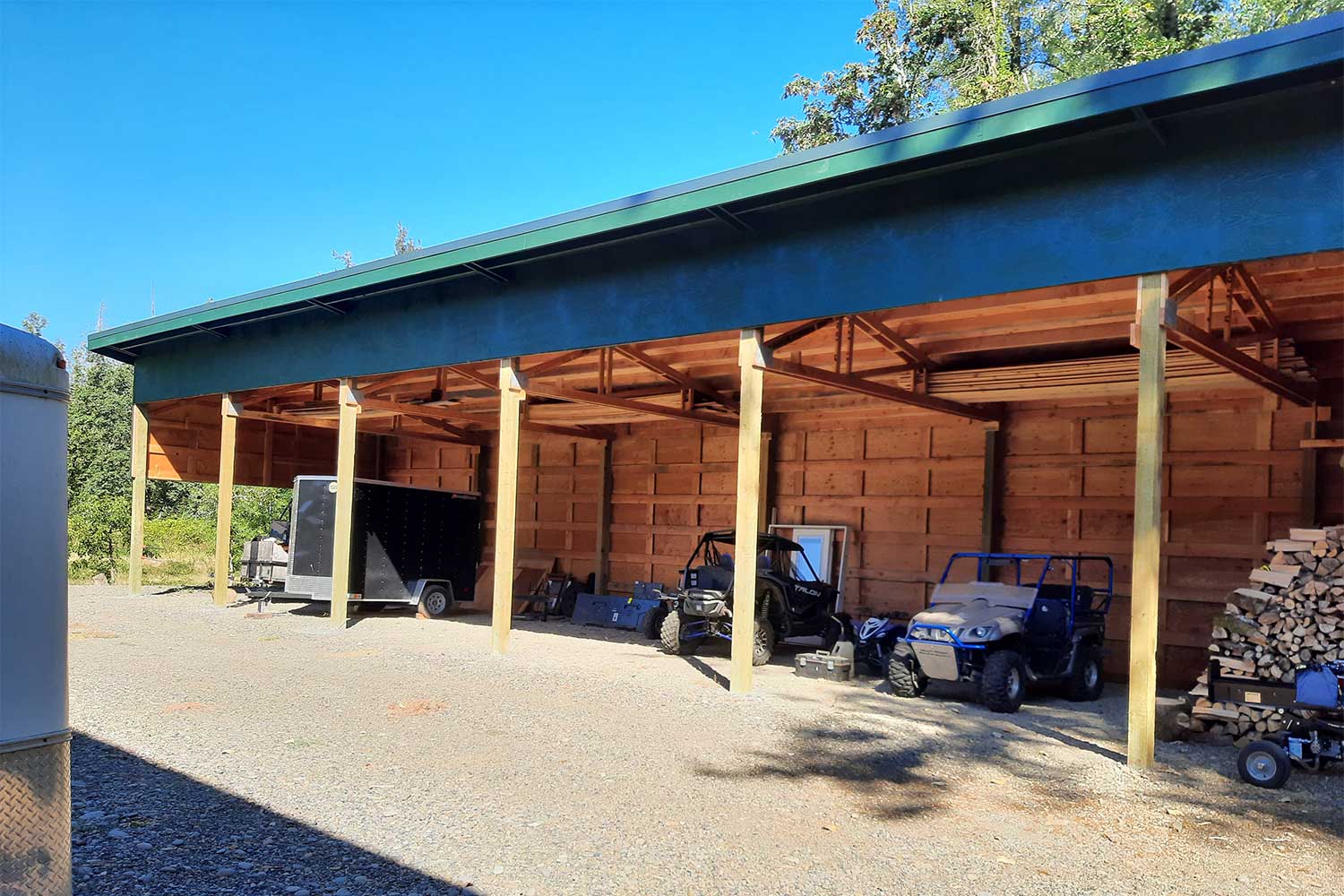
On secluded farm-zoned land she owns on the north bank of the McKenzie River 1.5 miles east of Springfield’s city limits, Jones-McCann in 2021–2023 built a two-story home (3,000 square feet of living space, with a 1,500-square-foot roof-top solar panel array, atop 3,000 square feet of garages); a separate 1,900-square-foot, 18-foot-tall garage/outbuilding; a 300-square-foot utility shed; and a 96-foot-long foot-thick concrete wall, county records and satellite images show.
Half of the two-story home and all the rest of the construction is inside what county planning officials say is a 100-foot wide no-build zone along the banks of the revered and protected McKenzie. Only fences can be built in these riverside set-back zones, known as riparian areas, the county says.
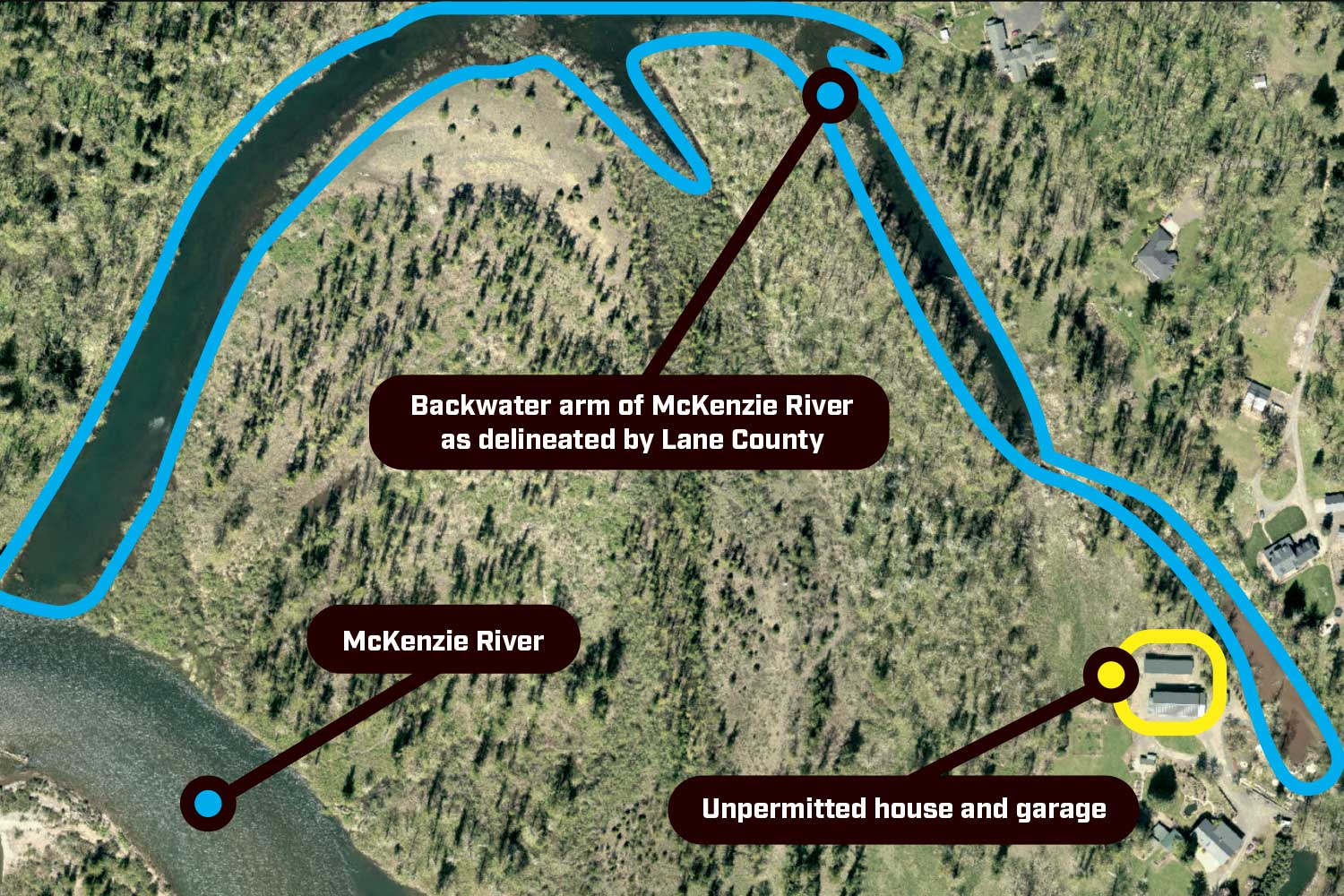
County inspectors discovered the construction in 2023, only after Jones-McCann completed it. Ever since, Jones-McCann’s lawyer and consultants have battled the county’s code-enforcement efforts, records show. A key issue is this: Jones-McCann’s construction work is not along the main channel of the pristine McKenzie River. Rather, it is along a slow-moving 3/4-mile long backwater arm that flows into the main channel. Jones-McCann’s lawyers argue that the backwater channel isn’t part of the river, and therefore the county has no right to impose the 100-foot no-build zone.
Jones-McCann has thus far been on the losing end. The county planning director and a county hearings official — an independent arbitrator — ruled the backwater channel is part of the McKenzie and therefore Jones-McCann’s construction is not allowed and cannot be approved retroactively.
Jones-McCann’s next stop: the five-member board of commissioners, including Ceniga and Loveall. The two joined Commissioner Pat Farr on April 2 in voting to hear the case. On May 12, commissioners held an initial hearing. A further hearing is set for early July.
A final resolution seems far off. Whatever the commissioners decide, the case will likely be appealed to the state Land Use Board of Appeals.
LandWatch Lane County, a nonprofit land-use watchdog, has entered the fight, opposing Jones-McCann. If the backwater is ultimately deemed not to be subject to the 100-foot riparian setback, that could trigger other property owners along the McKenzie to seek to build in other riparian areas.
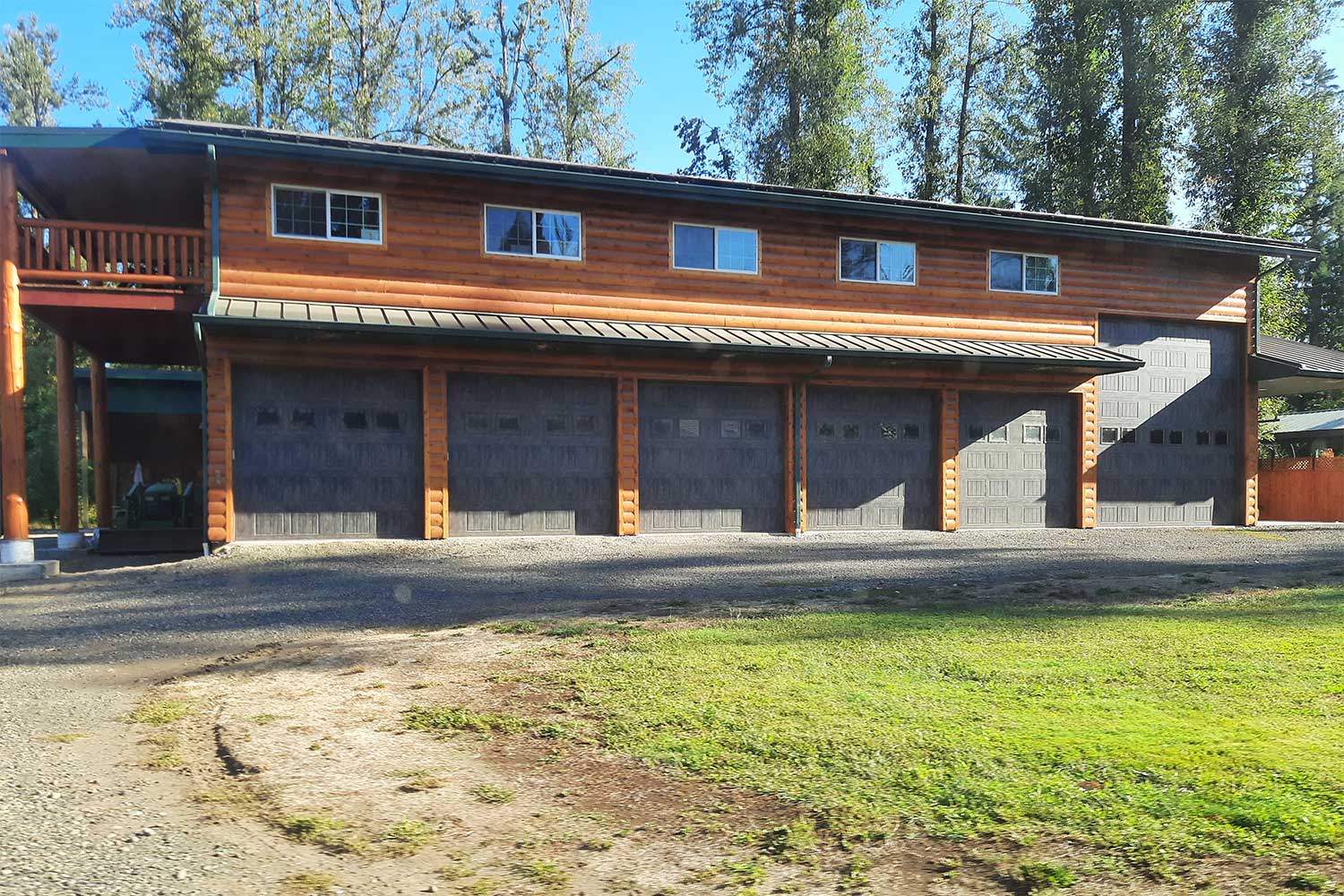
Even if Jones-McCann’s structures are allowed, she would retroactively have to get building permits from the county. That can involve paying penalties and removing wallboard, siding and the like so inspectors can examine framing, electrical wires and plumbing.
But if Jones-McCann loses, and the structures are definitively deemed unauthorized, the county could fine her up to $2,000 a day and potentially force her to dismantle them.
Commissioner Farr said he wants to hear the dispute because it will likely be a “test case” with impacts on “far-reaching policy decisions.”
Jones-McCann did not respond to questions from Eugene Weekly about why she did all the construction without getting planning approval and building permits. But she defends her appeal and her campaign donations.
“I have a First-Amendment right to seek redress from my government — in this case seek Board review of my land-use application — and to participate in elections through campaign contributions,” she said in an email statement to EW. “I donated to those three campaigns because I believe that the three candidates were the best candidates for the County and would serve the best interests of rural property owners in Lane County. I contributed for the good of all Lane County residents.”
No taxes
The land-use fight is eye-popping: Because Jones-McCann never applied for planning permission or building permits, the county assessment department never knew the buildings existed. So it never put them on the tax rolls. Jones-McCann has never paid property taxes on them. Further, Jones-McCann never built a fire-vehicle access road to the unpermitted house. County and fire officials say they require such roads for new homes. But because the house was built without permits, no authorities notified McCann that she needs an access road wide and durable enough for fire trucks.
Even if the 100-foot setback rule is waived, the lack of a fire access road makes the home illegal, the county says. To overcome that objection, Jones-McCann has proposed a startling solution: building an access bridge across the very same backwater channel of the McKenzie that the county wants to protect because of its environmental value.
The unpermitted construction might never have come to light, except someone in the neighborhood complained to the county. Jones-McCann’s wooded property, where records show she has lived in a modest 1980s-era home for about two decades, encompasses 28 acres. The unpermitted construction can’t be seen from public roads or the main channel of the McKenzie. But it looms large on satellite photos.
County inspection photos show the unauthorized dwelling appears to be lived in. Because it never went through county planning review, the house does not have septic system approval from the county.
‘Quid pro quo?’
Then there’s the campaign money.
Occasionally, county commissioners vote on issues that affect specific people or companies who have donated to commissioner election campaigns.
But the Jones-McCann case is remarkable for the sheer amount of money she gave, and how she gave it literally at the same time as her case was coming before Ceniga and Loveall.
Ceniga and Loveall both ran in the May 19 election — Ceniga for the West Lane District 1 seat, Loveall for the Springfield District 2 seat. Ceniga won. Loveall lost to challenger Sean Van Gordon. Loveall remains on the job until his term expires in January. Pelroy ran against Buch for the East Lane District 5 seat. Neither won outright, so they head for a runoff in November, for the term that starts next January.
Jones-McCann’s contributions were not illegal. Oregon law doesn’t cap political contributions. But the amounts, given at the peak of election campaigning, were super-sized: Her $46,716 to Ceniga accounted for nearly 36 percent of all the money his campaign received this election cycle. The $42,215 she gave to Loveall amounted to nearly 30 percent of his total receipts this cycle.
At the May 12 commissioner hearing, LandWatch attorney Sean Malone prodded Ceniga and Loveall about the contributions.
Addressing Ceniga, Malone asked: “A reasonable person could look at [the donations] and imagine that is some kind of quid pro quo. Is that the case here?” Ceniga replied: “No.”
Addressing Loveall, Malone asked: “Does [the money] affect your ability to render an impartial decision?” Loveall replied: “No.”
Heir to a lumber fortune
Jones-McCann comes from prominent Oregon stock: She is one of three daughters of the late Aaron Jones, who created a Eugene-based lumber and timberlands empire anchored by his Seneca Sawmill on Highway 99 near the Eugene Airport.
Jones-McCann bought into the rural Heather Drive neighborhood on the McKenzie just east of Springfield in 2007, purchasing for $725,000 a 16-acre tract with a 1,400-square-foot home built in 1985, property records show. In 2009, Aaron Jones bought an adjacent 12 vacant acres for $265,000 and transferred them to Jones-McCann. That 12-acre parcel is where Jones-McCann subsequently built the unpermitted structures. All her acreage is zoned exclusive farm use.
Aaron Jones died in 2014. He left his sprawling business, including two mills, a wood-burning electricity generating plant and 175,000 acres of Oregon timberland, to his three daughters. In 2021, they sold it all to California-based Sierra Pacific for an undisclosed sum.
Over the years, Jones-McCann has made many campaign contributions, mostly to conservative candidates for Oregon governor and the Oregon Legislature, election records show. But prior to her splurge earlier this year on Ceniga, Loveall and Pelroy, she only gave twice to Lane County commissioner candidates, the records show: $3,000 to Ceniga in 2022, and $1,000 to Gary Williams in 2018.
Jones-McCann told EW she had hoped her land-use appeal would have come before the commissioners in late 2025, “well prior to the May 2026 primary election. The fact that Board review was delayed until election season was beyond my control.”
Mapping dispute
The McKenzie River is regarded as pristine and iconic. But for many years, Lane County let homes be built close to the riverbank. Then, several decades ago, to comply with state land-use laws to protect valuable natural resources, the county imposed the 100-foot no-build setback for new construction on farmland along so-called Class 1 rivers, including the McKenzie. The county made exceptions for rebuilding houses burned along the river in the 2020 Holiday Farm Fire.
At the heart of the Jones-McCann dispute is the question: What exactly constitutes the Class 1 McKenzie River that is subject to the 100-foot buffer rule? The cold, fast McKenzie is 90 miles long. As it twists and turns, it splits off into side channels, backwaters, and marshy sloughs. In winter, the cascading water carves new channels and discards old ones, which become sluggish, ox-bow-like remnants.
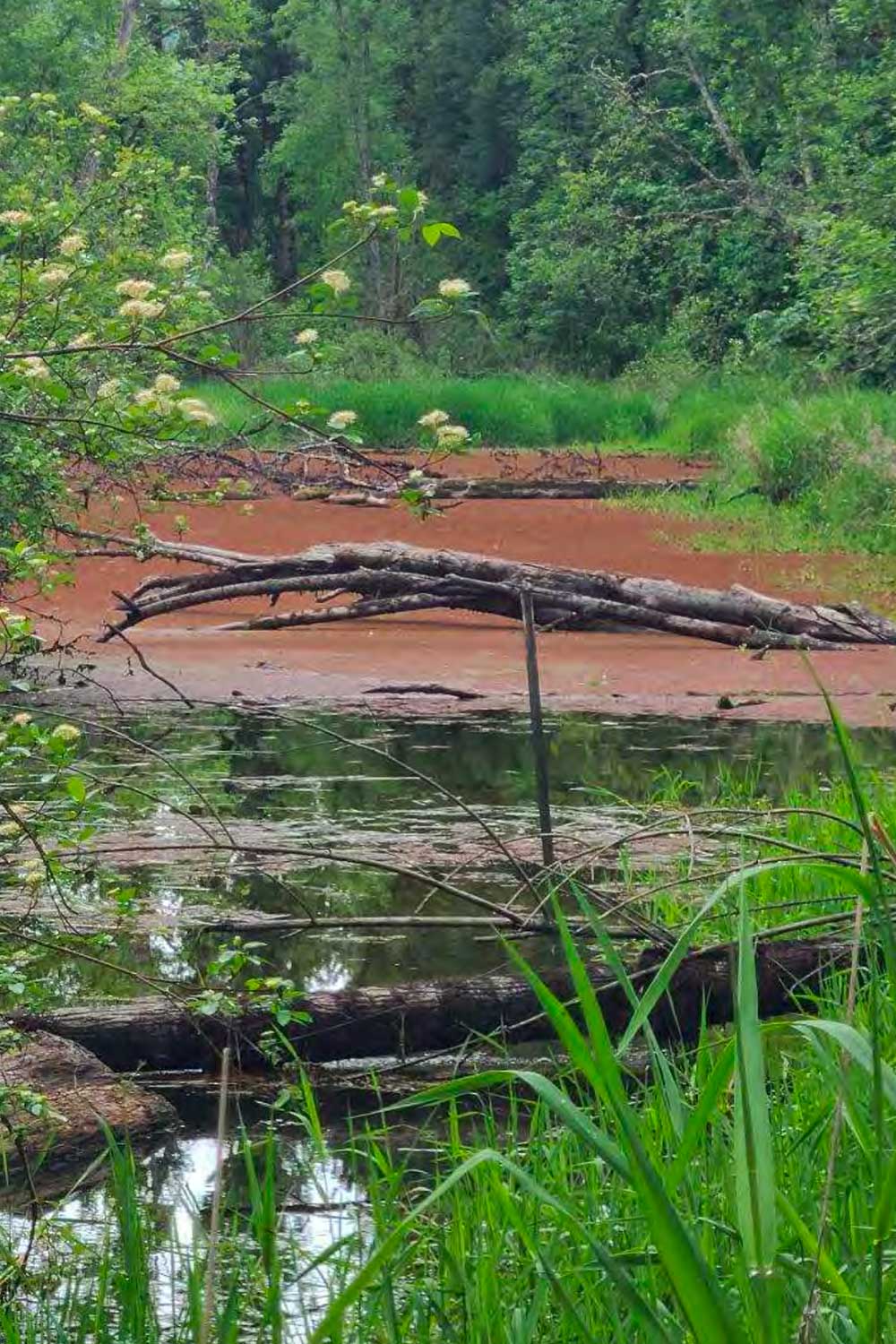
The 3/4-mile backwater arm in the Jones-McCann case appears to be an old ox-bow. It begins as an algae-rich pond about 470-feet long and up to 85-feet wide, satellite images show. That’s the waterway Jones-McCann’s unpermitted buildings are close to. This swampy pond is flanked by thick brush and trees. It flows into a stream that empties into larger backwaters that speed up and flow into the main McKenzie channel.
In 1980, the county passed rules designating Class 1 streams, including the McKenzie, and issued a map delineating Class 1 areas. Documents accompanying the map say it shows most but not all Class 1 stretches. The map doesn’t appear to include the backwater arm along Jones-McCann’s property as Class 1. For Reeder, Jones-McCann’s lawyer, that settles the matter: If the backwater isn’t marked on the map, it’s not protected.
The county, the state Department of Fish & Wildlife and Landwatch dispute that. The map’s text doesn’t claim the map to be definitive, the county notes. County code and official studies and policy documents confirm that the map isn’t meant to be definitive, and they allow county planners to make case-by-case evaluations to protect riparian areas that safeguard the Class 1 values that make the McKenzie so treasured — clean water, runs of salmon and other fish, and wildlife, and the like, the county says.
A supporting document for the 1980 map states “It would be impossible to map every single Class 1 stream exactly. That would be an enormous undertaking,” Noray-Ann Spradling, a senior county planner, told commissioners at the May 12 hearing. Plus, says Spradling, the river is “changing all of the time.”
A key factor that gives Class 1 environmental value to the backwater channel is its “hydrologic connectivity” to the main channel, say Spradling and Joseph Stack, a regional habitat biologist for the state wildlife agency. That means surface water flows either from the backwater into the main channel, or from the main channel into the backwater, or both.
“The backwater area or slough… meets the [state] definition of a Class 1 stream,” Stack wrote to the county, adding, “During winter months, backwater off-channel habitat provides valuable rearing habitat for young fish seeking refuge from high flows.”
“The McKenzie River is like a body that has more than just your trunk,” Spradling told the commissioners on May 12. “The main channel is like your trunk and your head. But that’s only part of your body. You’ve got your arms, you’ve got your fingers. If you lose some of that, you lose some of the function of the overall body.”
Philip and Heather Shaffer, whose property abuts the backwater pond in question, agree. They told the county they oppose legalizing Jones-McCann’s “illegally built structures.” The backwater area is home to Northwestern pond turtles, wrote the Shaffers, who have lived there six years. The turtle is a state-listed “sensitive” species being considered for federal Endangered Species Act protection.
‘No excuse’
But consultants hired by Jones-McCann say the pond is not part of the backwater channel. They describe it variously as a “bog” and a “wetland.”
Attorney Reeder admits that mapping Class 1 waterways is difficult because “it is common knowledge that streams move over time.”
But the only legal way for the county to deviate from the 1980 map is to re-study the McKenzie and go through an elaborate rule-making procedure to officially designate new riparian areas as protected Class 1 streams, he argues. “If protecting the riparian areas along Class 1 streams is of such importance, then the county should perhaps make the effort to amend [its] maps in conformance with Oregon’s land use planning process,” Reeder wrote to the county hearings official.
“Just because continual maintenance of land use planning documents may be cumbersome and expensive, it is no excuse for the county to impose… on the property owner who has no individual control of the land use planning process. The responsibility of changing the maps through the correct process lies with Lane County.”
In his decision, county hearings official David Doughman wrote that he “does not view [Reeder’s] position as unreasonable.” But the county code and other official county documents “best support the position of the county and LandWatch,” he wrote.
Rocky road
A further twist in the case is the matter of the fire-vehicle access road.
The new house, on its 12-acre parcel, sits about 190 feet from Jones-McCann’s old 1985-built house on its 16-acre parcel. Access to the old house is via a long private driveway from Heather Drive, a public road. That driveway crosses the property of neighbors, including the Shaffers. The driveway has a legal easement across those properties, county records show.
In theory, fire vehicles could use that old driveway to reach the unpermitted house on the 12 acres.
But the easement document states that the driveway legally can be used only to access the 16-acre parcel, county records show. The neighbors won’t amend the easement document to let Jones-McCann use the driveway to serve the unpermitted house on the 12 acres, county records show.
So Jones-McCann has proposed a spendy solution: She would build a new long driveway from Heather Drive on an existing easement on another neighbor’s property, up to the edge of the backwater pond that the county wants to protect, and construct a bridge across it to reach her unpermitted house.
“A bridge over the pond (i.e. wetlands) is feasible,” attorney Reeder wrote to the county, adding that lack of a fire access road is not a legitimate criterion for the county to reject the new house.
But county staff and the hearings official denied the application, saying Jones-McCann had not provided enough detail and certainty to demonstrate the bridge is in fact feasible.
That dispute, too, now sits before the county commissioners as part of Jones-McCann’s appeal.
So, too, is an additional dispute: Whether a “peripheral big game habitat” zoning overlay for that region of the McKenzie River valley prohibits new construction. Reeder says it doesn’t. The county staff says it does.
With the complex land-use issues up in the air, the process of retroactively getting building permits for the construction remains on hold.
Christian Wihtol writes the Bricks $ Mortar column. Full disclosure: This election cycle, he contributed $500 to the campaign of Sean VanGordon and $600 to the campaign of Heather Buch.