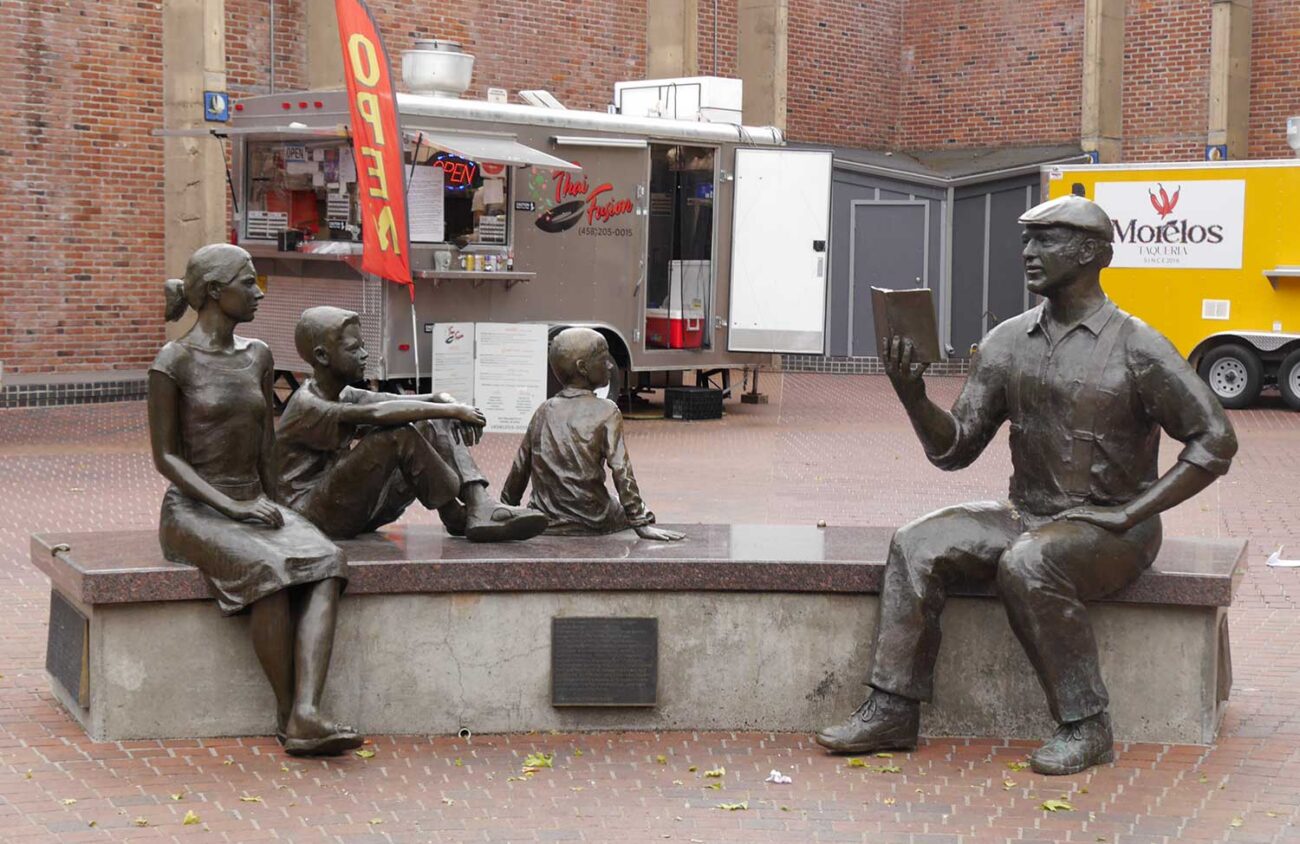
The iconic sculpture on a bench at Ken Kesey Square, “The Storyteller,” was created by Peter Helzer, a Eugene-area artist. He’s also known for his Rosa Parks statue at the downtown LTD bus station, the sighting pedestal on Mount Pisgah and more than 200 beloved artworks throughout the Pacific Northwest.
However, some of his statues are under attack by people stealing pieces or the entire work. Helzer says that the thieves are not after the art, but the metal. “After 50 years of making sculptures for playgrounds and plazas throughout Oregon and Washington, we have reached a point where thieves have been stealing my work faster than I can replace it,” Helzer posted on his Facebook page on April 6.
So far, Helzer has had bronze pieces stolen from parks and plazas in Medford, Eugene, Corvallis, Bend, Tualatin, Portland and Vancouver. “There is something about people stealing from children,” Helzer says, “These pieces were made for kids, settings are public spaces that are plazas and playgrounds, specifically for young children.”
Metal thieves try to sell the pieces to places such as recycling companies. According to the Recycled Materials Association’s website, “it is often difficult to tell the difference between stolen and legitimate materials.” It says that the metals would have been already stripped, crushed or cut into pieces so it is indistinguishable for the recycler to tell that the metal piece was stolen or not.
Amber Schultz from Pacific Recycling writes in an email to Eugene Weekly, “We care a lot about our community and preventing metal theft is something that we take very seriously.”
Moreover, Schultz writes that Oregon recyclers are required to follow strict laws designed to help prevent metal theft.
Under ORS 165.117 – Metal property transaction records, recycling companies such as Pacific Recycling are required to verify the identification of the sellers, maintain transaction records, and cooperate with law enforcement investigations. There are specific regulations for private sellers, such as delaying payments after the purchase and requesting additional information from them.
Pacific Recycling also uses ScrapTheftAlert.com, a nationwide system that enables theft victims or law enforcement to report stolen material, helping recycling companies spot thieves who try to sell it. The system was created by the Recycled Materials Association as a tool to help recyclers and law enforcement identify and recover stolen material.
Schultz says that if people experience metal or cargo theft, they should reach out to recycling companies such as Pacific Recycling to report it.
“We are always happy to help, and we share that with our team,” Schultz says and adds, “We are here to be part of the solution, don’t want stolen materials.”
Schultz says, as far as she is aware, other recycling companies she knows also follow Oregon state law. She says she was shocked to hear the metal art piece had been stolen, and it was hard to believe any company would purchase it from the seller.
When something does not look right, Schultz says they will turn materials away or ask for additional documentation to verify ownership or the source of the material.
Helzer usually takes four to five months to work on a public art piece. He says that there used to be one or two pieces damaged or stolen before; however, recently the rate has more than doubled to the point that he can’t keep up with repairing them.
Helzer says some of his art that has been stolen includes a sculpture in the Tualatin Commons of a girl with an ice cream cone, which had been there for 26 years and a sculpture in Arbor Lodge Park of an alligator, which had been there for 30 years.
See Pete Helzer’s work at PeteHelzer.com.