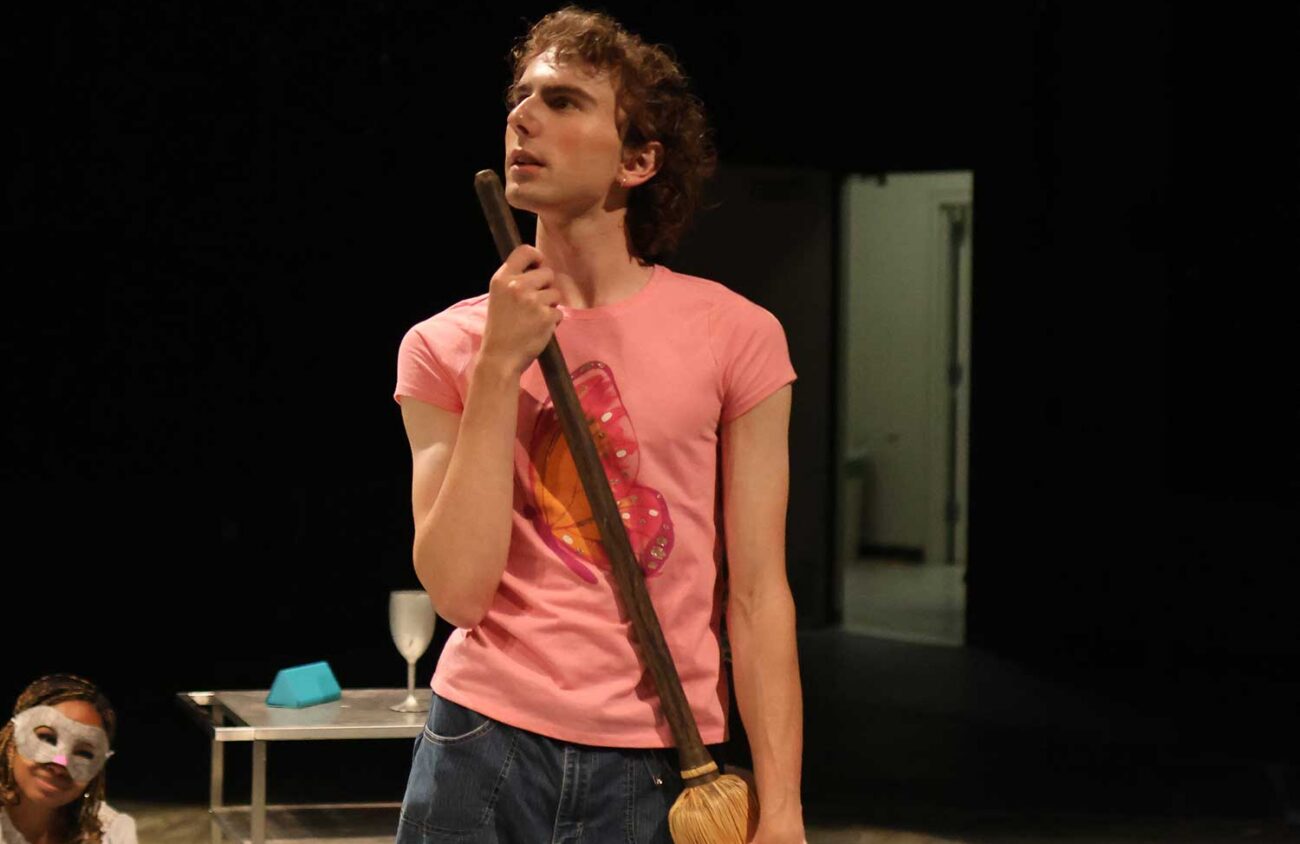
Everyone knows the story of Cinderella.
But not everyone knows Grindrella, Cinderella’s sexed-up, queer pantomime step-sibling. And no one knows it better than the students of writer Douglas Killingtree’s theater class, Movement for the Actor.
Last winter, Killingtree, a masters student at the University of Oregon, traveled to London with his husband to study queer representation in British pantomime theater. Pantomime, or panto, is almost always a retelling of a fairy tale, told in an extreme and humorous way, through slapstick humor, exaggerated body movements, gender-bending casting, elaborate costumes and music.
Upon returning to UO, Killingtree set out to write his own.
“I’m going to make it very much from the perspective of a gay man. What would my Cinderella story be?” asks Killingtree.
Killingtree’s playwriting centers on queer joy, jokes and daily activities — not only the struggles or tragedy often relegated to gay characters. Killingtree cast Logan Love, a third-year theater major, also an out gay man, as Cindy, the “principal girl,” and wrote that he would end up with the prince like Cinderella does.
By casting Love as the leading role, both men were able to see themselves as the complicated hero and love interest, a role usually confined to straight, cisgendered women. Killingtree also chose and altered different elements of the panto, to represent the vast, diverse UO Theatre Arts department. He split the “dame” character, usually a middle-aged maternal figure played by a man, into two characters of the stepsister and fairy godparent, played by students Zach Vega and Mason Bruderer.
When writing, Killingtree grappled with translating the traditional British structure to an American audience. Usually, the queerness or obvious swapped-gender casting is the butt of the joke. He intentionally placed a lot of the collaboration and responsibility in his students hands, asking them to think critically about the gender stereotypes they portrayed and speak up if they saw a lack.
“We wanted to play with gender and explore how the actors and audience would react to humor based more in self-authorship and self-parody than a send up of ‘the other,’” Killingtree says.
The resulting production of Grindrella includes no lack of oral sex, gay princes, U-haul lesbians, animal noises, cunty step-moms, improvisation, dance numbers and guest cameos by UO professors Malek Najjar and Janet Rose.
Write What You Know
Killingtree was raised by Jehovah’s Witnesses in Alaska. On his first day of kindergarten, he remembers seeing the clay station and the water fountain and so many boys. Brandon Hudson and Powell Gallagher were the cutest, he says, and so their names actually make an appearance in Grindrella.
Growing up at the height of the AIDS crisis in the ‘80s and ‘90s, his only exposure to queer people was through the news and his mother’s outspoken homophobia.
Killingtree started doing theater in high school, and, like for so many others, it was a place he felt comfortable being queer. At 16, the first time he was ever intimate with a boy, he went home and cried for 48 hours.
“Going from that to actually acting on it in a physical, embodied way with another person and that being out there in the world was extremely emotional,” Killingtree says.
After graduating high school, Killingtree attended Southern Oregon University in Ashland for an English degree. He found a father figure in theater professor Craig Hudson. During his time there, the Theatre Arts Program performed the Laramie Project, an ethnographic work about the murder of Matthew Shepard, a 21-year-old gay student at the University of Wyoming.
Killingtree read Angels in America, a popular epic play set in 1980s New York during the AIDS crisis, for a script writing class. Southern Oregon also produced the popular queer-musical event, Cabaret, starring Joseph Morales, Ruthie Ann Miles and D’Arcy Carden.
“Looking back on it, it’s like, no wonder that was an amazing show,” he says, and that show served as a catalyst for him to switch to theater.
It was in undergrad where Killingtree was first exposed to panto. Hudson bought and renovated the Oregon Cabaret Theater, where Killingtree worked as wait staff. During Christmastime, the theater put on a panto of Cinderella. One of the dame characters had to miss a week of rehearsal, and Killingtree stepped into rehearse in his place.
Killingtree did theater on and off after college — a highlight was playing Hamlet for an audience of 600 people for a Portland Shakespeare in the Park. After taking a 10-year hiatus and working a marketing job, a friend asked him to sub into a performance of Ellis Island: The Dream of America. Monologues were taken from real recordings and set to a full symphony. Killingtree took on the role just months before opening, after a years-long development process.
“I was like, that’s it. I’ve got to go back to grad school and remember why I dug into this in the first place,” he says. Killingtree started at UO to get a masters of theater arts and folklore.
Killingtree has previous playwriting experience for Kitty & The Crescent Moon, a play he wrote in undergrad and put on a reading of at UO in March 2025. The play is about Kitty Genovese, an Italian-American immigrant who was sexually assaulted and murdered in 1964 in Queens.
This year, Love asked Killigtree to write a 10-minute scene he could direct for a playwriting class. Specifically, he requested “some gay shit.” Killingtree wrote Terrible People about a gay couple attending their straight friend’s wedding, only to find out they’ve both slept with the groom. Between Love and Killingtree, they went through eight versions of the script, and Love tried to cast as many queer actors as possible.
Love says, “I was grateful to have them, so it was really easy to kind of… really fit these people into roles that are similar to me and Cindy, they’re already like yourself a little bit.”