It all began 34 years ago on Oct. 10, 1991. Arsonists, who were never caught, started a blaze that burned almost 9,000 acres of old-growth public forest land protected from logging. Four years later, the U.S. Forest Service announced it would “salvage log” the land, which was a protected spotted owl habitat called the Cornpatch Roadless Area.
This area just east of Oakridge is colloquially known as Warner Creek for the nearby waterway. After more than a dozen legal challenges against the USFS, then-President Bill Clinton signed a “salvage rider” into law, creating a broad definition of which fire-impacted or at-risk areas could be logged, regardless of whether the fire occurred naturally or from arson.
The salvage rider was an amendment to an Oklahoma City bombing disaster relief budget bill — which it had no connection to — that permitted the logging of any trees “imminently susceptible to fire or insect attack,” and any other “associated trees.”
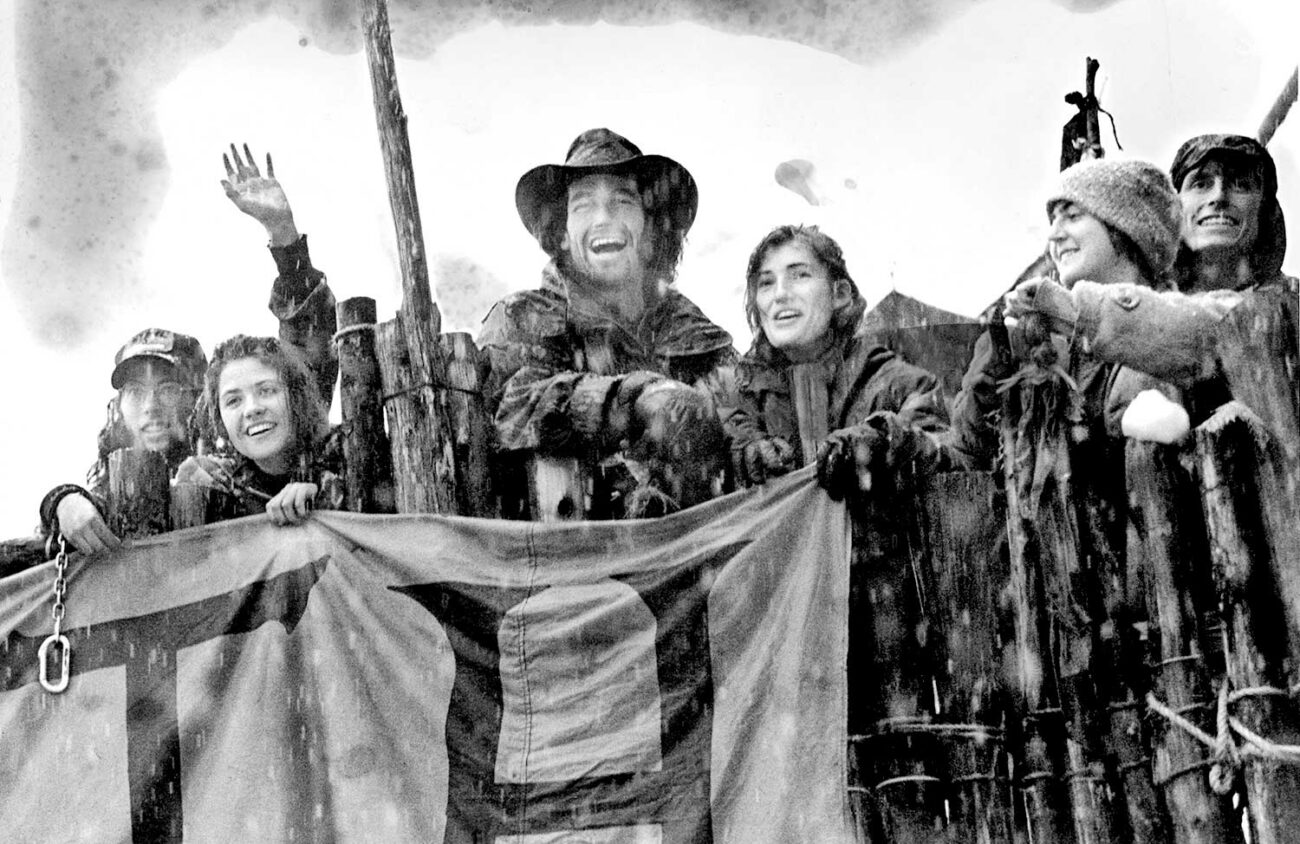
In 1995, a U.S. District Court judge threw out a lawsuit against the proposed salvage logging and exponentially expanded use of the salvage rider. In response, activists marched into the hills and set up a direct-action road blockade to stop the imminent logging.
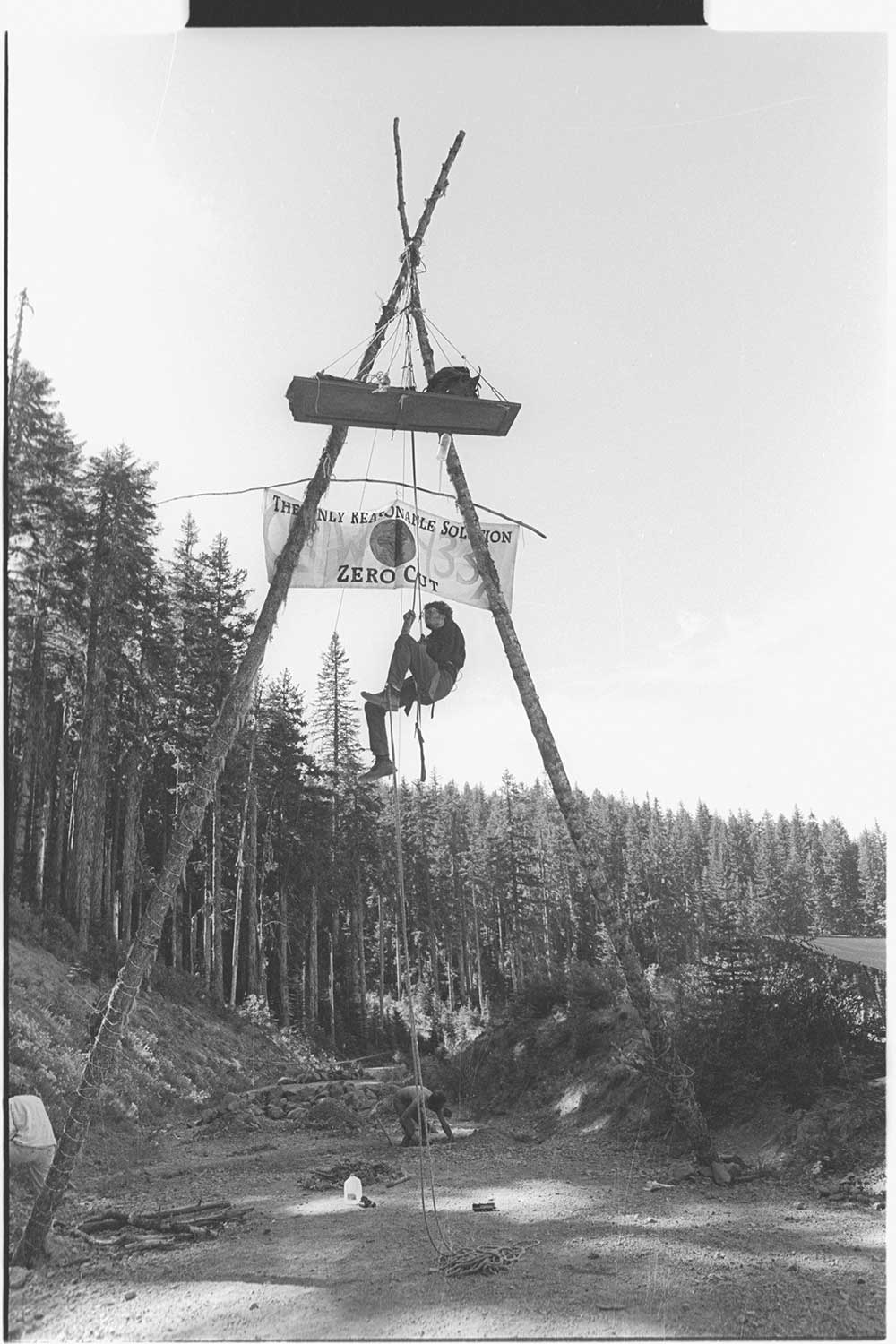
Unlike indirect actions like voting and political lobbying, direct actions — like strikes and blockades — are more disruptive. At Warner Creek, protesters chained themselves to concrete-filled barrels, laid down in front of logging trucks, sat high up in trees set to be logged, waited in bipods that would fall if struck by a vehicle and dug deep trenches, all in the name of protecting the burned forest.
No one expected the Warner Creek blockade to last 343 days.
Legal Battles
Deciding what to do with burned-over forest was an emerging hot topic. At the time, ecologists advocated for leaving burned forests largely untouched in order to allow the forest to naturally recover, while the timber industry and the USFS advocated for more logging to reduce the amount of viable fuel on the ground.
Timothy Ingalsbee, a former wildland firefighter, was a doctoral student at the University of Oregon studying environmental sociology when he joined a public USFS tour to see the burned area.
Ingalsbee says he and members of the public boarded a bus and the USFS revealed the scorched clearcuts that resembled a moonscape. The Forest Service then pointed out adjacent old growth and insinuated that it would be “next” to burn. Old-growth trees are found in biodiverse forests largely untouched by human activity for more than 100 years.
When the tour exited the bus, a snag — a burned tree — nearly fell on the group, and the Forest Service evacuated them.
“That was kind of the take-home message from the Forest Service: Be afraid, be very afraid,” Ingalsbee says. “That’s when they first divulged that, in their minds, a burned forest is no longer good for spotted owls.” He says that since the Forest Service no longer viewed the roadless area as a habitat for the endangered spotted owl, it set its eyes on timber sales. “It’s literally at that moment the lights went on in my brain and I said, ‘No way.’”
When the Forest Service began its first draft environmental impact statement, studying the impacts proposed federal actions would have on the environment and wildlife, it created a public participation group that involved representatives from the timber industry, environmental organizations and a neutral party. Ingalsbee was nominated by the local environmental community to be a part of the group.
During the public participation process, Ingalsbee heard how the Forest Service attempted to rationalize the logging of old growth under the guise of “wildfire prevention,” something Ingalsbee says is still prevalent today. So, when it came time to present proposed actions for the recovery project of the roadless area, Ingalsbee, with the help of other environmental advocates, wrote their own alternative: alternative “EF.”
When federal agencies draft environmental impact statements, they must include and study alternative plans to the proposed action, like salvage logging. In the case of Warner Creek, the Forest Service was required to fully examine and conduct a comparative analysis of its proposed action of salvage logging against Ingalsbee’s alternative “EF.”
Alternative EF officially stood for “ecology of fire,” the study of interactions between fire and living organisms that recognizes fire as a natural process and integral component of ecosystems. But Ingalsbee says the name “EF” was a nod to the Cascadia Earth First! movement, a group of radical environmental activists.
“It was kind of a wink and a nod that we expected everyone to see right through,” he says. The alternative, which included recommendations for things like increased prescribed burns during the fall using Indigenous methods, was not selected in the final environmental impact statement.
Initially, the USFS planned to salvage log 39 million board feet of timber, but in its record of decision on Oct. 13, 1993, the Forest Service selected a plan that allowed for salvage logging of 9 million board feet of timber, just under 25 percent of its original plan. A board foot is a piece of wood 12 inches long, 12 inches wide and 1 inch thick.
The decision combined two plans: One involved salvage logging, and the other involved creating “fuel breaks” to clear areas of forest and stop fires from spreading. Thirteen appeals followed, all of which were denied. In June 1994, the Sierra Club and the Oregon Natural Resources Council (now Oregon Wild) filed a lawsuit, seeking an injunction against the sale. A year later, in March 1995, U.S. Magistrate Judge Tom Coffin rejected almost all the arguments made by the environmentalists, except for one. Coffin found that the USFS failed to consider arson as a factor in choosing its plan to log the forest.
Coffin issued a nonbinding advisory opinion to U.S. District Court Judge Michael Hogan, who later issued a temporary injunction that prohibited the Forest Service from selecting any Warner Creek timber sale bids until he had ruled on the merits of the Sierra Club and ONRC lawsuit. But just months later, Clinton signed the salvage rider into law.
Hogan dismissed the environmentalist’s lawsuit on the basis of the salvage rider.
“This was the first ruling on the legality of the salvage rider, and he [Hogan] blew the scope of it way beyond any timber industry’s dream,” Ingalsbee says. He says that with Hogan’s ruling on the salvage rider, the law no longer applied just to burned forests. “If you could find a stand of trees with one single dead tree, a tree susceptible to bugs or disease or fire, it was a candidate for salvage cutting,” Ingalsbee says.
Direct Action
After the salvage rider’s passage and Hogan’s ruling, the Forest Service granted a sale of 520,000 board feet of timber at Warner Creek to the Thomas Creek Lumber & Log Co..
As a result, environmental activists like Kim Marks decided to march up to Warner Creek and block the forest road. “We knew that we were going to have to try something different that had not been done in the United States, both from a direct action standpoint along with a large-scale organizing movement,” she says.
Marks says the environmentalists already had people camping in the woods in the Warner Creek area to keep an eye on potential logging operations, but after the salvage rider’s passage and Hogan’s decision, “We knew we needed to put a big call out to people in Eugene to show up in force.”
On Sept. 10, 1995, Mick Garvin locked himself to a 55-gallon barrel filled with concrete on Forest Service Road 2408, the road leading into the roadless area. Marks and other activists surrounded him, forming a human barrier as a massive road grader approached, stopping just feet in front of them.
One of the activists sitting in front of Garvin was Jake Ferguson, who years later would be vilified for snitching about multiple arsons in the name of the environment committed by the Earth Liberation Front, an eco-sabotage group dubbed by the federal government as “domestic terrorists.”
Warner Creek was a catalyst for not only the ELF, but also for environmental groups that ranged from the direct action Cascadia Forest Defenders to the advocacy and litigation of Cascadia Wildlands to Ingalsbee’s Firefighters United For Safety Ethics and Ecology.
Local videographer Tim Lewis documented the scene, capturing the tension between the activists and Forest Service rangers. Garvin and the others refused to leave, forcing the road grader and the Forest Service rangers to retreat. “It was so powerful to watch a bulldozer have to make like a 35-point turn to turn around on this gravel road to go back down,” Marks says.
She says the victory gave the movement the inspiration and power it needed to double down and figure out how to reinforce the blockade. “We built more complicated things and then we were like, ‘Why not, build a wall and drawbridge,’” Marks says. “Why not put a wall between us the Forest Service?”
Hazel Robin, who used the forest name Hemlock, heard about the blockade when she and a friend were visiting Eugene for a weekend. Forest names are pseudonyms used by environmental activists to shield their identity. After visiting Eugene’s Saturday Market, Robin came across Tim Ream and Shannon Wilson.
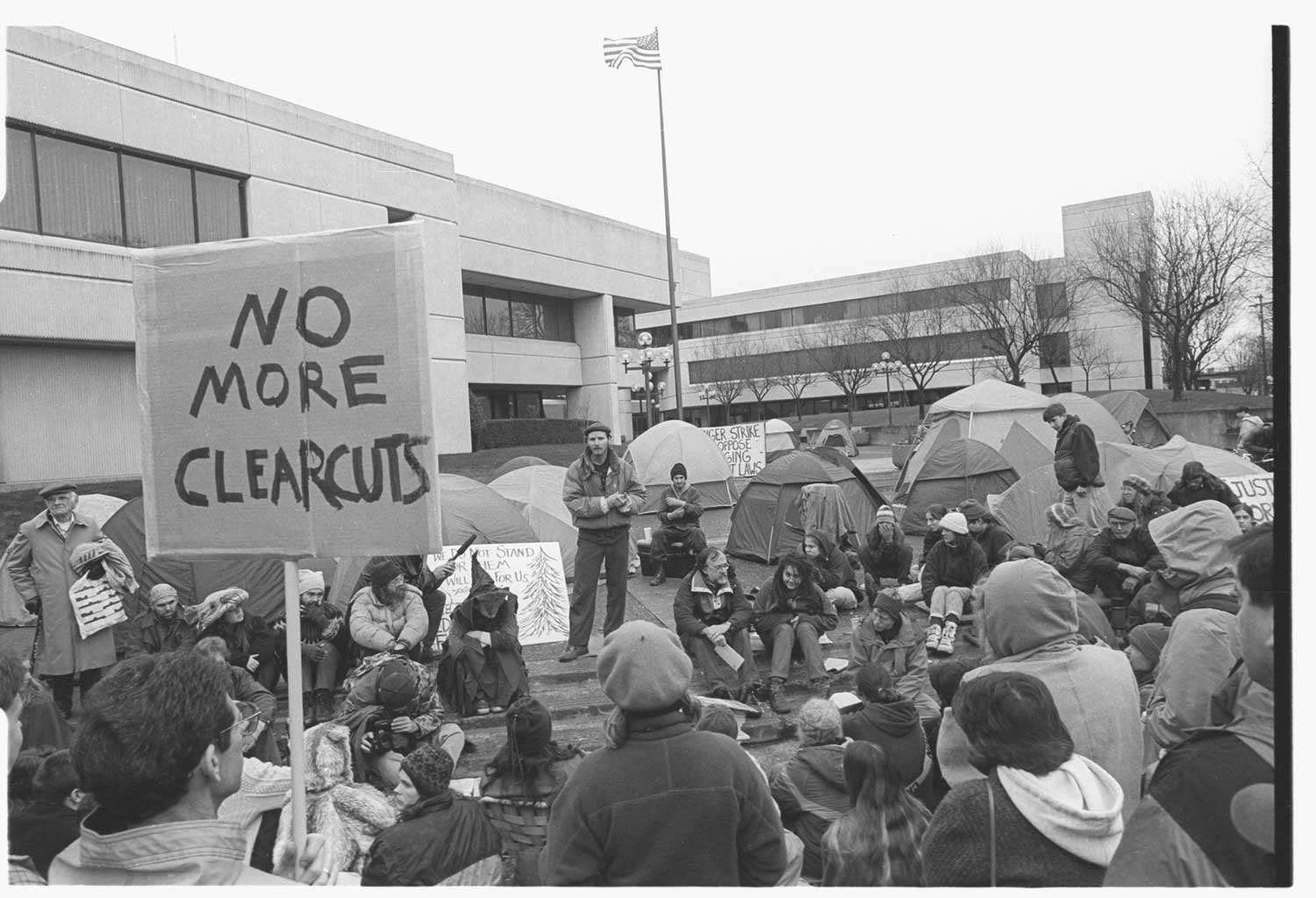
The two activists had just begun a juice-only hunger strike in front of the downtown Eugene Federal Building, protesting the Warner Creek timber sale and other timber sales in the region. Ream would continue his fast for 75 days, Wilson had to stop due to weakness 18 days in. Wilson and Ream informed Robin of a meeting two days later.
After hearing the story of Warner Creek, the feds’ plan to log the old-growth forest and the blockade, Robin says she dropped what she was doing and took the journey to the direct action.
Robin was already passionate about environmental issues and social justice. She had been working at the first desegregated summer camp in the U.S., where she learned about how logging companies threatened the last remaining old-growth forests in the United States.
On her way to the Warner Creek blockade, Robin says she was scared. “I wasn’t sure if it was the right thing to do, but I felt really passionate about trying to protect the last little bit of native forest and roadless areas that were remaining.”
When she arrived, she says, that fear disappeared.
Tarpees and Tree Sits
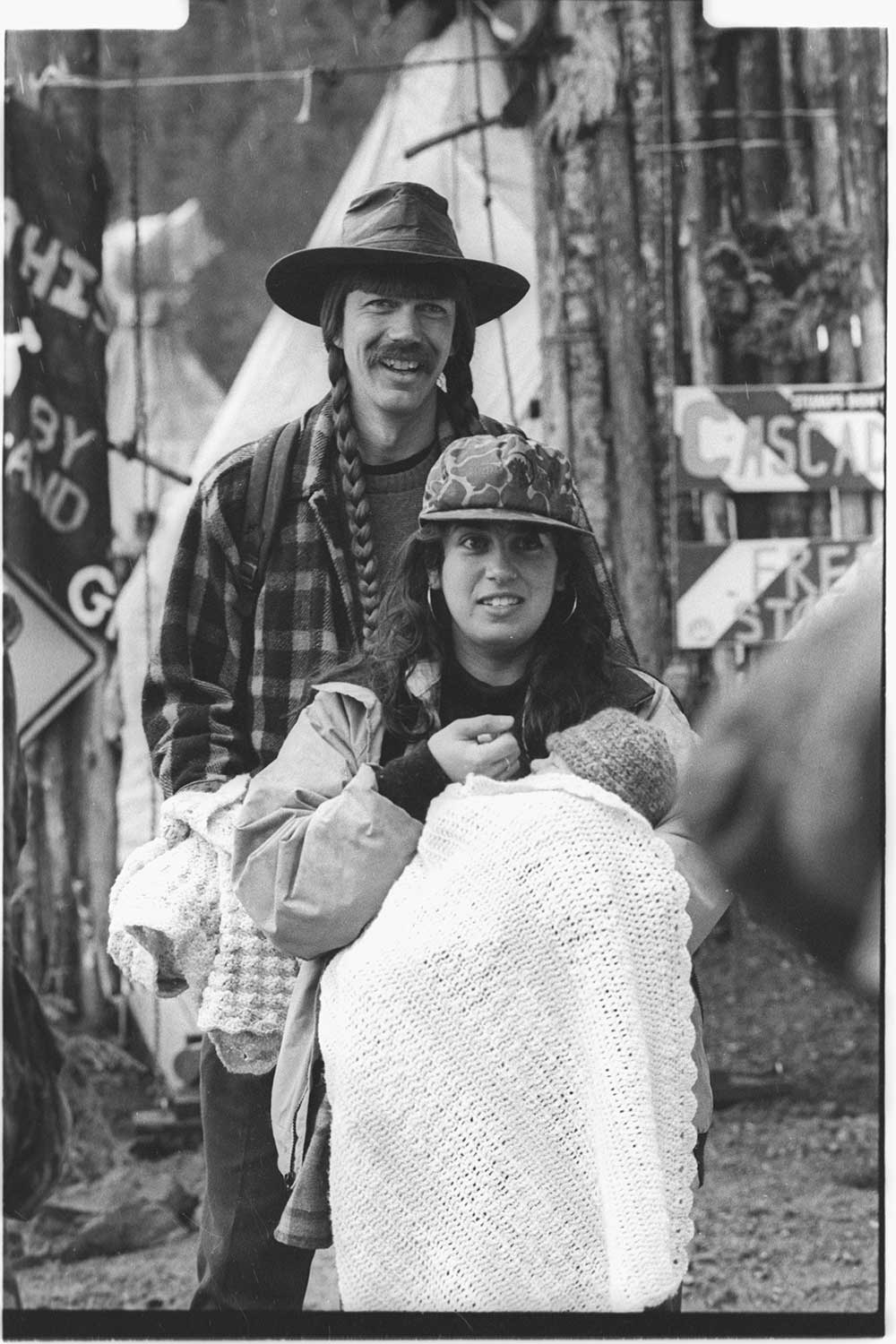
When Robin showed up, the camp had evolved into what activists called the “Cascadia Free State,” complete with the wall and drawbridge made from fallen timber, a moat and multiple “tarpees,” teepee-like structures made from logs with a tarp wrapped around them. The activists had also constructed small tree-sits high off the ground to watch for the “freddies” — federal agents such as Forest Service law enforcement.
Robin stayed for a few days at first, but continued to return for the duration of the blockade until the very end. There, she says the number of people manning the blockade would fluctuate, sometimes with only seven people manning the lookouts. Other times, there would be 50 to 60 people camping on the road.
“It became one of Oregon’s No. 1 tourist attractions,” Ingalsbee says.
Ingalsbee says it was so popular, even the mayor of Oakridge showed up to the blockade on a cold night, bringing hot soup because he was concerned for the safety of the forest defenders. “We had such high moral authority,” Ingalsbee says. “It was this remarkable example of civil nonviolent disobedient resistance in the face of the state’s number one industry and the nation’s number one national forest.”
Warner Creek might’ve been the most publicly visible blockade, gaining national media attention, but it was not the only one. During the time period that the salvage rider was in place, dozens of blockades against logging popped up around the country.
The Sugarloaf timber sale in the Siskiyou National Forest and others were at least temporarily hindered by activists blocking roads with their bodies, chaining themselves to logging trucks or sitting in trees. Some were more successful than others, but the message was clear: Warner Creek had sparked a new era of environmental activism that showed direct action was an effective tool to stop the destruction of forests when lawsuits failed.
On the 70th day of his hunger strike at the Federal Building — still the site of key political protests — Ream headed to Washington D.C. to try to lobby Congress to roll back the salvage rider.
Ream says while he was seen as a freak show by the representatives on Capitol Hill, activist Catia Juliana put in the legwork to really get the message of Warner Creek across to lawmakers. “Catia used the hunger strike to spearhead a letter campaign that eventually would result in letters from all 50 states,” Ream says. “She got them from all over the country and sent them to members of Congress from all over.”
Juliana and Ingalsbee married at the protest site in May 1996. Their daughter, Kelsey Juliana, named after the nearby Kelsey Creek, was a key litigant in Juliana v. United States, a federal climate change lawsuit.
When Ream returned from D.C., he decided to break his fast as his body began to give way to the lack of food. “It really built a strong, additional level of community energy, ” Ream says of the strike. “I think that made them want to keep working on the issue.”
The Warner Creek blockade continued throughout the winter. Under several feet of snow, a small contingent of activists remained, sheltered under their tarpees and warming next to a wood-burning stove. Robin says while she didn’t stay all winter, she was there for days at a time and the conditions were tough. “We would talk, people would play music, we’d sing songs,” Robin says.
Off to jail
As the snow thawed, winter turned to spring and spring to summer again. On July 2, 1996, then-Secretary of Agriculture Dan Glickman issued an order limiting salvage logging to true emergency actions needed to control insect populations and reduce forest fire danger. The same ruling prohibited logging in roadless areas like the one the Warner Creek blockade was defending.
Later that month, on July 29, the U.S. Department of Agriculture and the Forest Service announced the tentative cancellation of the timber sale in the Warner Creek area. Despite that, on August 16, 343 days after the blockade started, Robin spotted heavy machinery and dozens of Forest Service law enforcement officers making their way up Forest Service Road 2408.
The blockade was in danger.
The small remainder of activists at the blockade, including Robin, scrambled to their “lockdown positions,” chaining themselves to concrete-filled barrels in the road or shoving their hands into piles of rocks to make it harder for the “freddies” to pull them away. “We were staying because we wanted to see it in writing,” Robin says. “We wanted to make sure that it was officially done, so we didn’t leave.”
They were arrested.
“When those activists were arrested, they were the ultimate last stop that prevented it from getting logged,” Ingalsbee says. “I believe the Forest Service was fully capable and willing to even defy the president at that point.”
Four women, Lupin, Raven, Madrone and Robin — later referred to as the “Warner Women” — one male activist and a Register-Guard reporter and photographer who had been attempting to reach the blockade were sent to Lane County Jail.
As the arrests were happening, the heavy machinery began dismantling the blockade, knocking down the wall and drawbridge, and taking away the tarpees. Ingalsbee says the activists had planned to dismantle the camp themselves in an effort to “leave no trace,” but, “the Forest Service in its vengeance raid to bust all the remaining activists did it for free.”
Robin says the activists had an agreement on what to do if arrested: “No walk, no talk, no sign and no dine.” She says the agreement meant that if arrested, the protest would continue and the activists would keep up their fight for the forest, even from a jail cell.
Word of the arrests spread quickly and three days later, a massive crowd of activists marched into the Lane County Jail, demanding the activists’ release. A sheriff’s deputy informed Ream, the spokesperson of the protest, that only one person would be allowed in to witness the arraignment.
Shouts of disapproval echoed throughout the room as chants of “Cascadia Free State” and “No justice, no peace” started. “We got a little emotional,” Marks says. “Next thing you know, their metal detector is being shaken, a window gets broken and like 40 of us are accidentally arrested without a plan.” Marks was one of the 39 protesters arrested that day.
Marks says, in jail, they continued their protest, refusing to identify themselves, refusing to leave and refusing to move. Before they left, they demanded to see that the forests were actually protected. Eventually, all the protesters, including the Warner Women, were released with a range of minor charges.
More battles ahead
Warner Creek was not the end for many of the activists, as the fight against deforestation and fight for climate change awareness would continue for years. “We were a community of activists before, but [the blockade] really seriously added to that, and the process of creating something like Pickaxe gave us an incredible outreach tool to talk about direct action,” Garvin says.
Thirty years later, activists say President Donald Trump and his administration are coming after forests like never before. In 2025, Secretary of Agriculture Brooke Rollins announced her intention to rescind the Roadless Rule. In 2016, the federal Bureau of Land Management approved the Coastal Oregon Resource Management Plan that involves the logging of 1.3 million acres of forest.
“We’ve never seen the stack up of threats like we’re seeing now,” says Josh Laughlin, a former Warner Creek defender and now executive director of the Eugene-based environmental nonprofit Cascadia Wildlands. “There is an all-out blitzkrieg going on to basically turn our conservation framework upside down.”
Laughlin says Cascadia Wildlands grew directly out of Warner Creek as the environmentalists “started to taste success.” He adds that the group’s tactics “started to get a little more sophisticated as we understood what worked and what didn’t, adjusted accordingly and recognized there was a need for establishing an organization like Cascadia Wildlands.”
The group started as the Cascadia Timber Monitoring Project, then the Cascadia Wildlands Project and finally, Cascadia Wildlands. “We recognize that a project usually has an end date, and that we were here to stay, so we shortened it.”
Laughlin says while Warner Creek “inspired a new generation of public land advocates and forest defenders,” there is still work to be done. Cascadia Wildlands has involved itself in multiple lawsuits against the Trump administration for its attacks on forests and the environment. Despite the onslaught of attacks, Laughlin says, “I feel confident that we’re going to get through this and come out stronger on the other side.”
He adds that the relationship between direct action activists and those using the legal system is symbiotic. “I can count dozens of times over the years where forest defenders held the line at threatened forests while groups like Cascadia Wildlands, Oregon Wild, Klamath-Siskiyou Wildlands Center and lots of our other conservation colleagues work the administrative and legal channels to secure a legal injunction.”
As young activists continue to put themselves on the front lines of forest defense in places like British Columbia, Marks says, “If you want to be here for the long haul, you have to be a little reflective. You’ve got to really figure out how to push yourself and how to take risks, and you need to know how to ask for what you need, how to build a community and how to build people around you that will do that for you.” Marks adds, “Lasting movements aren’t built by individuals, they’re built by communities of people who care for one another and are willing to be honest about what they need.”
This story has been updated.
Many of the activists involved in Warner Creek will reunite 6:30 pm, August 24 at WOW Hall for the blockade’s 30 year anniversary, $5 to $50 suggestion donation, more info at FUSEE.org. Watch Pickaxe at CrimeThinc.com/videos/pickaxe. A screening of an extended version will begin 7 pm, August 22 at WOW Hall.