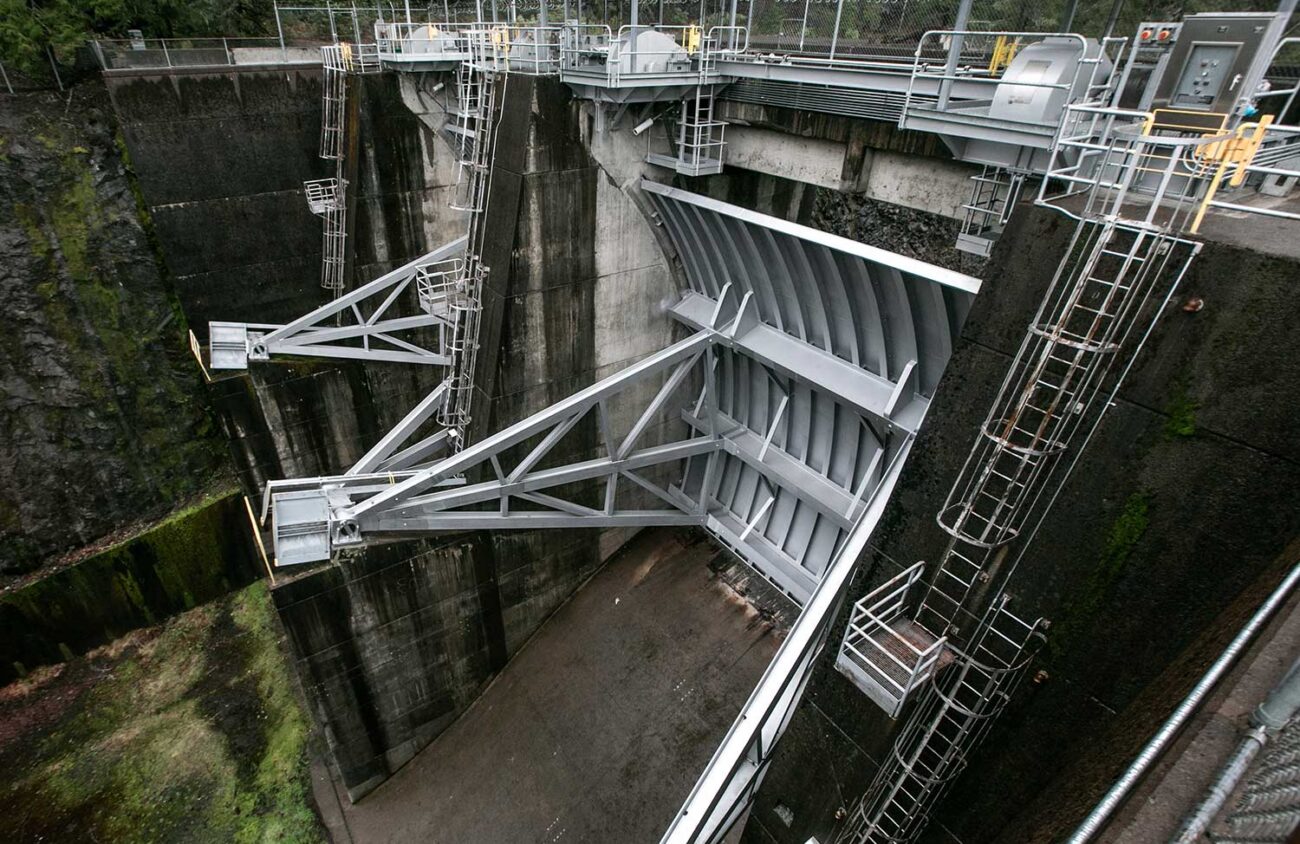
The U.S. Army Corps of Engineers says it will conduct “deep drawdowns” at several reservoirs to improve passage for threatened native fish, while continuing hydropower operations, per a June 23 decision on the feasibility of ceasing hydropower operations at the 13 federally operated dams.
Deep drawdowns substantially lower reservoir water levels to provide safer passage for native fish. Drawdowns will occur at Lookout Point, Cougar, Green Peter and Detroit reservoirs.
The drawdowns are part of the Army Corps’ continuing hydropower operations at the 13 dams within the Willamette Valley. The Corps is also consulting with the National Marine Fisheries Service (NMFS) on long-term infrastructure plans intended to improve native fish survival.
The June 23 decision comes after a May 22 final supplemental environmental impact statement (SEIS) that, as required by the 2024 Water Resources Development Act, analyzed the feasibility of ceasing hydropower operations at the 13 dams. The Willamette Valley System has been subject to years of litigation, environmental review and consultation regarding whether the system can operate without violating the Endangered Species Act.
An environmental impact statement (EIS) evaluates the potential environmental effects of major proposed actions for federal projects, like the continued operation of the Willamette Valley System. The Corps released its most recent SEIS as an addition to a 2025 EIS that studied alternative operational practices and fish passage infrastructure in the system.
The May 22 SEIS proposed that the dams “continue the operations and maintenance of the WVS for specific, authorized purposes.”
In its record of decision, the Corps says it will conduct the deep drawdowns as well as implement several other measures like targeted spills, delayed spring refills, nighttime winter water releases and more to increase fish survivability.
It is also consulting with the NMFS to “find long-term, practical actions that will support endangered fish and come with a lower price tag.” A 2024 NMFS biological opinion, an assessment that determines a federal project’s impact on endangered species, found that multiple structural improvements would be needed to prevent fish death in the Willamette Valley System.
Jennifer Fairbrother, conservation director for the Native Fish Society, says she’s “cautiously optimistic” that the Corps is seemingly more focused on fish survival.
The dams are congressionally authorized primarily for flood risk management, while also being authorized for hydropower, fish and wildlife, recreation, navigation, irrigation, municipal and industrial water supply and water quality. The Corps must also operate the dams in compliance with the Endangered Species Act to ensure native fish like Chinook salmon and steelhead are not killed by the dams’ operation.
The SEIS found that despite the Willamette Valley System’s hydropower operating at a net loss of more than $500 million over the next 30 years, ceasing hydropower operations could cost much more. Additionally, the Corps cannot alter or eliminate any authorized purpose of a dam. Only Congress can change authorized purposes.
When reservoirs are at normal operating levels, it’s difficult for juvenile fish to locate and pass downstream through regulating outlets located deep under water at the base of the dams, and fish mortality rates through turbines are high.
When fish are traveling upstream, the Corps’ Willamette Valley dams are too tall for fish to naturally pass on their own. Human interventions like trap-and-haul systems become necessary to pass the fish over — or around — the dam.
Fairbrother says the most effective way to prevent fish death at dams is volitional fish passage, where the fish pass the dam under their own power, without human intervention. An example of volitional passage is a fish ladder, where fish can swim up and over a dam.
Deep drawdowns and increased spillway operations can provide some volitional passage at dams where elevation prevents the feasibility of fish ladders. She says, “That’s what I really hope we can see coming from the Corps, which is how we can continue to iterate and drive towards the volitional needs of these species for fish passage.”
Fairbrother says she’s happy the Corps is continuing the drawdowns. “These fish have effectively been cut off for decades from their really important key headwater habitats, and those habitats are going to become increasingly important, given climate change,” she says.
Drawdowns in places like the Detroit Reservoir have been controversial, since they often dislodge sediment at the bottom of the dam, increasing the amount of suspended mud known as turbidity. Increased turbidity can negatively affect drinking water supplies as filters must work harder to filter out the sediment. It also can impact fish survival, as it obscures fish vision, making hunting more difficult.
“These river systems naturally are supposed to be moving a lot of sediment and large wood, and that’s a part of a healthy functioning river system,” Fairbrother says. “When we built these dams, we essentially cut the systems in half, and for more than a century now, they have been collecting all of that sediment that should have been moving downstream.”
The Detroit Reservoir, through the North Santiam River, feeds the primary drinking water source for Salem and its surrounding areas.
In an email to Eugene Weekly, Corps spokesperson Kerry Solan writes, “We are seeing reduced turbidity each year. To date, the drawdown at Cougar Dam has not resulted in increased turbidity. We have developed emergency action plans for the drawdowns at Lookout Point and Green Peter in response to community concerns, and we’ll continue to work with the Oregon Health Authority and downstream communities during the planning and implementation of drawdowns at these dams, as we have since these drawdowns first began.”
The Corps will take an incremental approach to the Detroit Reservoir drawdown, first lowering the reservoir to 1,425 feet, a level that in the past did not cause issues with turbidity. In the second year, the Corps will lower the reservoir below the 1,425-foot mark if water quality does not drastically decline. In the following years, the Corps will lower the reservoir to 1,395 feet, which will make the regulating outlet accessible to juvenile fish.
Deep drawdowns at Green Peter, Lookout Point and Cougar reservoirs will take place in the fall to guide downstream migration.
“It’s a big change from how the Corps has operated for more than half a century in this basin, and it’s what’s going to be necessary in order to have the things that are important to Oregonians, like clean water and abundant fish and healthy rivers,” Fairbrother says.
Solan writes that the Corps initiated reconsultation with the NMFS in June and is working to establish a timeline for the consultation and a new biological opinion.
This story has been updated.