There are only so many states blessed with soaring mountains, a raging ocean coastline and the high desert, so it’s no surprise that Oregon is home to so many motorcycle clubs and enthusiasts — the back highways simply demand to be explored, and motorcycles surround riders with the taste of Oregon wind.
As grizzled motorcycle enthusiast Tom Overton says, “A freeway is only a way of getting somewhere in a hurry.”
2026 marks 49 years of Overton’s membership in Pacific Northwest motorcycle clubs that police have classified as “outlaw clubs” — groups of motorcycle enthusiasts who adhere to very specific rules, values and loyalty to one another, colloquially known as “biker gangs.” Police refer to them as “outlaws,” because they are not affiliated with or follow rules of the American Motorcyclist Association and are instead associated with the biker counterculture.
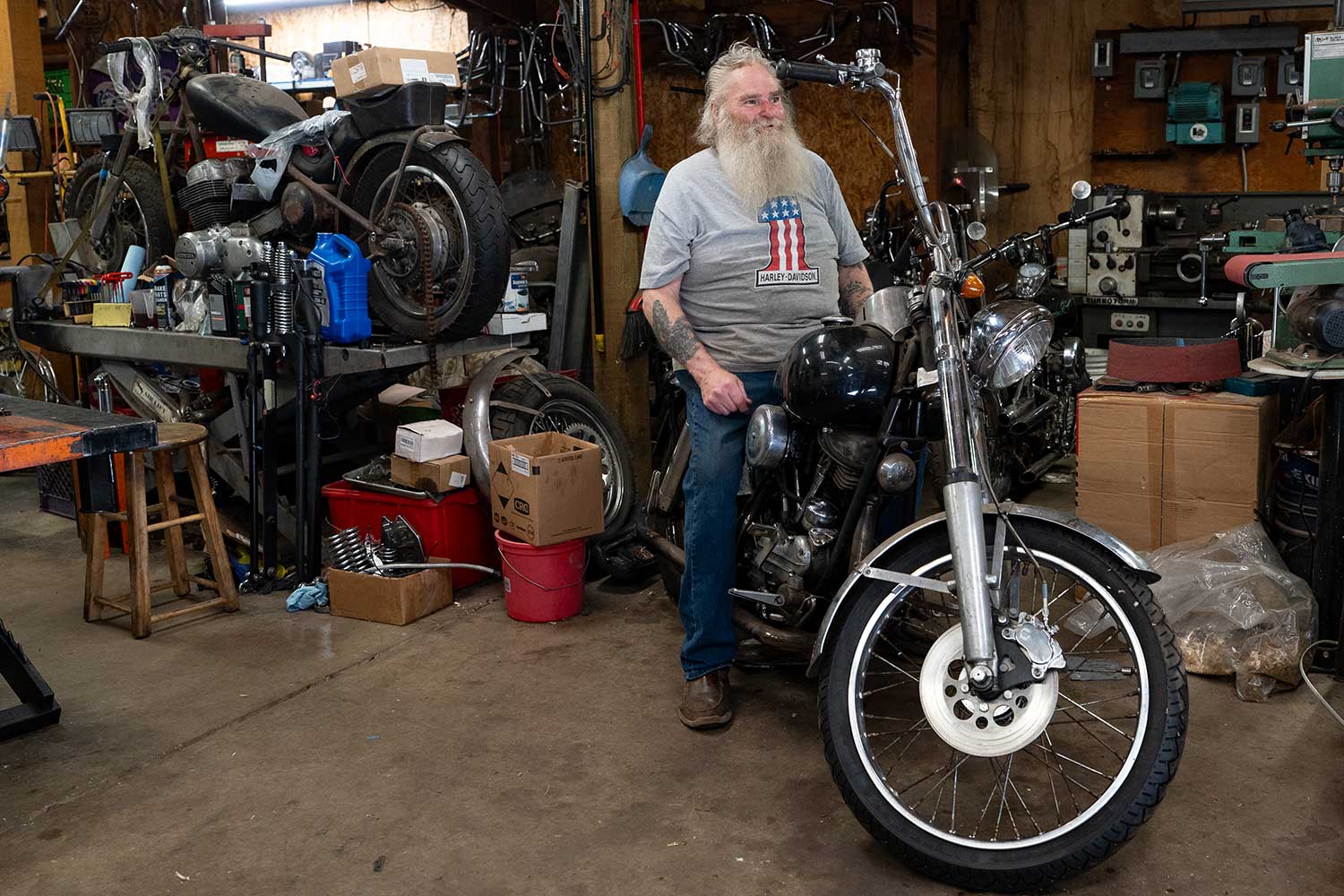
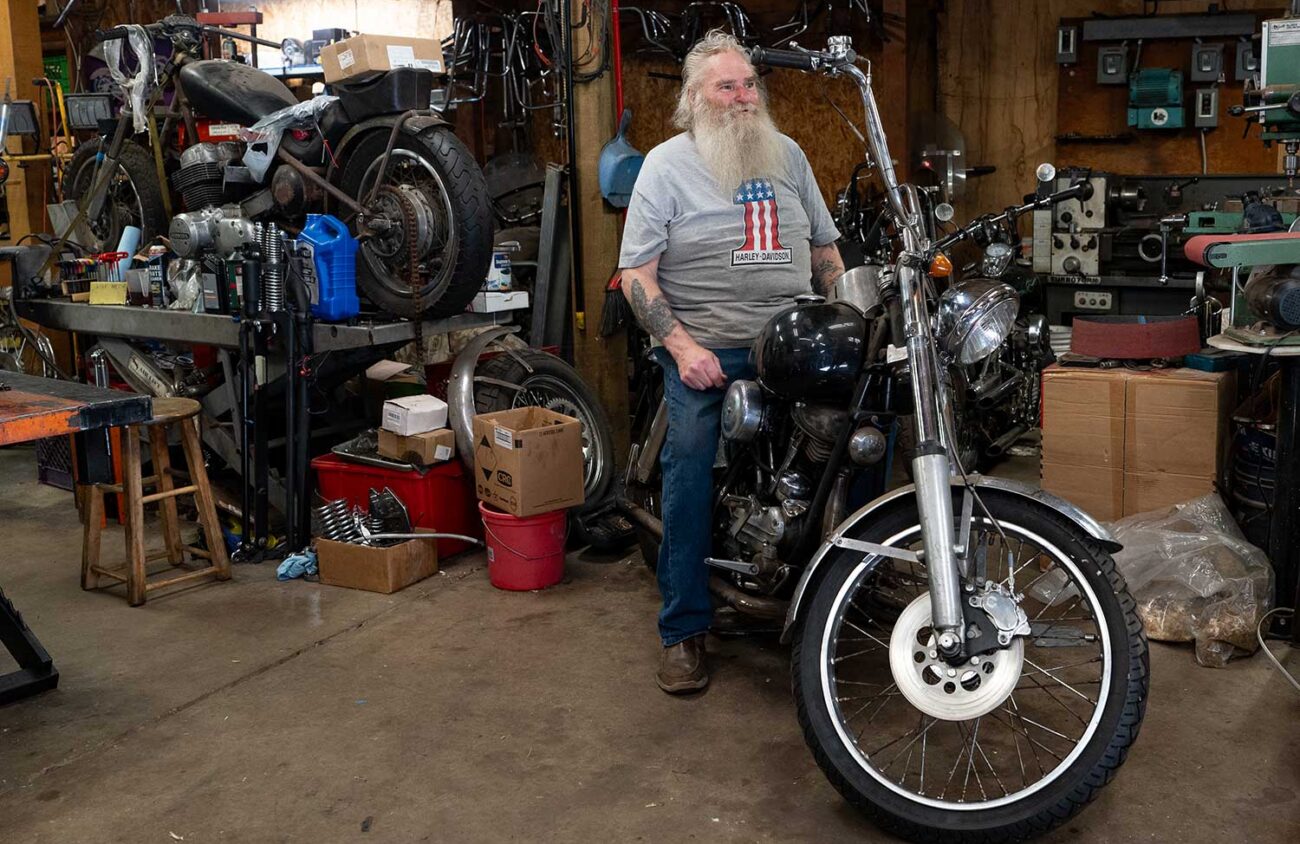
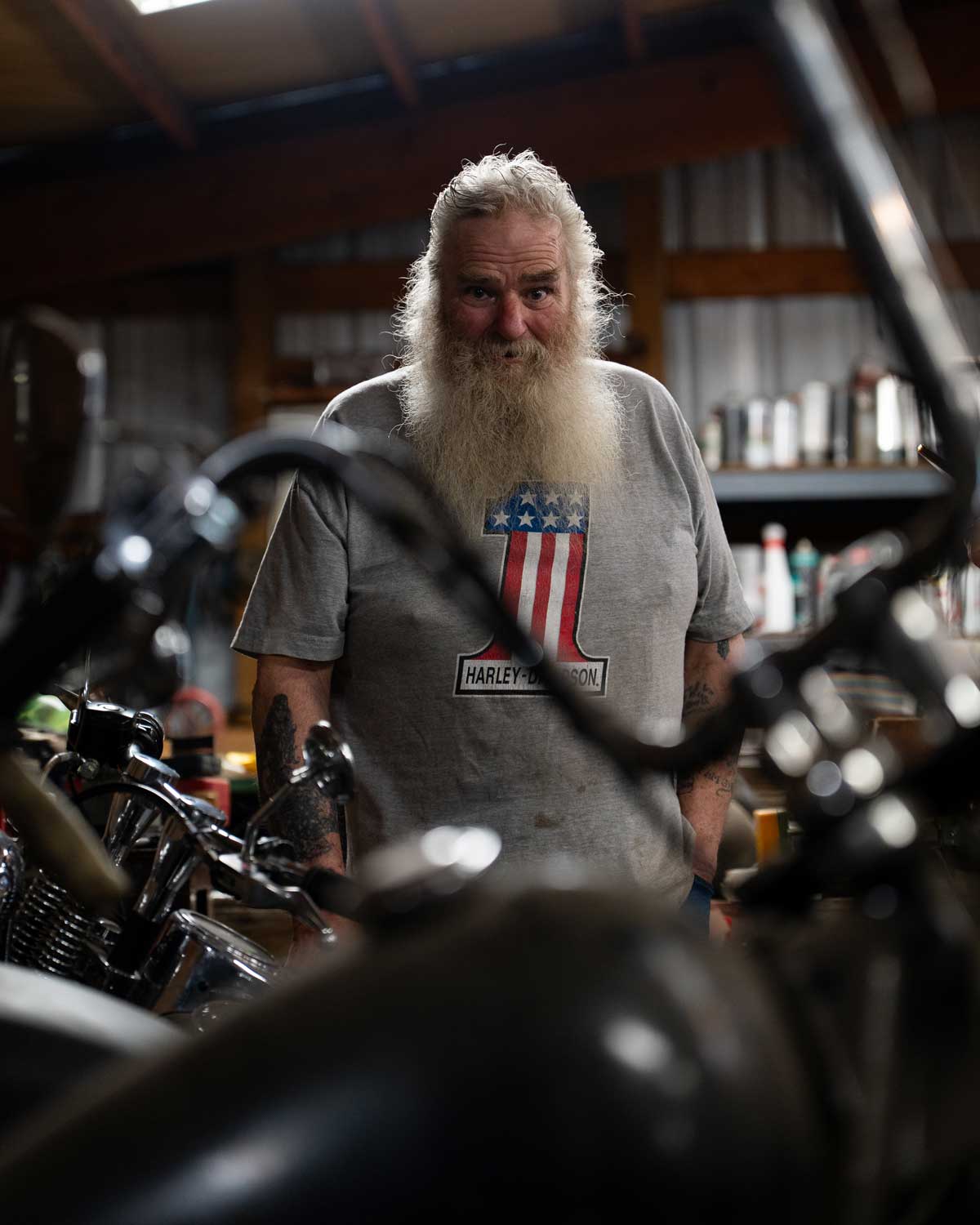
He has been an active member of the Eugene-based club Free Souls since 1977, and was the president of its sanctioned club Clean and Sober for 16 years. At 74 years old, Overton is a tried and true motorcycle aficionado, alleging to have owned over 60 motorcycles throughout the course of his life and ridden over one million miles. Walking into his at-home informal shop just outside of Goshen, it’s easy to take his word for it. He’s a large, burly biker draped in tattoos and a long white beard — so it’s also best to take his word for it.
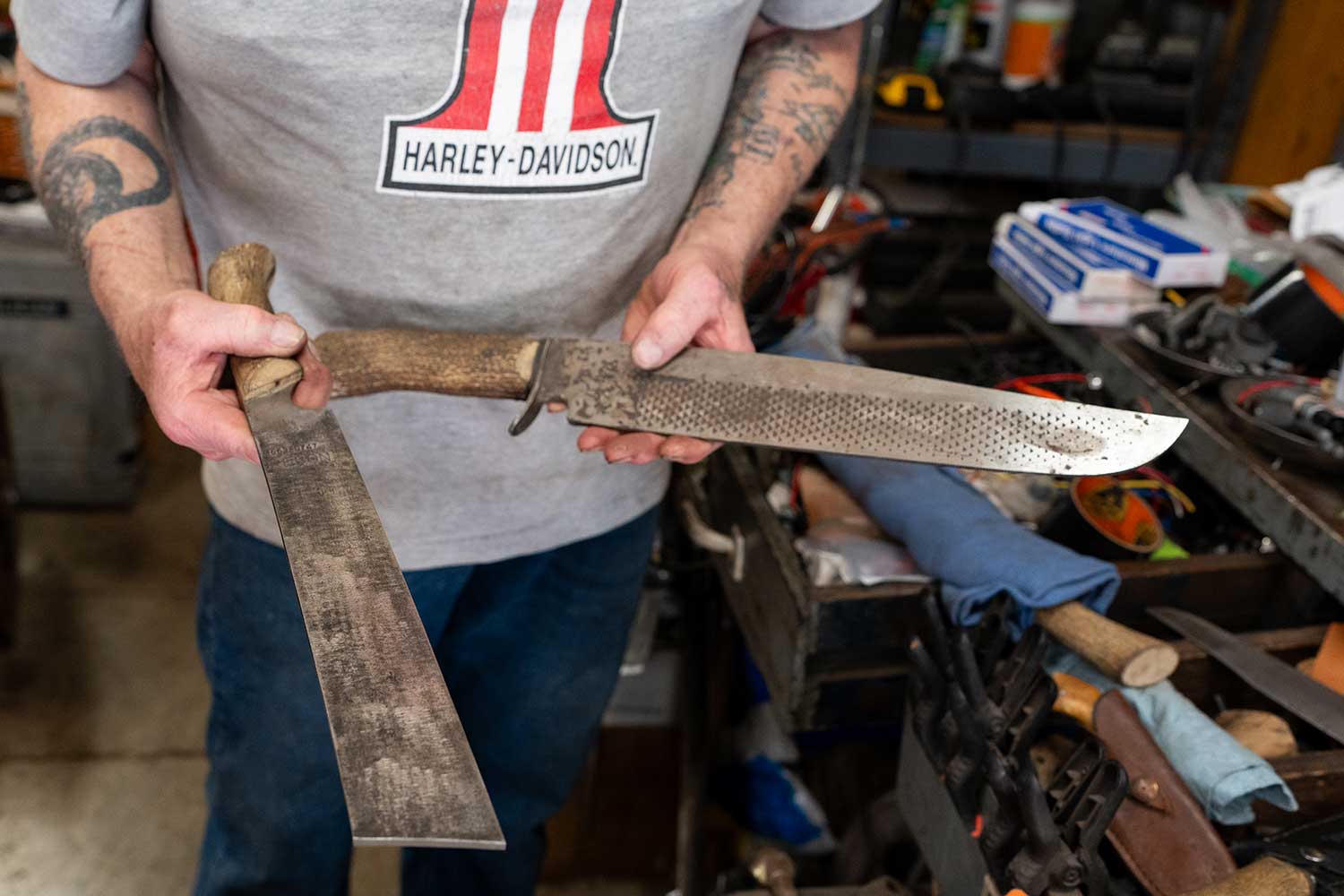
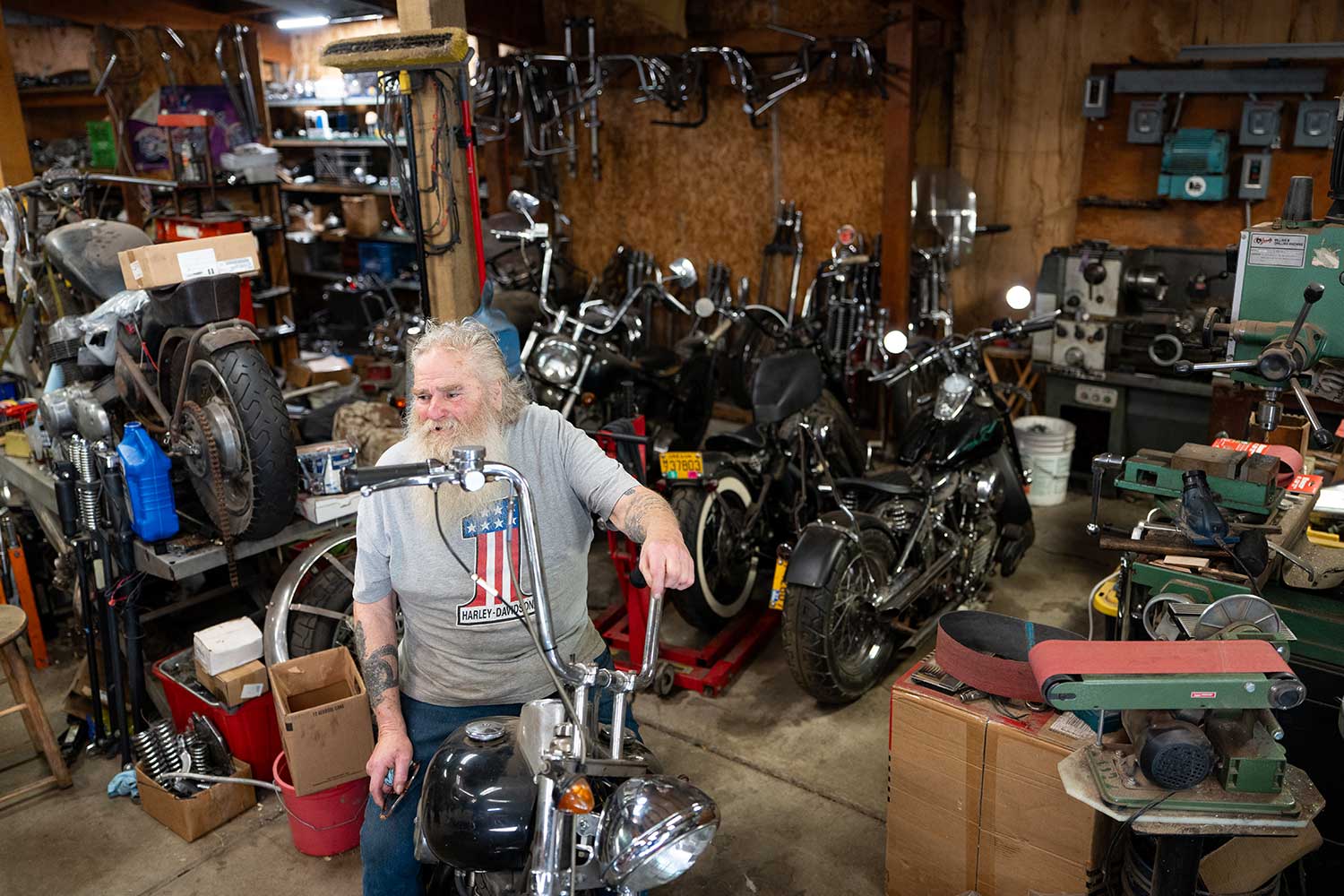
Sharing his rural property with his horses, chickens and two mules, Coffee and Serenity, are 23 bikes and three-wheelers that he currently owns, and even more that he’s either fixing up for people or building by hand. Seats, throttles, handlebars and more line the walls, while knives and swords that he’s made out of scrapped motorcycle parts are impaled in the support beams and fill the drawers.
Most of the bikes are “choppers,” which means “a bike built for you the way you want,” Overton says, as opposed to a bike that comes fresh from the factory. In the glory days of biking, Overton says riding choppers was always the way to go.
Overton is the third-youngest of four brothers, all of whom have since died. When he was a teenager, “my oldest brother, David, ran around with the Gypsy Jokers,” Overton says, which is a California-based motorcycle club with a strong Oregon presence, once described by journalist Hunter S. Thompson as the No. 2 most dangerous outlaw club in California.
As a 15-year-old, Overton spent the weekdays reading a Harley-Davidson manual to tinker with his brother’s bike so it could hit the road on the weekends. Billy Scannell, Overton’s close friend and fellow Free Soul, notes that “Harleys break down a lot, and someone needed to learn how to fix them.”
Eventually, David Overton left the Gypsy Jokers and joined the Free Souls. His three younger brothers all followed him soon after, “and I’ve been here ever since,” Overton says.
The attraction of being in a club, as opposed to riding independently, is that “you got brothers that are thinking the same way you do, and they ride around doing the same thing you do.” Overton says, “and they’re pretty independent of everybody else.”
That being said, “things have changed a lot,” Overton adds. “The way things are done now, it’s not the same as when I started.”
These days, the Free Souls instill a “family-work-club” policy that directs members in terms of listing their priorities. “Well, when I joined the club, my job was prospecting. My family were the Free Souls. That’s all I did. And build motorcycles,” Overton says.
Before becoming an official member of a motorcycle club, newcomers must “prospect,” which means proving their brotherhood by demonstrating nonstop dedication, involvement and loyalty. “They basically have to prove that they are worthy of being in a club,” he says.
After becoming a full member, life rolling with the Free Souls in the 1970s was simple and “fun. That’s the only way I can describe it,” he says. Days with the Souls meant “we were riding around just doing crazy shit,” before they would “go to bars and party with everybody.”
One time, he recalls, the Free Souls had partied all night with a Tacoma, Washington-based outlaw club, and when they all left the clubhouse in the morning, he noticed that a bar was opening. He ran in to grab a cup of coffee, and spent the next six hours partying there instead of going home.
Another change since the old days, he says, has been in the club’s overall behavior. “In the ’60s and ’70s, maybe 60 percent of them would be off key and do off-color things. Today it’s probably 10 to 20 percent.”
In 50 years of being involved with police-classified outlaw motorcycle clubs, though, Overton says he has only been involved in two fights, and both times were because someone was being “smart” with him. Aside from that, “It’s really easy for me to apologize,” he says.
In 1996, his youngest brother, Steven Overton, started the Clean and Sober Motorcycle Club when he had recovered from his own addiction. He created the club for bikers who wanted to stick with the Free Souls, but had no interest in drinking. Clean and Sober is officially sanctioned by the Free Souls, which means “The Free Souls said it was OK to be here,” Overton says.
As of 2022, Clean and Sober is a support club, which means that it operates independently but offers support to Free Souls as its establishing club.
Scannell, a former Clean and Sober member and president, says the club is modeled after the Free Souls, “but instead of family-work-club, they put sobriety first.”
The idea, Scannell says, is that “being involved in a motorcycle club does not actually require you to drink and do drugs,” and that joining a 12-step program “is not the only way to get and stay sober.” The club instead focuses on outreach and charity work.
Tom Overton, who has now been clean and sober himself for 36 years, joined the club when Steven started it. As members of Clean and Sober, “we’d get on our bikes, and we go to another member’s house, and we go to another member’s house and start picking up everybody, and go for a ride,” Overton says. “It was really cool.”
In 2002, Steven was killed at age 47 by a drunk driver in a car accident, so Overton took a hiatus from the Free Souls to become president of Clean and Sober. “He had made a promise to his brother that he would do what he could to keep that club going,” Scannell says.
“I found in Clean and Sober a sense of brotherhood that I didn’t realize I felt lacking in the fellowship of recovery programs.” Scannell says that in his experience with his recovery programs, “it seemed the sense of camaraderie has a lot more to do with convenience for them, and real brotherhood is what really matters.”
In 2018, Overton went back home to the Free Souls. “I’ve always been a member of the Free Souls. When I joined the club, I joined for life,” he says. After 16 years of being Clean and Sober president, Overton trusted the people in the club, such as Scannell, to keep it going. “I figured they would do just fine without me.”
Still, he says that being in the Free Souls can sometimes be overwhelming because everything is so different now. The biggest change has been in how motorcycles are viewed within the community. “They compete to see who can buy the newest, fanciest bike. They build fancy hard-ride bikes,” he says.
His very favorite memory he’s ever had, he says, was when he went on a ride with all three of his brothers, and Steven’s bike broke down on the side of the road between Creswell and Cottage Grove. David rode to a nearby air hangar and brought back all he could find: two screwdrivers and a crescent wrench. “Steve’s Knucklehead (a nickname for a Harley Davidson engine that resembles two fisted hands) stuck a valve, and I fixed that on the side of the road with those three tools,” Overton says. “You can’t do that today. Now you have to order parts.” He adds that several of his built-from-scratch bikes are no longer street legal due to his customizations and other methods of fixing them.
Scannell says, “It’s always amazing to me how much that man knows about fixing motorcycles and making motorcycles work with parts and pieces that are around that weren’t necessarily designed for that,” adding that he’s witnessed Overton fix a broken tail pipe with a tin can.
Currently, of the dozens on his property, Overton has only one bike that he’s kept stock (exactly how it came from the factory): a 1961 Red and White Panhead Harley — a vintage Harley with an engine that replaced the Knucklehead, and resembles a frying pan.
Everything else in his shop is made by his own hands, just the way he wants it. Sometimes he makes adjustments, such as to the wheels, handlebars, pegs and seats. Other times, he builds them from the ground up, constructing everything from gas tanks to fenders with parts from the steel yard and other items that “just come by me.”
In 2024, he salvaged a 1988 Electra Glide Classic from a garage fire — a bike known for its electric starter and lack of accessories, which makes it efficient for long, comfortable rides. After saving it, Overton repaired several essential pieces of equipment that had issues from the flames.
Now, the bike is completely green, spotted and weathered from the damage (it looks exactly like something that has survived a garage fire), but “it runs absolutely phenomenal,” he says.
After he fixed it up, he took it on the Rhody Run, which is an annual mandatory group ride to the Florence Rhododendron Festival that the Free Souls and several support motorcycle clubs participate in to kick off the season. “I rode that down there because I knew everybody’s gonna be riding their new baggers and fancy baggers,” he says. “I got more attention than anybody.” He kept his bike’s rugged appearance because “the paint don’t make it run good or handle good, and that’s what’s more important than how it looks.”
With everything that has changed in the motorcycle clubs over the years (comparing it to the difference between a blue-collar construction worker and a white-collar businessman), and all of his biological brothers having passed away, Overton says, “the riding is the same no matter what.” Dealing with weaker legs as a result of recent heart surgery, he says that he’ll ride a trike until he recovers, and worse comes to worst “I got a sidecar I can put on if I want to do that.”
Overton doesn’t think he’ll ever stop riding. Being on a bike, weaving in and out of traffic, and winding around the country roads in the wind, “it’s just a feeling you get when you ride,” he says. “When you’re a kid and you lose your favorite toy and you find it again, that feeling you get, that’s kind of what it is when you get on a bike and ride it.”