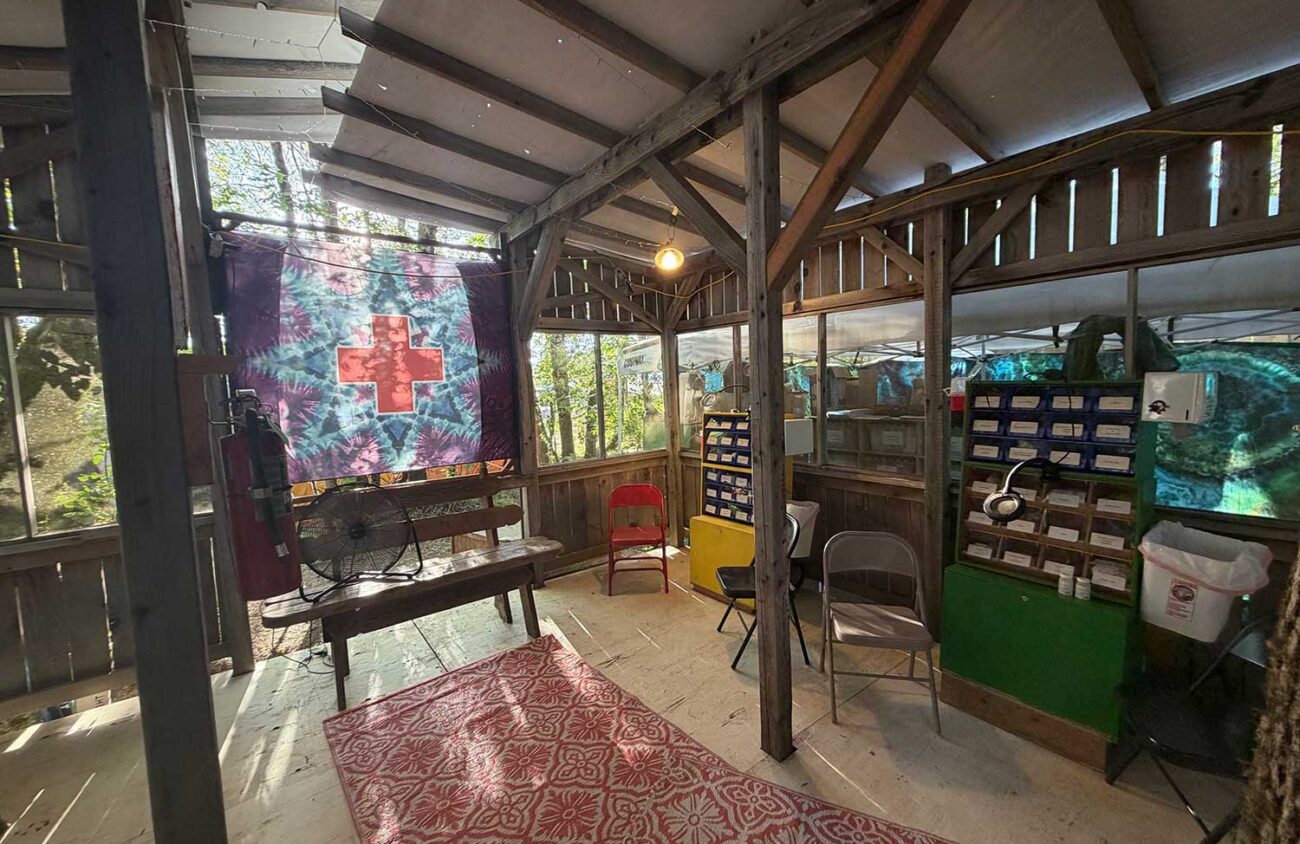
In 1969, when the Oregon Country Fair was still in its infancy, a small group of White Bird Clinic volunteers showed up with a box of medical supplies and established White Bird Rock Medicine, a nonprofit medical organization that provides services at OCF and other major festivals.
Now, 57 years later, WBRM is able to provide comprehensive care, dealing with medical emergencies, behavioral health issues and providing harm reduction to fairgoers.
At the Fair, WBRM has two distinct locations, Big Bird and Little Wing. Both are staffed 24-hours a day with nurses, paramedics, behavioral health workers, emergency medical technicians and even medical doctors. “We always have an emergency room physician at each location as well as other doctors to support less intense situations,” says Kate Gillespie, WBRM executive director.
Gillespie says the most common ailments WBRM encounters are cuts, twisted ankles, splinters, bruised toes and heat-related injuries. As a fully staffed facility with access to heart monitors and some medications, WBRM is also able to deal with some chronic health issues and more seriously, heart attacks, strokes and larger traumas. “We have most of the equipment that you would find on an ambulance,” Gillespie says.
Beyond physical ailments, WBRM is able to work with patients experiencing psychiatric crises, panic attacks, or general anxiety. “Oftentimes, people just need an ear to listen to them when they’re having a hard time and at festivals, we think we’re going to have a bunch of fun, but stuff comes up and sometimes things don’t go how you expect them to go,” Gillespie says.
Part of WBRM’s model is an emphasis on harm reduction, providing people with basic needs that prevent unsafe or unsanitary conditions. At the front of each White Bird booth is a “window box” where people can walk up and ask for things like Band-Aids, ibuprofen, tampons, ear plugs and condoms.
While the Oregon Country Fair is strictly a drug-free event, Gillespie says there are times when people become altered. “Sometimes that’s just from overstimulation, sometimes it’ll be a result of substances and our crews are just trained to meet people where they’re at in a non-judgemental way,” she says.
Beyond its two tents, WBRM has teams that patrol the Fair, looking for people who may be experiencing heat-related stress, injuries or other medical issues needing attention. Having multiple teams that move throughout the Fair allow for rapid response times, as the Fair itself covers nearly 500 acres. Each team consists of a medical professional — often an EMT — and a mental health worker. “That way we can kind of hold the head and the body at the same time in our care model,” Gillespie says.
In the event of an emergency or ailment where a patient must be transported off of the fairgrounds, WBRM oftentimes has a designated ambulance from the Lane Fire Authority. This year, Gillespie says OCF will have to “supplement some of the cost of that stand-by ambulance,” due to the Fire Authority having funding issues. Patients with less serious injuries like a sprained ankle that requires an X-ray can be transported off property in a civilian vehicle.
In the event of a serious trauma requiring immediate advanced life support, the Fair has areas where a helicopter could land, although Gillespie says that in her 16 years with WBRM, that’s never been needed. Despite the rarity of serious traumas or illnesses, Gillespie says WBRM prepares contingency plans for all events, including a mass casualty incident.
Mass casualty incidents are when the number of patients overwhelms the local health care system. They can include anything from a large number of heat-related casualties all the way to a more serious incident involving multiple deaths.
“A large portion of our higher level command staff on our crew has taken incident command training and have certifications,” Gillespie says, adding that before the event, WBRM and the Fair’s safety crews go over different scenarios and discuss resources and how incident command would be handled.
As a volunteer-led organization, WBRM is always looking for more members to help in the tents or on the field. “We do a day-long training annually that our volunteers can attend and we really encourage new folks,” Gillespie says.
WBRM’s Big Bird tent is located next to the main stage and its Little Wing is located in the Xavanadu area next to the information booth.