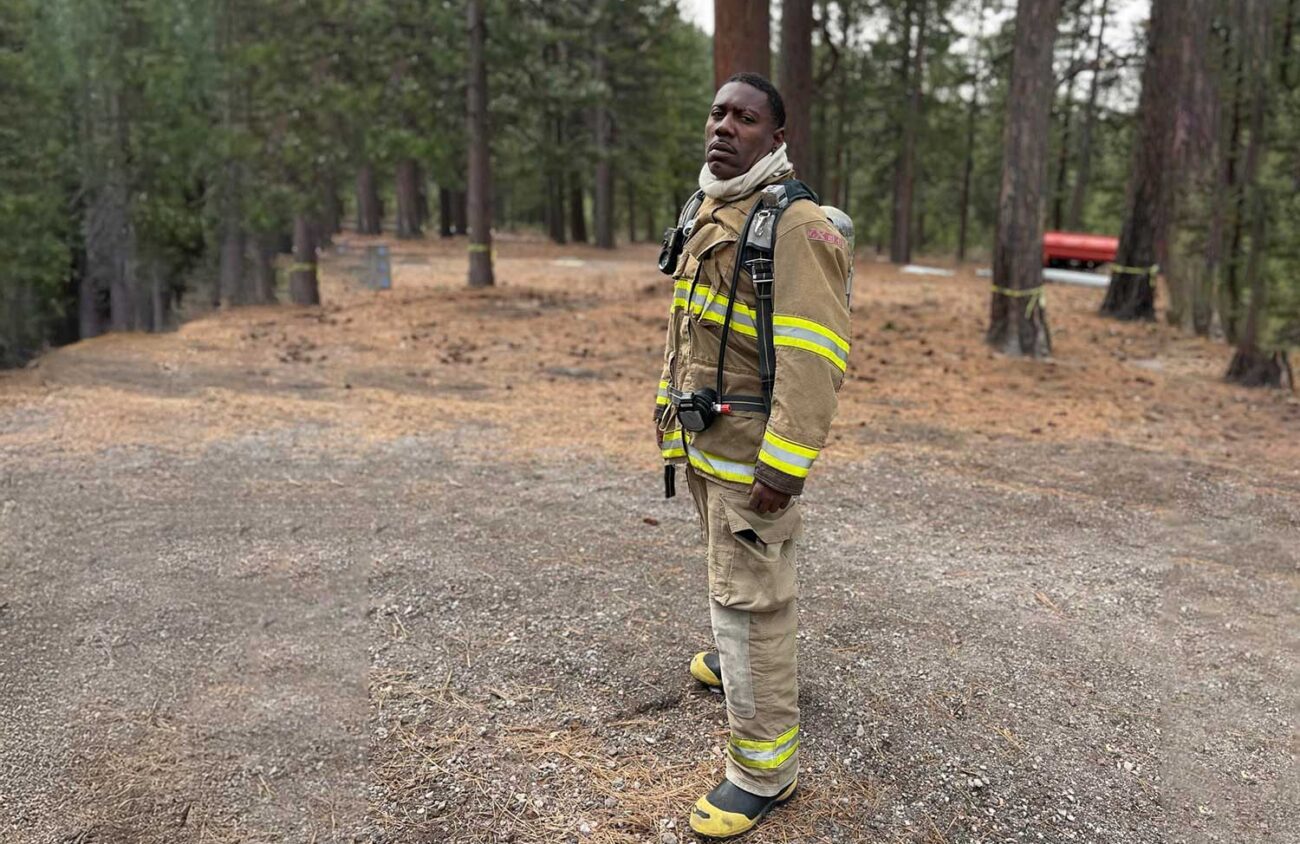
As wildfires rage across Oregon, the 2024 fire season still looms large for one wildland firefighter in particular. Activist coalitions across Oregon are working together to grant clemency to Brian “Hakiym” Simpson, a Black wildland firefighter, and convince Gov. Tina Kotek to exonerate his conviction for second-degree assault, which they believe was wrongful and racially motivated.
In June 2024, Simpson and Brandon Keith Olson got into a fight, in which Olson admitted to throwing the first punches. Simpson also testified in court that his co-worker used racial slurs, which Olson didn’t deny. A toxicology report also showed that Olson was under the influence of illegal opiates, with heroin being identified as the most likely source.
On June 11, Southern Oregon Public Broadcasting Service released a long-form documentary called “Justice for Hakiym” on the coalition fighting to exonerate Simpson, as well as details about the altercation and in-depth analysis of the court case. The episode marked the first episode of the sixth season of Us As We Are, covering rural and southern Oregon.
Simpson was sentenced to 70 months in prison by an all-white jury in Josephine County and moved to the Snake River Correctional Institution, a medium security prison in Oregon. Olson was never charged.
“He was tried in Josephine County, which is historically known for having a systemic racial bias and was a sundown town for a long time, one of the most infamous sundown towns,” says Madison Lusk, digital communications coordinator for Firefighters United For Safety, Ethics and Ecology. The initial altercation happened in Merlin and the trial took place in Grants Pass. “There were a lot of things wrong with the trial itself,” Lusk says.
FUSEE, a grassroots organization working on ethical wildlands management and empowering firefighters, has been involved with the case since early on and is currently working with other Oregon organizations to collect signatures and deliver a clemency package to Kotek’s office.
Lusk says that one of the glaring mistakes with the trial was that Simpson was not offered or denied pretrial immunity hearing, which is a right under Oregon law. Simpson’s defense attorney, Eric Fournier, has also filed an appeal citing six major errors within the case.
The major errors written were: Admitting evidence of Simpson’s prior criminal history which violated due process, creating unfair prejudice for the jury. Errors two through four are the judge’s decision not to admit evidence regarding Olson’s alleged behavior leading up to the altercation.
“I think something that really sticks out to me as someone who’s not native to Oregon is that Oregon has a lot of reckoning to do with its very racist past and its racist present. And I think this case is a really clear opportunity for that reckoning to happen and for Kotek to stand up for what she says she stands for,” Lusk says.
The Eugene-Springfield NAACP was also involved in advocating for Simpson, although the group has taken a less active role for the clemency package.
As of “2024, our concerns continue to be centered on issues of racial equity in the criminal justice system, including jury representation, the potential impact of implicit bias and disparities in sentencing,” says Demond Hawkins, Eugene-Springfield NAACP president. “We believe those issues deserve careful examination and ongoing public attention. For that reason, we expressed concern about whether Mr. Simpson received a trial free from the effects of racial bias and whether broader disparities in jury representation and sentencing were adequately addressed.”
Simpson is a trained firefighter and teacher, with over two dozen response certifications. In addition, Simpson, a father of four, is a poet and educator and advocates for youth empowerment.
Organizations such as FUSEE, Don’t Shoot PDX and Black Alliance and Social Empowerment Oregon continue to advocate for Simpson’s exonerations and hold community events to let more people know about the case summary. Currently the petition for his exoneration has received over 2,400 signatures and BASE is encouraging individuals to mail letters to Kotek.
Mia Ferrera Wiesenthal, an organizer for Simpson’s freedom and a friend, says during the altercation Simpson was working on de-escalating the situation and only after Olson began ramping up did Simpson act in “self-defense.” She says that Kotek is currently “aware” of the situation and is continuing to raise awareness for the case.
“There were minor things in the past that were used to bias the jury,” Wiesenthal says. “It was a jury of white men versus a person of color for the sentencing.”
FUSEE hosted a documentary watch party on July 2, which explained Simpson’s case in depth and opened space for the community to talk further about strategies to exonerate him. At the gathering, Kyle Trefny, a research coordinator at FUSEE, shared a poem that Simpson wrote in prison.
“I want to share a poem that Hakiym sent me that he wants us to hear,” Trefny said. “I want to greet you with peace. P E A C E — positive energy always creates elevation — and I want to greet you with the essence of love — L O V E — living our values every day. Thank you for meeting me at this moment, thank you for showing up as your authentic selves.”
For now, Simpson remains incarcerated at Snake River, more than a thousand miles from the fire lines he once worked. His case sits with Kotek’s office — the outcome still unknown.