At any time, around 1.3 to 1.4 million people in the U.S. live in nursing homes or assisted living facilities — with roughly 35 percent of older adults entering a nursing home at some point within their lives. But the care of facilitated living comes with a hefty price tag, with the median cost nationwide for private rooms being around $129,000 per year, according to the American Health Care Association and the National Center for Assisted Living.
The price of facilities quickly add up, leaving older Americans with a considerable amount of financial woe, oftentimes depleting almost all of their life savings. “Aging in place,” a term used to describe older Americans who choose to live independently in their own homes and community as they age, rather than moving to a senior care facility, has been shown to save generations multiple thousands of dollars.
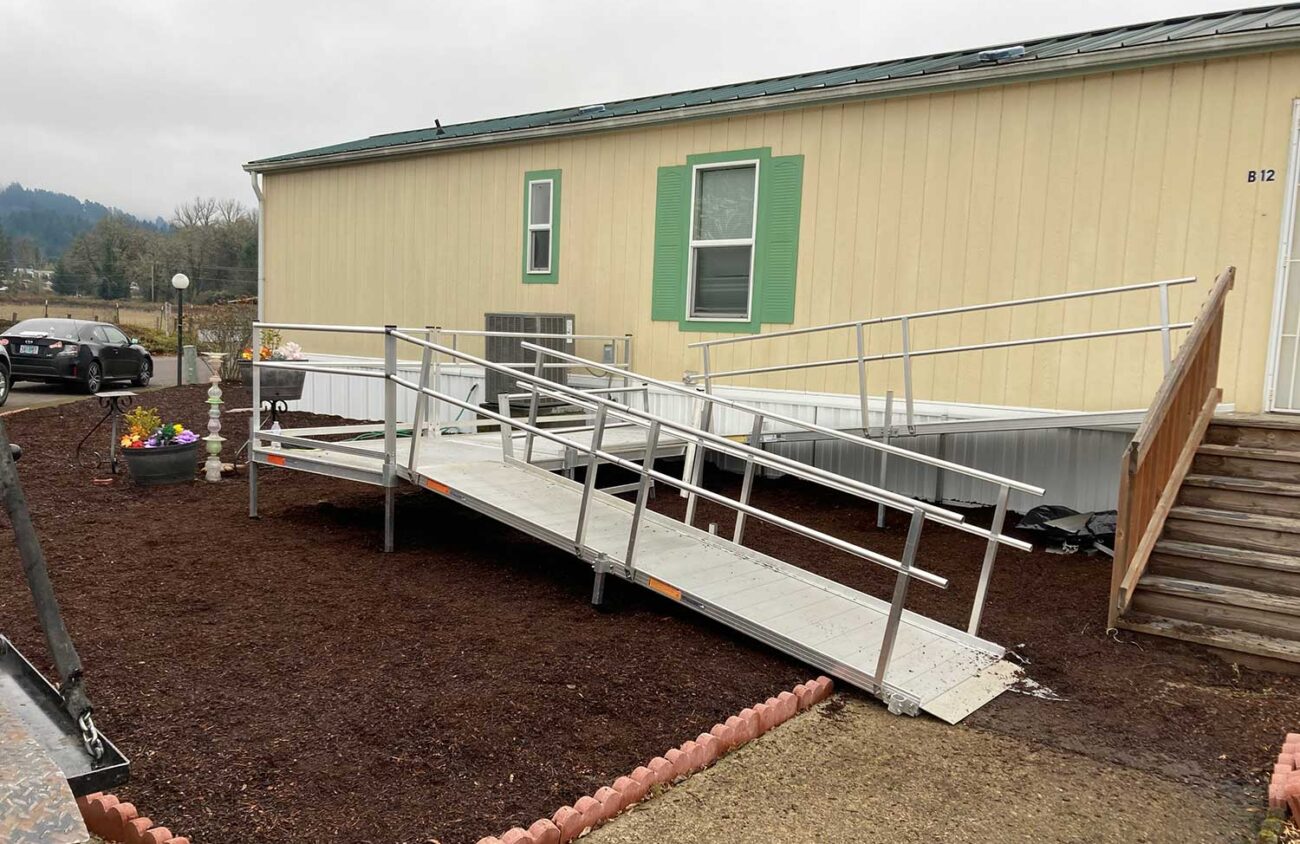
The fix could be quite simple. Habitat for Humanity of Central Lane launched a new initiative called the Ramp-Up! Challenge, a program providing reusable aluminum ramps to households, increasing in-home accessibility. The program covers $7,500 in costs for income-qualified homeowners.
“What we have found in recent years is that a need for an accessibility ramp is one of the most common and urgent requests that we see come through the repair program,” says Amanda Adams, Central Lane Habitat deputy director. “We are piloting this new aluminum ramp program this year with the hope of doing 12 ramp projects in the central Lane County area in the year ahead.”
Habitat has received a couple of grants, with one of the grants coming with a “challenge” to raise funds in the communities; the goal being to raise $22,500 to match the grants. Since May 11, it has raised almost $70,000 towards the Ramp-Up! Challenge through community donations and additional grants.
Annie Leadingham, development and marketing director, says that local Habitat for Humanity ReStore customers “would be so happy to see that we were doing something for our senior veterans and locally disabled, because we had probably over 75 people donating from the ReStore.” She adds, “The challenge really has resonated with the community. Number one, they see the need — we get calls every single day about needing a ramp.”
Leadingham says that the requests come from various sources, including adult children trying to help get their parents to age in place so they don’t have to move to an assisted living facility, or people with short-term disabilities who need accessibility into their home. The aluminum ramps are reusable and weatherproofed, so when one family is done using the ramp, it can be given to the next one.
The current ramp program is working with homeowners who are at or below 80 percent of the area median income and requires homeowners to be up to date on property taxes, insurance and mortgage payments.
“By keeping people able to age in place and successfully stay in that more affordable stable home, it is really helping to stabilize the community in a larger way because they are not moving into other less affordable, available house types,” Adams says. “Not only is it great from an accessibility standpoint, but it’s really pretty great for housing stability and preservation.”
Older Americans overwhelmingly prefer to age in place, with an option for in-home care if needed. At the same time, only 10 percent of homes are designed to accommodate older people, according to the U.S. Census. Aging-ready homes have accessible designs, such as ramp accommodations, and build in handrails and grab bars.
The upfront cost of installing a ramp could go as high as $15,000, leading to many not wanting to deal with the immediate up-front costs. However, one Harvard study shows that over 30 percent of seniors have reported paying one-third of their monthly income for housing, making them cost-burdened due to the rising cost of senior housing.
“All the equity you’ve built, owning your home for maybe 30 years, could just go like that. And then your kids would get nothing,” Leadingham says.
The group is currently planning to continue fundraising another $20,000 to $30,000 specifically for the ramp program. The program has also resonated with business partners, such as PG Long, which has sponsored some ramps in the past.
“When you donate towards the Ramp-Up! Challenge, it is staying within our local community,” Leadingham says.
Find out more at HabitatLane.org/ramp-up-challenge or call 541-741-1707.