On a Thursday evening, a group of people gather in a circle, each sporting a red, blue or purple nametag. Everyone takes their place within the church basement, and begins chatting about the last softball game or what new recipe they tried, and the color of the nametag fades to the background.
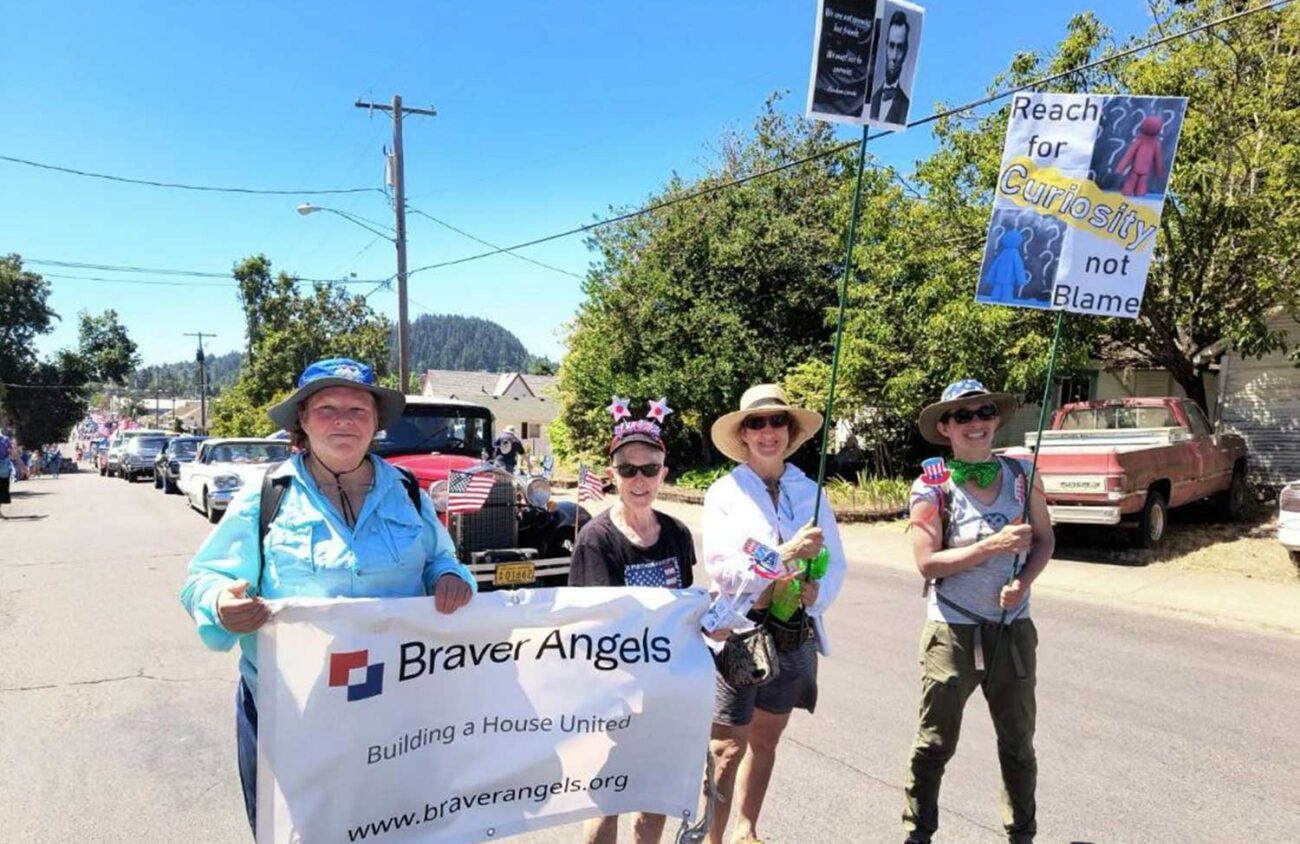
A group of self-identifying Democrats, Republicans and independents convene each month to host civil civic discussions about an array of issues; Braver Angels is a national organization that works on hosting meetings to create safe spaces of disagreement and understanding. The Southern Willamette Valley Alliance chapter meets at a local church in Eugene to have structured facilitated discussions about community issues. They use clinically tested methods to facilitate spaces for civil conversation.
All across the country, communities are divided along political lines. Neighborhoods are deemed to be blue or red zones, and neighbors profile others based on ideological indicators. Eugene is not immune from this trend, and partisanship remains at an all-time high. Recent conflicts have risen over the role that Immigration and Customs Enforcement should play within the city, to whether or not Eugene Police Department Chief Chris Skinner should resign over racist remarks within the department.
Research conducted at Syracuse University found that the country is the most divided in American history, excluding the Civil War. Pew Research polling shows an increase in partisan hostility, with the rise of political violence becoming more and more common.
“I grew up in a very rural area of Oregon, as well as Idaho. It was where we all got along, and we didn’t have such a political divide,” says Debbie Bosche, the Republican facilitator of the chapter meeting. “Community is community. And we have to be able to get along with each other in spite of these differences and start getting our skills back.”
Every month Braver Angels’ Southern Willamette Valley chapter gathers with community members to discuss a topic. The May 28 meeting focused on whether participants felt that they could state their views “freely and fully without fear,” or had experiences in the past that have caused fear to share political opinions. Participants across the aisle shared that they had feelings of feeling misunderstood, ignored and even attacked for their opinions that they have shared.
“We’re talking to each other’s human experiences,” Lisa Dayton says. “That’s far more powerful than trying to argue policy, or argue whose politician is better and throwing out information that you believe is true.”
The national chapter was founded in 2016, as a result of polarization and political division within the country after President Donald Trump’s first election, with local chapters popping up across the country soon after. The Southern Willamette Valley chapter was founded in 2018.
The Southern Willamette Valley chapter, like others across the country, has three chairs that represent each political ideology. The liberal co-chair is Luke Grossmiller, the independent co-chair is Diane Ryan, and Dayton is the conservative co-chair. There are 12 volunteers who are a part of the steering committee. They are divided evenly between political ideologies and discuss how to facilitate different meetings and organize community events for Braver Angels.
The national chapter oversees the different alliances and the program materials that are being produced. It also works on conducting research on how to bridge bipartisanship in discussions and best practices in conducting conversations.
“What we do is outreach and activities to the community, to introduce them to this idea of healing and dialogue that can help unite neighbors with neighbors,” Dayton says. “There has been just terrible experiences of losing family and friends, people losing jobs over politics and over disagreements — unnecessarily so.”
During the main meeting, participants are split into smaller groups of three to four people. Each group has a designated timekeeper and conversation facilitator to ensure everyone has equal time to speak and none of the core conversational rules are broken.
People are encouraged to share without interruption, follow-up discussion or rebuttals to comments — creating a space purely meant to share personal experiences, rather than debate. Participants are only allowed to acknowledge one another’s experiences and provide constructive reflections on comments.
“Having been a mediator I saw that if people can talk honestly, respectfully, trying to understand one another, that people can make agreements on common ground that is beneficial for everyone,” says Barry Nobel, one of the steering committee members and a facilitator for a small group discussion. “That’s why they call it a win-win, rather than a win-lose” situation.
Listeners were encouraged to focus on understanding speakers, looking into what is considered true or meaningful, and then acknowledging those statements to the speaker. This is part of Braver Angels’ national guide for communication framework that follows Listen, Acknowledge, Pivot, Perspective or “LAPP.” The acronym sets up a guide to listen and understand the other person, acknowledge what you hear, pivot the conversation before opinions are shared, and offer perspective through using “I” statements.
Participants afterwards are invited to share general reflections and critiques of the activity through either an anonymous feedback form, or through verbal comments. One of the popular ideas that generated within the large group discussion that May day was to provide information guides and do a session that focuses on media literacy and analyze how people pick and choose information.
Braver Angels chapters across Oregon convened for a day at the Oregon Capitol in March 2026, where they were able to meet with their elected leaders. Dayton explained that participants were able to introduce “braver politics” and encourage bipartisanship between legislators.
Each volunteer came with inspiring stories as to why they wanted to join the organization, but at the end of the day, each volunteer wanted to make a commitment to making the community a little less divided.
Grossmiller, the liberal co-chair, spearheaded the monthly Oakshire Public House meetings, where individuals of different political leanings can get together and talk about specific things that divide the community. Grossmiller also arranges community volunteer events to have politically different individuals work together on projects. One of the summer projects Grossmiller wants to organize is to bring together the Democratic Party of Lane County and the Republican Party of Lane County on a joint service project.
They’re “not really talking politics, just getting to know each other side by side because just getting with other people and doing something positive for the community tends to produce a sense of closeness and appreciation for one another,” Grossmiller says. Some past projects they have organized were writing mail to prisoners and volunteering at the Lane County Youth Farm.
“I’m not adding to the mess of [polarization] and turning it into an opportunity for connection,” Grossmiller says. “The idea is to just get local people together and do real direct democracy and talk about an issue and come up with solutions that just regular people think would work and then refer them to the government.”
Bosche pointed to her roots as growing up as a conservative in rural Oregon and remembered the importance of having a tight-knit community. She noted that the political division within the community continued to grow, and the divisions also impacted families.
Bosche says that she came from a big family and had six children, and her family is spread across the political spectrum. As she reflected on Braver Angels she mentioned that one of her family members went “rudely obsessive” over her stance on COVID-19 vaccinations and became verbally abusive. Bosche found that spaces like Braver Angels open the skill set to talk with one another regardless of political stance.
“I still don’t have a relationship with my grandkids that live just right around the corner — and it’s been six years,” Bosche says. “That’s been really difficult to watch that kind of divide just in families, let alone in our communities, let alone in schools and work, and other different things we participate in.”
From 6 pm to 8 pm on Sept. 24, and every fourth Thursday of the month, Braver Angels hosts “Beyond Red & Blue: Practicing Better Conversations.” This month’s theme: Having an open mind, avoiding exaggeration and stereotypes. The meeting is at Bethesda Lutheran Church, 4445 Royal Avenue. Register at EventBrite or go to Swva.braverangels.org.