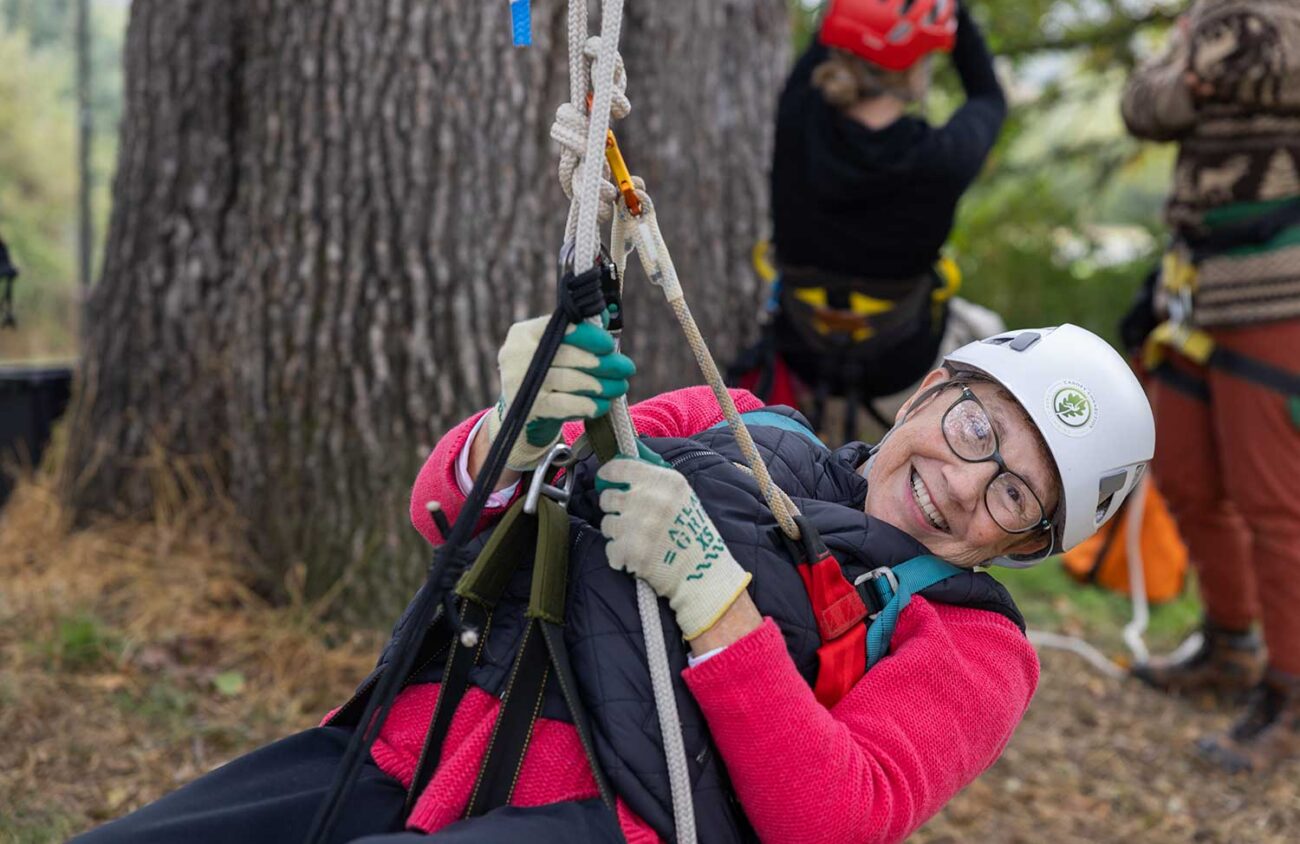
The broad crown of an Oregon white oak stretched into the foggy morning as four people clipped into tree-climbing saddles. Helmets secured, ropes threaded through a pulley system and feet dangling above the ground, the group began its climb.
For members of Oregon Parkinson’s Warriors Foundation, a nonprofit gym and community for Lane County residents with Parkinson’s disease and their caregivers, the Sunday morning climb was an opportunity to try something new.
“It’s nice to be able to get out and do things that you weren’t sure you could really do,” says John Hickey, an OPWF member.
On Sept. 20, Canopy Connections Tree Climbing hosted OPWF members for two climbing sessions. The Portland-based tree climbing organization, founded by Rowan Mitchell, uses climbing as a way to get people outside and connected. Its motto is “A place to be, not a thing to do.”
“Whether it’s a physical or financial barrier, we can find ways to overcome those to create accessibility to the outdoors,” Mitchell says.
OPWF work is rooted in research that suggests movement is the best method for combating the progression of the disease. The group classes and outings are intended to encourage the warriors to find “confidence,” says Lori B. Havas, OPWF founder and executive director.
“The disease is not them,” she says.
Parkinson’s disease is a progressive brain disorder caused when cells that make the chemical dopamine slowly stop working or die. Parksinsons can cause tremors, balance issues and rigidity, along with non-motor symptoms like depression and sleep disturbances. It is often diagnosed in patients in their early 60s, however, it can present earlier in some cases.
Mitchell and his partner, Leah Steindorf, lead a meeting before and after each climb to reflect on what the climb brought to the group.
“There were emotions invoked of feeling empowerment and strength, of being able to do something in spite of other limitations and focusing on their capability rather than inability,” Steindorf says.
The group’s visit was part of Canopy Connections’ work bringing tree climbing to Eugene through a partnership with the city hosted by the River House. Before a climb, a third-party certified ISA arborist inspects the trees and assesses their suitability for climbing. The assessment is submitted to the city before Canopy Connections receives the green light to climb.
Hickey, Eddie Hollis, Kathie Bruscia and Gail Wingard-Gould were among the first group of Parkinson’s Warriors who took to the trees. At times, some of the members struggled with the pulley system and the challenges that come with Parkinson’s, but the group never deterred from getting to the tree top.
For Bruscia, getting there required some adjustments. As she worked her way up the oak, she struggled with the motion of bringing her knees toward her chest to advance the pulley system. She says she found herself leaning farther back than the other climbers. So Mitchell adapted the equipment, adding a chest harness and changing the rigging so Bruscia could eliminate one of the movements. Soon, she was making her way up the oak.
“Having Parkinson’s, there are limits,” Bruscia says. “But I think that it’s important to just go for it. It’s like, why not live your life to the fullest?”
The adjustment was a small example of what the group had come to practice: finding another way forward when the first one didn’t work out.
“Well, I think that we have discovered, in big ways and little ways, just even during class at the gym, that there’s a whole lot more that we can do than we think we can,” Hollis says.
Oregon Parkinson’s Warriors Foundation can be found at 4065 West 11th Avenue Suite 50 and OPWF.org. More information about Canopy Connection Tree Climbing can be found at CanopyConnectionTreeClimbing.com.