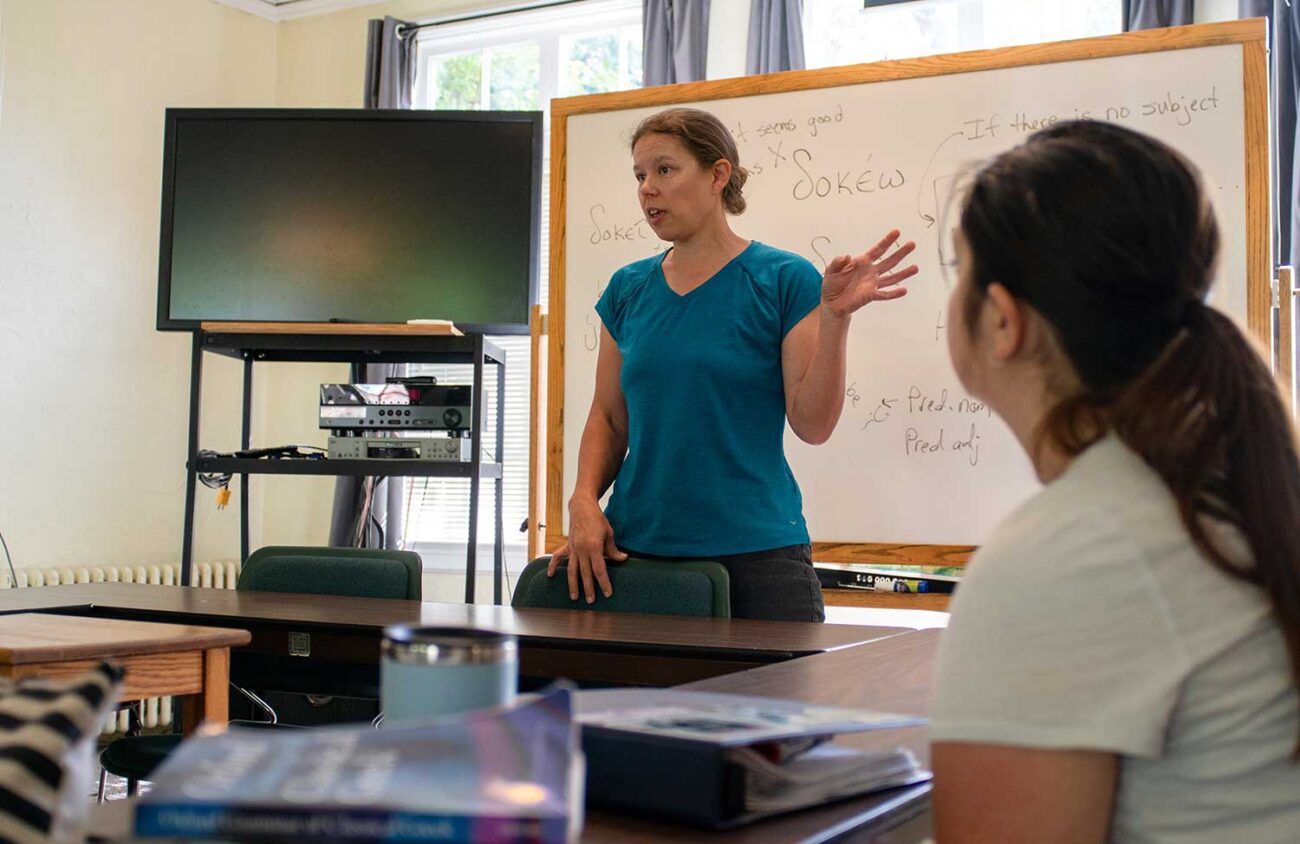
Inside the walls of a former fraternity house on University Street, books are everywhere. Gutenberg College students mingle with the translations of St. Jerome, with the writings of Homer and with the perspectives of their peers. Inside the books, though, they hope to find more questions than answers.
“We are very much interested in understanding and asking questions about Christianity, about truth, about God,” says Chris Swanson, Gutenberg College president.
Questions are the root of a Gutenberg College education. The Christian university does not have majors or more than 20 students at a time. It structures curriculum by the “Great Books,” integrating teachings of the Bible with work of philosophers and stories from ancient history like the Mesopotamian Epic of Gilgamesh and Virgil’s Aeneid. Swanson says there are no off-limit questions, and topics that make Christians and non-Christians uncomfortable alike are encouraged.
The goal, according to Swanson, is to pick at the foundation of beliefs the students were raised on and encourage them to come to their own conclusions. The nontraditional structure limits the number of students interested in getting this type of education, and sufficient enrollment is a yearly struggle. Gutenberg’s recruitment focuses on a growing community of K-12 Christian homeschool movements coming out of states such as Texas and Arizona.
Enrollment is “an existential challenge, really,” Swanson says. “I think the college’s biggest challenge is making the case and finding people who are interested. Are we going to make it or are we not going to make it? Are we going to find students or not?”
In 1979, R. Wesley Heard founded the McKenzie Study Center. It was intended as a residential opportunity for University of Oregon students to think and discuss what they were learning from a Christian perspective. In 1994, the McKenzie Study Center founded Gutenberg College and admitted its first class of four students. Since then, the classes have grown to between 14 and 20 students.
Swanson earned a Ph.D. in physics from the University of Oregon in 2001. “The one question that was never asked is ‘What is science?’” he says. “And yet I was a scientist.”
Swanson took up a full-time position at Gutenberg College in 2004 and became president in 2016.
Molly Pickens is entering her senior year at Gutenberg. Raised Christian in a small town in Oregon, her family followed the Classical Conversations homeschool model, a program that combines traditional homeschooling with Christian themes.
“I thought maybe it would be uppity or philosophy or lots of sweater vests,” Pickens says. “But everybody here is like super deep thinkers. It was the first time I had a discussion that I really got to chew on for a while.”
Gutenberg students get a general overview of Western civilizations in the first two years, then during the second two years, they practice microexegesis, or close reading. It was this past year that Pickens learned about Søren Kierkegaard, a Danish philosopher who left a particular impact on her.
“He talks about the weird paradox of being a human being,” Pickens says. “Part of what he was talking about is not about getting the right answer. It’s about going through the process of learning and being reshaped over and over again with God.”
Pickens says she feels particularly called to the film industry, and wants to “show-not-tell” what her understanding of Christianity is. She says she’s witnessing an overwhelming appeal to science and logic when it comes to Christianity rather than a genuine self-sufficing curiosity to know if it’s real.
She says people of her generation “don’t want to know if God is real. They want to know if he’s good.”
Swanson says Gutenberg alumni have moved on to become business people, doctors, communicators, philosophers and teachers.
Erin Greco met her husband, Gil Greco, at Gutenberg, and both currently work as on-site residence managers at the college. As the residence manager, she is surrounded by students daily, takes part in an evening meal with them five days a week and witnesses their conversations.
All faculty are required to practice Christianity and to believe the Bible is true, though Greco says they intentionally do not place their beliefs on students. Gutenberg teaches the Bible as a foundation, asking what the author is trying to communicate holistically, not picking and choosing what verses serve them.
“If you were to ask each individual person here about their personal thoughts and beliefs regarding politics, you would probably find a spectrum of things,” Greco says.
Swanson identifies as apolitical and says politics are antithetical to the idea of Christianity the college promotes.
“I just don’t think that it’s a very good approach or solution to the problems that we face as a culture,” he says.
When political discussions come up between students, Greco gives her unapologetic beliefs, but says she tries to make space for everyone else to do the same.
“It’s important because the project here is to give these students a place to really explore and come to their own conclusions to learn how to think, not just being told what to think,” Greco says.
Gutenberg College is located at 1883 University Street. Visit Gutenberg.edu for more information.