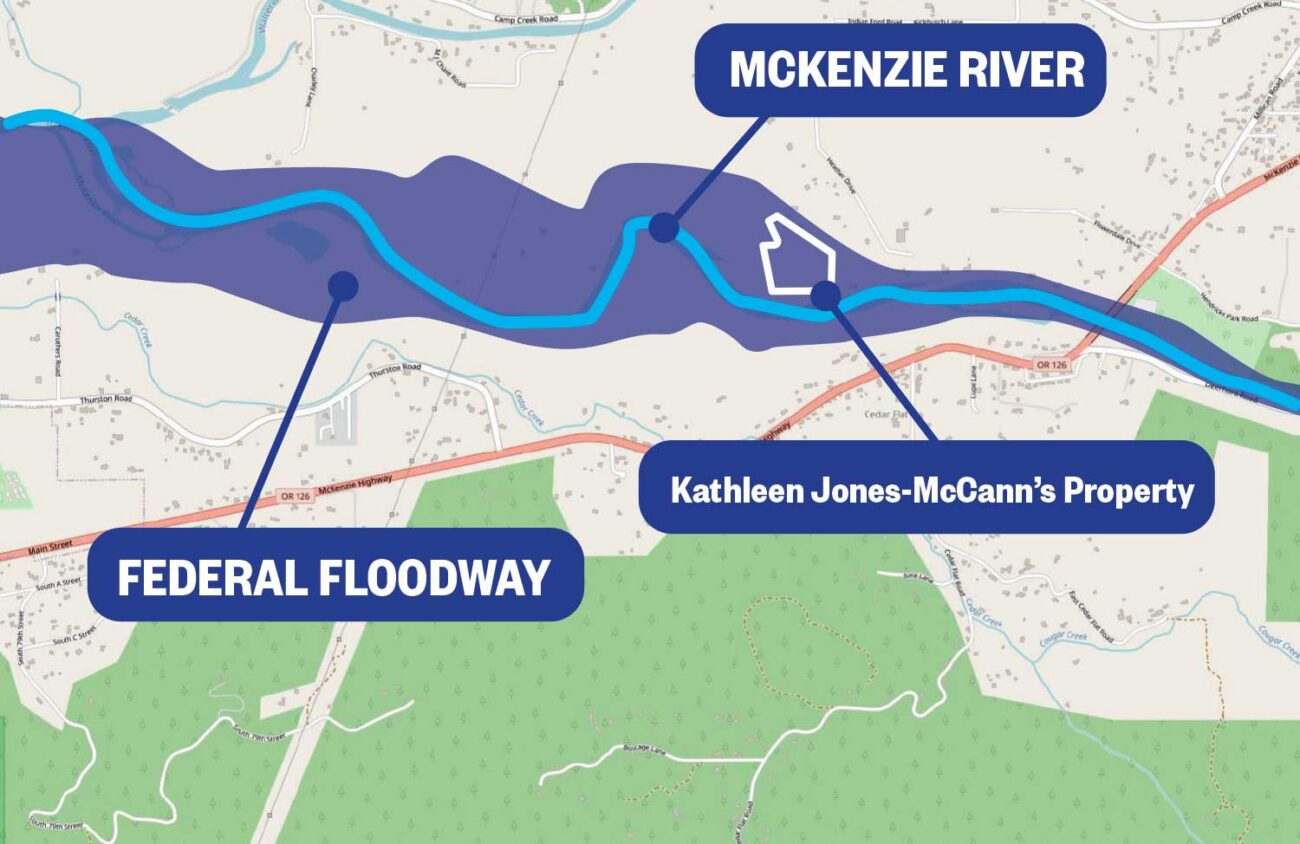
In winter and spring, the surging waters of the McKenzie River are such a hazard that for a quarter of a century Lane County has banned the construction of new homes near the banks, in what are called “floodways.”
These low-lying tracts along the river can be inundated by fast-moving water that may knock down homes and propel the debris downstream, wrecking more homes.
Other local rivers are also flanked by these perilous floodways, all formally mapped by federal and county officials.
But it’s the floodway designation along the McKenzie that is galling to Kathleen Jones-McCann, a timber-empire heir, major financial donor to conservative political candidates in Lane County, self-described “recluse” and up-scale survivalist.
That’s because the entire 28-acre exclusive-farm-use property she owns and lives on next to the McKenzie 1.5 miles east of Springfield is officially designated as a floodway. That includes the spot on her property where, from 2021 to 2022, she covertly built a colossal two-story home, a 5,600-square-foot structure she herself describes as a “monstrosity” and that her own lawyer admits is “illegal.”
Jones-McCann had the construction done with no land-use approvals, no building permits, and, most significantly, no permission to build in the floodway. Floodway permits are separate from land-use approvals. The floodway violation has only recently come into the spotlight as public debate continues over the house.
The county’s prohibition on building new homes in the floodway is stringent. It’s effectively impossible to get a permit for such work.
Yet a majority of the five-member Board of Lane County Commissioners at their meeting this past July 7 was straining at the gate to legalize Jones-McCann’s house in the floodway. Their remarkable solution: They voted to “waive” the floodway code for Jones-McCann, so the construction ban would not apply to her. The trio — commissioners Pat Farr, Ryan Ceniga and David Loveall — carried out the July 7 vote by surprise, with no public advance notice and virtually no discussion, the county’s recording of the meeting shows.
Backing down
It wasn’t until nearly three months later, on Sept. 29, after the three commissioners were pummeled with objections to what they had done, that they backed down and scrapped their bid to waive the floodway code for Jones-McCann.
Before the Sept. 29 board meeting, the county’s own lawyer told the trio they didn’t have the legal power to grant such a “waiver,” and that the lack of public notice meant the waiver vote would likely be invalidated if it was appealed.
In a letter to the county, the state Department of Land Conservation and Development warned that if the county ceases to enforce its own floodway code, the Federal Emergency Management Administration may refuse to renew federally subsidized flood insurance for the 1,589 Lane County households that have this coverage. These homeowners might have to pay up to 25 percent higher premiums to get replacement insurance, the state warned.
At the Sept. 29 meeting, Commissioner Farr — who made the motion at the July 7 meeting to waive the floodway code for Jones-McCann — admitted his “error.” He said he was “bearing the burden” of that. He said he now understands the board didn’t have the authority to waive the code, and that the July 7 vote was “last minute, was not [publicized by formal notice], and it wasn’t thoroughly discussed, vetted,” and that he failed to discuss it with county land-use staff and the county’s lawyer.
Daily fine
It’s now unclear how or if Jones-McCann will satisfy the floodway code. It’s also unclear what the county or FEMA will do if she doesn’t.
Neither she nor her attorney, Micheal Reeder, returned messages from Eugene Weekly.
The county in September 2024 issued Jones-McCann an “order to comply,” noting that her new building violates the floodway code, which carries a fine of up to $2,000 a day. But the county has put the fining process on hold while Jones-McCann contests the restrictions, says Devon Ashbridge, county spokesperson.
The misbegotten “waiver” effort has intensified criticism that Ceniga and Loveall are helping Jones-McCann because earlier this year she gave their re-election campaigns hefty donations — $46,716 to Ceniga and $42,215 to Loveall. The two deny the donations influence their decisions.
Commissioner Heather Buch, who opposed the floodplain rule waiver for Jones-McCann, said the episode may encourage residents to avoid getting permits and instead figure they can “just pay off commissioners after the fact.” Buch did not name any particular commissioner.
For her part, Jones-McCann is furious at the county’s land-use code enforcement staff and at the nonprofit watchdog group LandWatch Lane County, which has opposed her efforts to legalize her house.
“What is going on in Lane County with staff and with LandWatch is abhorrent,” Jones-McCann told commissioners at the July 7 board meeting. It is “absolutely horrific to read lies and fabrications from people who seem to just want to wage a vendetta, and apparently it’s especially against me because I can afford to fight,” she said. She did not identify specific lies or fabrications.
She added that she is paying Reeder a “freaking fortune” to advocate for her.
At the Sept. 29 meeting, Loveall expressed admiration for Jones-McCann: “This is a person of means. It takes a person of means to set precedent and policy for those who don’t have means.”
The commissioners’ gaffe over the floodway rules caps three years of war between Jones-McCann and county land-use staff. The county planning director and a county hearings official last year denied Jones-McCann’s land-use applications to retroactively make the structure legal. The wrangling drew little public attention until a Eugene Weekly article earlier this year, and subsequent coverage by other media.
Election issue
Now, it’s become a campaign issue for the East Lane seat on the county board. Challenger Jake Pelroy — whose campaign is robustly funded by Jones-McCann — seeks to oust incumbent Buch. Jones-McCann, or companies she manages, have donated nearly $108,000 to Pelroy’s campaign — or 20 percent of his total receipts. Pelroy declines to answer Eugene Weekly questions about the money.
The county only found out about the illegal house in 2023, when an irate neighbor reported it. Jones-McCann then applied for land-use permits. But she’s never applied for a floodway development permit.
On land-use issues, the planning director and the county hearings official ruled the house is too close to a so-called Class 1 stream — the McKenzie River — and that it lacks a legally required access road, and that it violates rules protecting deer and elk habitat.
Farr, Ceniga and Loveall at the July 7 meeting rejected those findings and sided with Jones-McCann. They made a final land-use decision, 3-2, on Sept. 29. They ruled the Class 1 stream setbacks don’t apply to the part of the property where Jones-McCann built the new house, because the brackish water body near the house is not part of the McKenzie River; that the county rules requiring an access road are unenforceable because they’ve never been approved by the state; and that the so-called “big-game habitat” development restrictions don’t apply to her property.
But the home’s violation of the floodway code remains unresolved.
No new homes
Numerous homes exist in floodways in Lane County. Most predate the construction ban, which attorney Reeder said commissioners enacted in 2001. Some homes in the floodway are newer than that. They’re replacement dwellings, built after a fire or other calamity destroyed the original building. The floodway code lets a property owner build a replacement if a home is destroyed, but not a new home that isn’t a replacement.
The home Jones-McCann now lives in on her property in the floodway is older, built in 1985, and sits on a 16-acre lot. In 2009, she bought the adjacent vacant 12-acre lot, deeds show. That’s where she built the big new illegal home.
The board public notice for the July 7 hearing listed Jones-McCann’s land-use disputes. It didn’t list the floodway issue.
Reeder, in his oral presentation to the board, slipped it in anyway, asking commissioners to waive the floodway code for her.
The new house sits on land zoned for exclusive farm use. Reeder asserted, without providing evidence, that it cannot be farmed. “It has no economically beneficial use if [Jones-McCann] cannot put a dwelling on it,” he said. The new-home construction ban in the floodway is a “total taking” that violates Jones-McCann’s property rights, he said.
Unmentioned was the fact that, according to FEMA, more than 22,000 local jurisdictions nationwide limit floodway development. Many do this because they want to prevent property owners from building new houses in dangerous spots, and also want homeowners already living in flood-prone areas to qualify for low-cost federally subsidized flood insurance, FEMA says.
Farr, Ceniga and Loveall never asked county counsel to respond to Reeder’s legal claims.
The commissioners’ sudden vote on July 7 left county staff and other observers reeling. FEMA officials heard about it and called the county in alarm, saying it could jeopardize the low-cost federal flood insurance Lane County residents receive. The premiums are low because the county has strict rules on building in flood areas, county staff said.
After the July 7 meeting, LandWatch’s lawyer, Sean Malone, complained to the county that the “waiver” vote had improperly denied the public, including LandWatch, a chance to comment. “This is a procedural error of the highest magnitude,” Malone wrote.
At the Sept. 29 meeting, Keir Miller, manager of the county’s land management division, said he had never seen a case in the county in which an applicant sought to change the county code “to retroactively permit a structure.”
“This situation is quite abnormal,” he told commissioners.
Bricks $ Mortar is a column anchored by Christian Wihtol, who worked as an editor and writer at The Register-Guard in Eugene 1990-2018, much of the time focused on real estate, economic development and business. Reach him at Christian@EugeneWeekly.com.