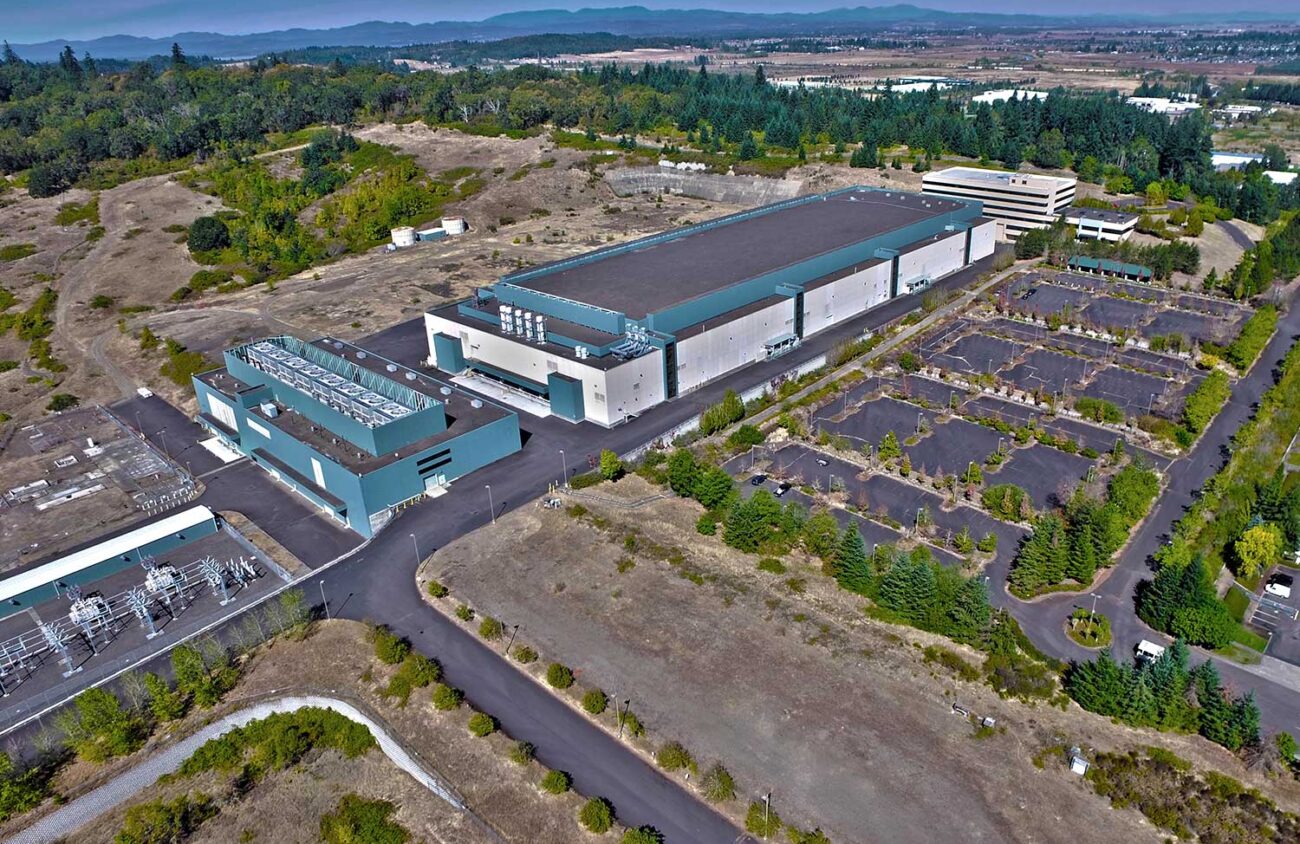
Ohio electronics entrepreneur Chris Riegel had two options for the vacant former Hynix factory he bought in 2020.
The first was for his company, Stratacache, to equip the west Eugene complex with $1 billion of production lines to make micro-LED-chips. Riegel would hire hundreds of employees for chip manufacturing.
If that concept fizzled, his fallback was quickly to sell the property to another user — possibly as a data center, a line of business now much vilified.
This year, both options suddenly evaporated.
Here’s how it happened.
The LED-chip factory dream died in March when the Trump administration rejected Riegel’s request for hundreds of millions of dollars in federal grants to buy equipment, previously undisclosed records reviewed by Eugene Weekly show.
In its rejection letter, the U.S. Commerce Department cited “the project’s uncertain commercial viability.”
Following that, Riegel in May hurriedly tried to sell the 1.2-million-square-foot factory to a buyer who wanted to be guaranteed a massive supply of electricity, the records show. Stratacache had a buyer “ready to close in cash in less than 75 days, that would be the largest power uses [sic] in Lane County history,” Stratacache’s real estate broker wrote to the Eugene Water & Electric Board in May. The records, previously undisclosed, don’t name the buyer. Some sources say it was a data center developer.
However, that buyer’s demand for electricity — 84 megawatts, enough to power about 68,000 homes — was so huge, and Stratacache had provided such scanty information, that EWEB couldn’t begin the research to determine where or if EWEB could get the power, how it would be delivered to the site, and how much it would cost the user, EWEB replied to Stratacache in late May.
EWEB insisted the power request go through EWEB’s and the Bonneville Power Administration’s lengthy formal analysis procedure. So the factory sale never happened.
Then, in a coup de grâce, Eugene city planners in September announced the Hynix property’s “campus employment” zoning barred data centers, because they create so few jobs. Stratacache’s lawyer had asked the city if a data center was allowed.
Stumped at every turn, Riegel this fall put the place publicly up for sale for an undisclosed price.
Now, local economic development officials are marketing it nationally for jobs-intensive manufacturing, including computer chip making.
Lane County’s main economic development agency, Collaborative Economic Development Oregon, “has been fielding real interest from semiconductor and advanced manufacturing companies, which is exactly who this building was designed for,” says Matt Sayre, CEDO’s executive director.
In a brief email exchange with Eugene Weekly, Riegel indicated he has a current potential buyer that is not a data center. He declined further comment.
Idle equipment
Riegel’s businesses, based in Dayton, Ohio, provide hardware, software and tech support for LED retail displays.
Riegel doggedly pursued the Eugene LED factory concept. It cost him millions of dollars, records indicate.
Riegel bought the factory and its adjoining 200 vacant acres in 2020 for $6.3 million.
In 2024, Oregon Business, the state’s economic development agency, awarded him a $19 million grant to buy equipment for a test micro-LED production line at the factory. Last year, he used the whole grant to buy the equipment, state records show.
But he never put the equipment into service, the records show. Earlier this year, he formally terminated the grant contract with the state and, under a formula in the contract, paid back $16.9 million to the state. The state forgave part of the grant because Riegel created about 20 jobs at the plant while he pursued the LED factory idea, state records show. The bottom line for the state: The failed incentive effort in Eugene cost $2.1 million in taxpayer dollars.
It’s unclear what Riegel has done with the unused equipment.
Riegel’s plan had been to gather $1 billion in private investment, loans and federal funds to equip the factory. Getting a grant from the federal high-tech CHIPS Incentives Program was key. “The federal matching funds were a central component of this project’s viability,” Riegel’s lawyer wrote this summer to Oregon Business.
In its denial letter in March, the federal government said the project’s shortcomings included “limited expected contribution to economic and national security.”
As prospects for the Eugene plant abruptly withered, Riegel this year sold some of his Ohio real estate and his retail-display business ventures, news outlets in Dayton report.
Eugene home
But Riegel apparently has not given up on one piece of Eugene real estate: the luxury rural home he bought in 2025, when prospects still seemed bright for the Eugene factory. He bought the home in southwest Eugene for $1.15 million, the deed shows. Earlier this year he deeded it to Stratacache. The 3,000-square-foot home sits on five acres of woodlands and meadow.
The demise of the factory project is a black mark for Eugene’s efforts at cultivating a high-tech industry. The state launched its own CHIPS grant program in 2022. Stratacache is the only Lane County business to win a state CHIPS grant. And it is the only state CHIPS grant that has been officially canceled.
The state made 10 other CHIPS grants, totalling about $170 million, mostly in the Portland metro area. The bulk of the money — $115 million — went to expanding the Intel plant in Hillsboro. Seven of the state CHIPS recipients have created new jobs, Oregon Business says.
An unprecedented volume of proposals for big, electricity-guzzling projects has created a logjam at the BPA, EWEB’s main power source. Since 2024, the BPA has tamped down on new applications while it evaluates how its transmission grid can handle more demand.
In Eugene, any company wanting a large volume of power for a new industrial project must submit a detailed description plus a $75,000 fee, says EWEB spokesman Aaron Orlowski. Stratacache did neither, EWEB says.
“EWEB requested detailed information from Stratacache and their potential buyer about the load service they were requesting, so we could assist as much as possible with securing transmission and power supply. Those parties did not respond to EWEB’s proposed path forward,” Orlowski tells Eugene Weekly.
Sayre, the economic development official, says the Stratacache factory is a “rare asset,” with a tech-manufacturing cleanroom, utilities and process infrastructure in place. “That head start is the whole value proposition,” he says.
Bricks $ Mortar is a column anchored by Christian Wihtol, who worked as an editor and writer at The Register-Guard in Eugene 1990-2018, much of the time focused on real estate, economic development and business. Reach him at Christian@EugeneWeekly.com.