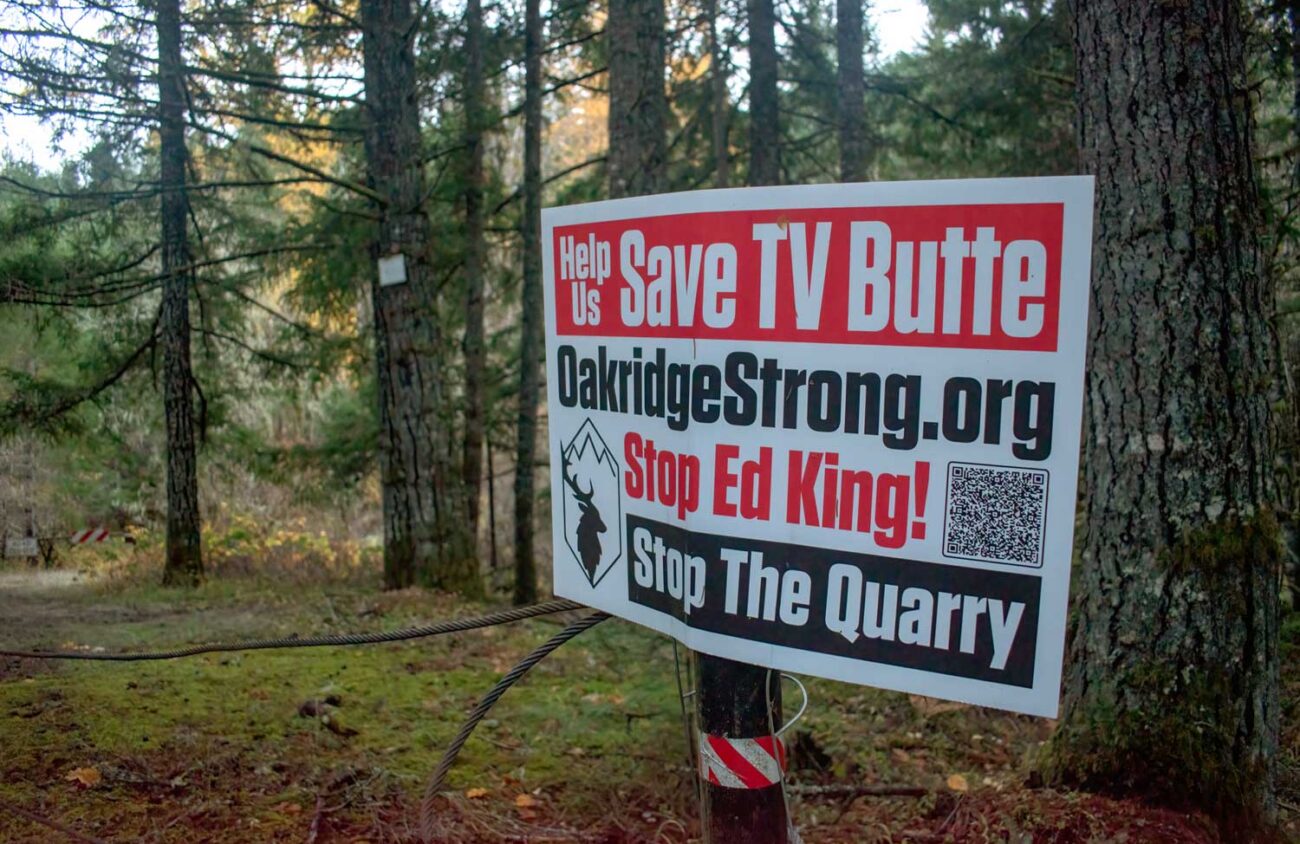
The battle for TV Butte, just outside Oakridge city limits, began in December 2015 when Old Hazeldell Quarry LLC (formerly Stonebroke LLC), a subsidiary of Crown Properties LLC, submitted its first proposal to rezone 107 acres of protected forest land, 46 of which will be used for mining.
Oakridge and the surrounding communities do not want a quarry in their backyard that could potentially cause environmental and health impacts, says Sabrina Ratkowski, executive director of the environmental nonprofit Oakridge Strong and one of the many people who have opposed the mine for the more than 10 years since the quarry’s first application.
On Oct. 15 the Oakridge City Council passed a resolution that would prohibit the use of city resources, like water, to support mining operations on TV Butte. And on Oct. 20, the Lane County Board of Commissioners will hold a public hearing on the proposal — the latest in the yearslong battle.
Bryan Cutchen, Oakridge’s mayor, says he opposes the quarry because of inadequate analysis on its potential impacts on the environment and wildlife, particularly the potential impacts to groundwater resources.
He acknowledges that concerns over noise and dust pollution are equally valid, but says his top concern is currently a former landfill near the proposed quarry and potential water impacts.
Cutchen says that when Oakridge sold the land for the quarry in 2011, the city retained liability on the site. This means if a hazardous material leaks into the groundwater and causes the water supply to become non-drinkable, the city would retain liability. “We could go into court, but those court cases take a long time,” Cutchen says.
Cutchen says that there has been zero communications between the city of Oakridge and the quarry,
Crown Properties is a company of Ed King of King Estate Winery.
In its most recent application, the quarry says it will bring tax revenue to local governments like Oakridge, which has a population of just over 3,000 people. But locals say any financial benefits are inflated and overshadowed by potential impacts on the environment and wildlife.
Su Stella lives on the corner of a dead end road in Oakridge. There, when the weather is nice, she sits on her porch and writes. Each time she looks up, the forested TV Butte stands tall in the sky. Stella says she’s afraid her peace, and the peace that the people of Oakridge enjoy will be disturbed by loud noises, dust pollution and truck traffic.
“I wish he would quit,” Stella says of King. “You know, just be a human, just quit.”
But King hasn’t quit. Instead, Old Hazeldell has pushed back at every roadblock the quarry has encountered.
Throughout the years, Old Hazeldell has gone through numerous rounds of denials, appeals and approvals. The most recent vote was in 2025, when the Lane County commissioners tentatively approved the quarry 3-2, directing staff to draft an ordinance to approve the proposed zoning change.
Right-leaning commissioners Pat Farr, Ryan Ceniga and David Lovell all voted in favor, with Heather Buch — whose district includes Oakridge — and Laurie Trieger voting against. Buch is up for election Nov. 3 against a right-leaning challenger, Jake Pelroy.
In its 2023 application, the quarry estimates that, at full operation, it will extract and transport 500,000 tons of gravel per year through Oakridge, going south on Highway 58. According to the application, this amounts to an average of eight- to nine-roundtrip truckloads every hour, every day. That means at full operation, the quarry could see a total of 86 truck roundtrips in a single day.
Ratkowski says that’s unacceptable. “That’s going to make it harder for tourism. It’s going to make it more dangerous.”
Oakridge is surrounded by national forest, making it a hot spot for tourists, hikers and mountain bikers. Ratkowski says endless trucks, dust pollution and loud noises from the quarry’s rock crusher could dissuade those tourists from stopping in the small town.
In an email to Eugene Weekly Phil Donovan, quarry spokesperson, writes, “Out of respect for the quasi-judicial decision making process, OHQ declines EW’s interview request.”
In its 2023 application, the quarry estimates that it will contribute $137,516 per year in state and local taxes. However, the application states that the quarry will support only 10- to 15-full time equivalent jobs at full production. “That’s not re-booming a whole economy,” Ratkowski says. “That’s saying, ‘Yeah, we’ll provide 10 jobs,’ but we’re not going to promise them to Oakridge.’”
Mick Garvin, longtime environmental activist and owner of the Warner Creek Company, a private forestry service, says he’s doubtful the projected 10 to 15 jobs would add any substantial boost to the Oakridge job market. “They’ve got their truck drivers, and we’re not going to be doing that. They’ve got the people that operate their mining equipment and we wouldn’t be hired for that sort of thing,” he says.
Garvin says he thinks that the best Oakridge locals “could hope for is the task of sitting in a trailer and keeping the site secured from theft or vandalism or whatever.”
Besides jobs and trucks, another issue that concerns locals about the proposed quarry is its proximity to the old landfill formerly referred to as Dunning Road Landfill. According to the Oregon Department of Environmental Quality, the site has the potential to contain hazardous chemical waste from the former Pope and Talbot lumber mill that frequently used the site. The quarry’s application states it will maintain a 25-foot, undisturbed setback from the historic landfill area.
But people like Stella are not convinced. “It’s absolutely horrifying, that’s our drinking water,” she says.
The University of Oregon focused on Oakridge as part of its Sustainable City Year program and the proposed quarry was a topic in several studies. A 2025 independent assessment by students in the UO’s School of Planning, Public Policy, and Management found that placing a rock crusher in close proximity to the historic landfill warrants investigations into the stability of the dump given potential vibrations from mining operations.
Another 2025 study by UO hydrology students looked at Oakridge’s aquifer, the main source of drinking water for the city, and found evidence that suggests that there may be a groundwater interaction between TV Butte and the aquifer.
“If there was an issue with that landfill and it did contaminate our groundwater and our city’s aquifer that everybody uses for drinking water, showering, everything, the city would go bankrupt because of that,” Ratkowski says.
On Oct. 15, the Oakridge City Council voted unanimously to pass Resolution 15-2026, which prohibits the use of city resources, like water, to support mining operations on TV Butte. The quarry’s application states that drilling on site and the review of literature and well logs in the surrounding area indicate that the ground water is “limited in quantity.”
“It feels really good to see the city continue to stand with its citizens and understand the negative consequences that this proposed quarry could have on our community, our citizens and our health,” Ratkowski says.
With the project being tied up in bureaucracy for so long, Garvin says it’s hard to fight the thought that at this point, the King is pushing forward out of spite. “It seems like at a certain point of time you would think you’d cut your losses and find some other purpose for this land,” Garvin says. “I think that right now it has to be at least partially driven because we have pissed Ed King off a lot.”
Ratkowski says even if the commissioners decide to approve the quarry’s rezoning request after the hearing, the people of Oakridge will continue their fight against the quarry. She adds that despite the lack of communication between anti-quarry activists and King, “We’re willing to work with him on something that might be mutually beneficial.”
The Lane County Commissioners do not have a set date to officially vote on the proposed quarry, but Ratkowski says she does not expect a final vote for at least a couple months.