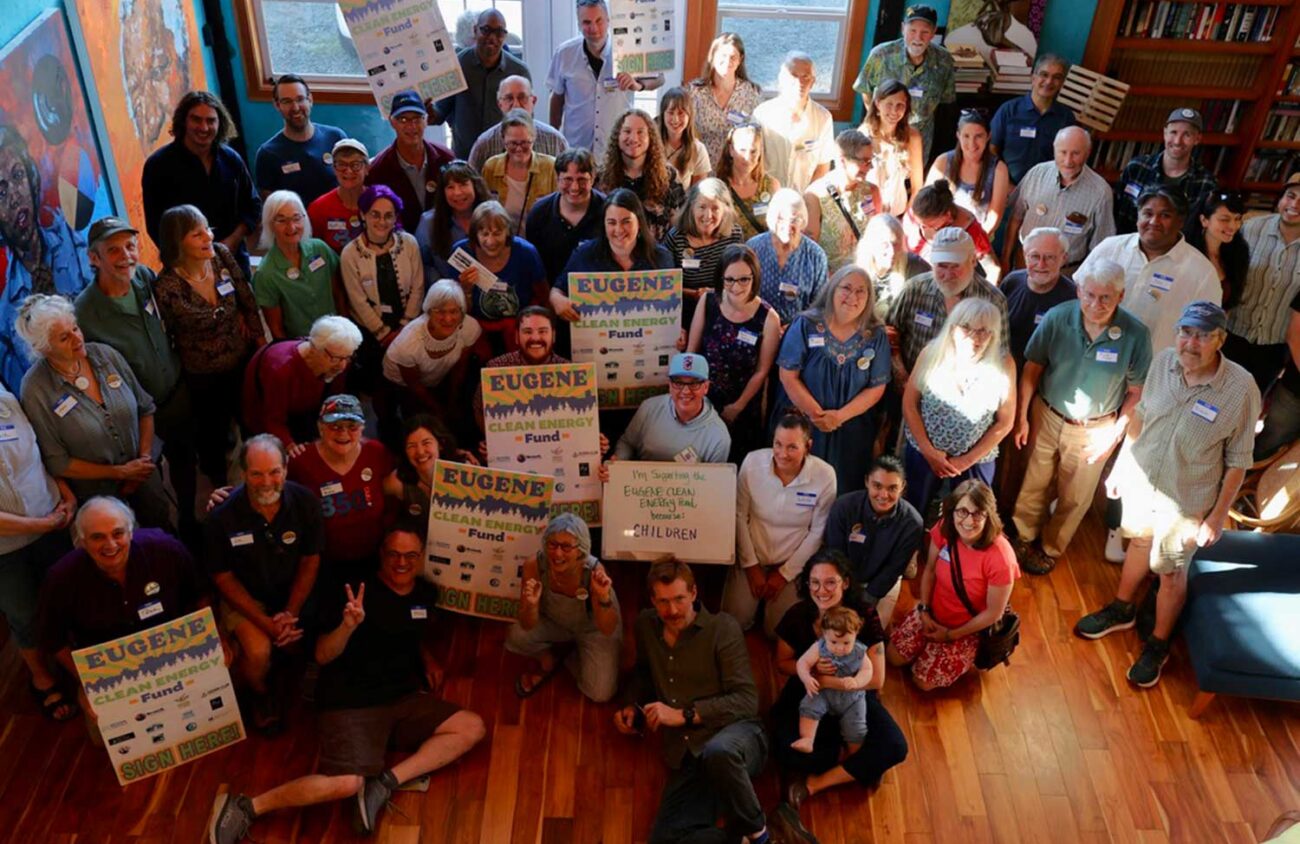
Café Mam, the locally owned Eugene coffee roaster donates 10 cents of every pound of coffee purchased to the farms in Chiapas, Mexico, where the coffee is sourced. The business is endorsing Measure 20-388, the Eugene Clean Energy Fund on the November ballot.
The measure would place a 2 percent business license fee on corporations making over a billion dollars nationally and half a million dollars locally in gross profits, excluding items like grocery and medicine. According to a survey of local businesses by the ECEF steering committee, no Eugene-owned businesses qualify in that threshold.
Joel Iboa, executive director of Oregon Just Transition Alliance and co-chief petitioner for ECEF says that since the Portland Clean Energy Fund (PCEF) passed in 2018, “I think other cities have also had a dream of having a fund that could really benefit local communities.”
Cities such as Denver, Colorado, Ann Arbor, Michigan, and Seattle, Washington, have created their own versions of a clean energy fund to fit the needs of the community. Some have opted for a sales or property tax as opposed to a surcharge on large corporations for funds.
Written into Measure 20-388 is language defining the “Eugene Clean Energy Fund Committee,” a group of nine Eugene residents who will advise the mayor and City Council on allocations. Defined is also how the funds will be allocated to “programs” or “an organized effort by a qualified non-profit organization to achieve greenhouse gas reduction outcomes.”
The majority of the funds would go towards renewable energy efforts and the rest distributed to clean energy job training, green infrastructure programs with 5 percent to future innovation.
According to Jennifer Davis, executive director of Beyond Toxics, the ECEF is an opportunity to meet Eugene’s climate goal of reducing fossil fuel use 50 percent by 2030. And it would support communities like west Eugene, which are disproportionately impacted by air pollution by funding higher efficiency applications. Other long-term projects include community-wide solar power, improved bike paths and tree coverage.
In terms of the 5 percent allocated to future innovation, Iboa says the emerging industries of Oregon are a likely investment, like moving heat pump manufacturing to the state.
The measure is heavily based on the PCEF, which passed with 65 percent of the vote. Racial and economic justice was in the DNA of the Portland measure, as Coalition of Communities of Color, Asian Pacific American Network of Oregon and the NCAAP of Portland were all part of the original coalition and written into PCEF is prioritizing low-income and communities of color.
As of 2026, the PCEF has allocated $1.7 billion to strategic initiatives and community grants, dramatically exceeding expectations. The PCEF called for a 1 percent surcharge while Eugene’s calls for 2 percent. PCEF also taxes gross receipts, or net profits, while ECEF taxes gross profits, or the amount of money a company makes minus the cost of goods sold.
“I think part of what we’re so excited about for ECEF is I think it’s a chance for some true community sovereignty,” Iboa says. “It’s a chance for folks to save themselves by saying, ‘Hey, we’re going to hold these corporations accountable.’”
The opposition, known as Stop the Hidden Tax, has been voiced at Eugene City Club and other discussions by Laura Sedwick, a Eugene-based mom of three and senior Google Cloud delivery manager for Daston Corporation, a Virginia-based IT company. She is longtime friends with Betsy Schultz, grassroots organizer with Stop the Hidden Tax and principal of PNW Strategies, and with Tiffany Edwards, vice president of Policy and Community Development at the Eugene Chamber of Commerce. When Sedwick heard about the tax, she says she felt very angry and offered to share her perspective in interviews.
“I’m not a coordinator, I’m not a political operative, I’m not being paid. I really just had a strong opinion,” Sedwick says.
Stop the Hidden Tax argues the tax on corporations will act as a hidden sales tax on consumers as retailers mark up their items to compensate for the charge. According to a statement by the Northwest Grocery Retail Association featured on the Stop the Hidden Tax website, compensation for the tax could include fewer wages, layoffs or reduced investment.
Under Oregon’s Unlawful Trade Practices Act, hidden or falsely advertised prices are illegal. Retailers are free to add surcharges so long as it is disclosed before customers get to the register.
The Oregonian reported in 2024 that Winco and Safeway paid millions in a class-action lawsuit after adding a surcharge on items in response to the PCEF. The case ruled Winco is required to itemize the tax so consumers are aware of the surcharge.
The ECEF coalition responded to these concerns in a Rebuttal Fact Sheet, saying corporations like Amazon and Walmart set their prices at a national or regional level, and are not adjusting Eugene’s prices to account for the tax.
“Such a [hypothetical] scenario would immediately call into question how well the business is being run locally, and/or whether the business is engaging in tax minimization and avoidance strategies,” the fact sheet says.
After exceeding expectations, the PCEF made headlines this September when it failed to vote on amending the Climate Investment Plan to divert funds to hire 400 more police officers. The city of Portland website lists the PCEF as one of the potential funding sources for green infrastructure renovations of the Moda Center. Critics argued funding these projects would be a diversion from what the original intent is.
“What I don’t like is taking a revenue mechanism and then bypassing education, libraries, roads, homelessness to put it into this bucket,” Sedwick says.
As of Oct. 20, Stop the Hidden Tax received $90,010 in cash contributions. $15,000 from Oregon Business & Industry Issues PAC and an additional $55,000 in-kind contribution. OBI advocates for pro-business legislation and for the private sector’s ability to directly support candidates. $19,000 of cash contributions was from Lift Lane, a political action committee formed by the Eugene Chamber of Commerce. An $18,000 cash expenditure was paid to Rushlight, a campaign production and research agency.
The Eugene Clean Energy Fund has received $292,695.36 in cash contributions and in-kind donations. The Breach Collective gave $121,719.22, which according to Aya Cockram, was the fiscal sponsor of the coalition before joining the steering committee. The Breach Collective money includes an in-kind donation to compensate for her and her colleague’s time. Yes to the Clean Energy Fund, has received $346,780.61 in cash contributions and in-kind donations, including $19,252.50 from The Breach Collective.
According to an Elections Division Investigations Request dated Oct. 20, on Oct. 14, a violation of Oregon elections law was reported when Stop the Hidden Tax failed to report cash contributions corresponding to cash expenditures of $25,000 by the Grocery Retail PAC and $15,000 by the Oregon Bankers PAC. The document says the Secretary of State should investigate the late reports, and issue due fines and penalties.
“Eugene has been a thought leader in so many ways, and I’m just excited that we’re getting on this bandwagon and can hopefully, you know, set an example for other communities to follow around the country,” says Brad Lerch, owner of Café Mam.
See the full list of endorsements and read more about the Eugene Clean Energy Fund at EugeneCleanEnergyFund.org/.