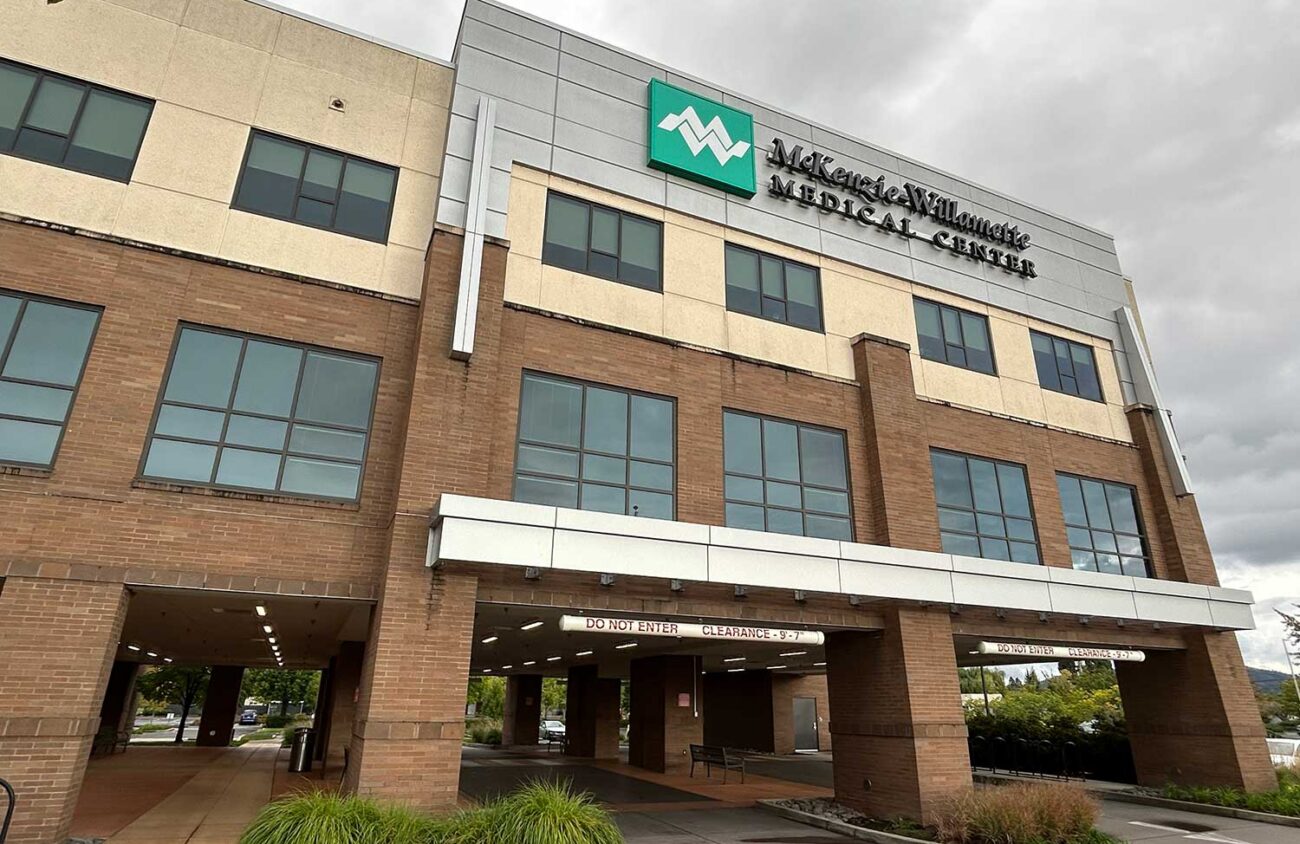
Residents eager to know more about the plan to turn for-profit McKenzie-Willamette Medical Center in Springfield into a non-profit should mark 10:30 am Nov. 3 on their calendars.
Yep, that’s the day of the superheated national election.
And it’s when the newly formed Tennessee-based non-profit QKA/Healthside will hold a federally required public hearing on the hospital conversion deal before the Lane County Board of Commissioners in Harris Hall in the county Public Service Building.
Only skimpy information about the conversion plan has been disclosed to the public. And QKA is not obliged to follow the public’s suggestions.
Still, it’s the official chance for residents to comment on what lies ahead for Lane County’s second-largest hospital.
“We want to be really sure we are giving the community their chance for feedback,” says Commissioner Laurie Trieger. She says she’s concerned about the “long-term viability” of McKenzie-Willamette under the proposed nonprofit structure, and will question QKA and hospital officials at the hearing.
After the hearing, the county board will likely vote on endorsing the conversion plan.
The deal is complex. QKA would borrow $1.259 billion in the bond markets. It would use $957 million of that to buy the for-profit Quorum Health chain of 11 small-to-medium-sized financially ailing hospitals — including, in Oregon, McKenzie-Willamette. Quorum Health is majority-owned by New York private equity company GoldenTree Asset Management.
The deal would saddle the 11 hospitals with heavy bond debt. Observers, including the Oregon Health Authority, question whether the chain could handle the interest payments. But the deal would free the facilities from GoldenTree’s control. GoldenTree has squeezed the chain for money ever since becoming a majority owner of Quorum about five years ago, filings show.
Before it can issue the bonds and take ownership of the hospitals, QKA needs local government approval in each jurisdiction where the hospitals operate. Oregon’s Health Care Market Oversight program has conditionally approved the deal, saying it likely would not worsen McKenzie-Willamette’s services, and might improve them. (For state and county records on the deal, print readers can find this article at EugeneWeekly.com and click on the hot links.)
Many of Quorum’s 11 hospitals are barely breaking even financially on their health-care operations. On top of that, the group is burdened with $957 million in high-interest-rate debt it owes to GoldenTree and other lenders. GoldenTree plays a double role in the drama: It’s a majority equity owner of Quorum, and a major lender to Quorum. GoldenTree has tried to sell the chain, but found no takers.
Quorum’s disclosures to regulators show that in recent years, Quorum and its hospitals have been unable to make the bulk of their interest payments to GoldenTree and other lenders. So, the lenders have tacked the unpaid interest onto the principal — like a mortgage lender might do to a delinquent homeowner.
GoldenTree exit plan
To exit the mess, GoldenTree and other equity owners are offering to relinquish ownership of the chain, provided the hospitals and QKA pay off the $957 million debt the hospitals owe the lenders. As a nonprofit, QKA should be able to issue tax-exempt bonds at annual interest rates lower than the roughly 10 percent or more that GoldenTree and other lenders are charging, the rationale goes. QKA would use the remainder of the $1.259 billion bond money as a cash reserve and to fund hospital improvements, including building a McKenzie-Willamette standalone emergency department in west Eugene, QKA filings say.
Uncertainties abound. Will bond lenders provide QKA the $1.259 billion at acceptable interest rates? Will the hospitals generate enough revenues to cover their operational costs plus annual interest payments on the bonds?
“The viability on paper is one thing, but the long-term viability of this proposal for the community” is another matter, Trieger says. She characterized GoldenTree’s strategy as “corporate maneuvering.”
QKA “will remain highly leveraged,” the Oregon Health Authority cautioned in its analysis. “Whether QKA remains financially viable in the long term will depend in large part on whether it can successfully turn around struggling hospitals, including (McKenzie-Willamette), and build sufficient reserves to reduce its debt load and withstand external financial headwinds.”
The conversion plan amounts to a “fingers crossed” approach, Trieger says.
Piecemeal information
Quorum and regulators have released only piecemeal financial information.
They’ve released Quorum’s financial statements for 2022-2024, which show massive losses, mainly due to interest payments to GoldenTree and other lenders. But they have not released Quorum’s financials for 2025 and this year, so Quorum’s current condition is not publicly known.
Quorum did not reply to Eugene Weekly’s request for up-to-date financials and detailed QKA projections.
No comprehensive financial projections for QKA have been released.
QKA says its annual bond interest payments would be $105 million, which would be $31 million less than Quorum’s current interest payments. Also, QKA, as a nonprofit, would save $13 million a year by not paying property taxes, the filings say. That would hurt Lane County jurisdictions, as McKenzie-Willamette pays $1.7 million a year in property taxes.
Also, Oregon regulators disclosed that QKA will not pay any principal on its bond debt for the first five years. That’s akin to a homeowner being so income-strapped that they take out an interest-only mortgage.
QKA made projections in a 2025 filing with the Internal Revenue Service, asserting that it would post a profit in its first three years, after making bond interest payments. But more recent disclosures contradict those projections. The 2025 IRS filing says QKA would spend $99 million a year on bond interest. But QKA earlier this year said it would be $105 million a year. Plus, in recent months, bond interest rates have risen as inflation accelerates. The impact on QKA is unclear.
State conditions
The Oregon Health Authority’s assessment was somewhat bleak. “Debt payments can be expected to increase significantly after the five-year interest-only period expires,” it said. “Given numerous financial pressures facing U.S. hospitals, such as increasing labor and supply costs, workforce shortages … the financial projections on which the (Quorum/OKA) transaction is predicated may not materialize.”
The state approval set many conditions on McKenzie-Willamette: it must keep a slate of basic services; spend $12 million in 2027 upgrading its medical records system; spend $24 million on the west Eugene emergency department at an unspecified time; and have a local board.
However, the national QKA/Healthside board, not any local board, will make major financial decisions, QKA’s filings show. The national board appears to have been assembled by Quorum officials.
Jim Blake, QKA/Healthside board chairman, didn’t return messages from Eugene Weekly. He is a health care venture capitalist, his bio says.
QKA/Healthside has no assets. It was created to take over Quorum’s 11 hospitals. Quorum’s executive team would become QKA/Healthside’s executive team.
If the conversion to nonprofit does not occur, Quorum “would eventually need to pursue restructuring alternatives,” Quorum told Eugene Weekly last month, without offering specifics.
Bricks $ Mortar is a column anchored by Christian Wihtol, who worked as an editor and writer at The Register-Guard in Eugene 1990-2018, much of the time focused on real estate, economic development and business. Reach him at Christian@EugeneWeekly.com.