Jayleen Kite says she’s lived in an unsanctioned camp in a city-owned Veneta wetland for the past two years. The camp is “safer than Eugene” and has a close-knit community of people trying to make it by, she says. Kite describes herself as “residentially challenged” rather than homeless because, “in my experience, homeless people are entitled, and they have no gratitude.”
“Lot 400” near Jack Kelley Drive in Veneta, 13 miles west of Eugene, has been an unsanctioned camp for more than a decade. Now, the city of Veneta plans to move forward with a wetland restoration project using a nearly $500,000 state grant. The project, not far from Fern Ridge Reservoir, has the potential to displace Kite and the eight to 16 other people she estimates to be living there.
City officials say they’re working in good faith with the local homeless community, and the project’s intended goal is that of environmental protection, rather than the displacement of the homeless. Matt Michel, Veneta city administrator, says work at the site may begin next year, as the rainy season prevents the city from doing work.
Michel says the city still needs to officially delineate what parts of the property are in fact a wetland before starting work, but it cannot move forward until the state signs a contract for the grant. “We’re trying to get that contract signed and hopefully do that delineation before the end of the year,” he says.
The project will be implemented in phases, including the installation of a fence that may surround a large portion of the wetland property, impacting Lot 400 residents’ access to the longstanding site.
Kite says she thinks the city “does what they can” to help the local homeless community, but ultimately, many people still stereotype people experiencing homelessness — making it harder for them to be seen as individuals. She hopes talk of a transitional housing project to relocate those living at Lot 400 will come to fruition before the restoration project begins.
City documents show Veneta came into possession of the 14-acre lot around 2007 during litigation regarding Oregon’s Measure 37, a 2004 measure that required state and local governments to pay landowners or forgo enforcement when land use regulations reduced a property’s fair market value.
This year, the Oregon Department of Land Conservation and Development, the state agency responsible for overseeing statewide land use goals, awarded a $480,100 grant to the city of Veneta to be used for wetland restoration, stormwater management and the preparation of adjacent land for economic development. The city identified Lot 400, as well as a larger portion of wetlands along Jack Kelley Drive, as prime candidates for the restoration project.
According to the Oregon state wildlife action plan, wetlands are habitats that are “inundated or saturated by surface water or ground water at a frequency and duration sufficient to support vegetation typically adapted for life in sodden soil conditions.”
Veneta City Council documents list Lot 400 as having “significant public health and safety concerns” including human waste, discarded needles and illegal structures. Michel says the city does not have the resources to continually enforce camping regulations at the site 24/7, so instead the city takes what he describes as a “live and let live” approach.
“It’s not a place you want to stay for a long time, but people have their stories and their reasons, and we try to respect that as long as they respect the land and each other,” Michel says.
Kite says that while it can be hard living at times due to the camp being within a flood-prone wetland, the benefits outweigh the downsides. “In the rural towns, I have a better chance,” she says. “I’d rather take my chances with bears and cougars that are predictable predators than with male humans that are not.”
She adds that the city does periodically visit the camp to perform clean-ups and the people at the camp try to take care of each other. “You help where you can,” she says. “We manage. Nobody starves down here. Nobody. I refuse to let that happen.”
The city uses a Lane County Sheriff’s Office work crew to conduct its cleanups at the site. Michel says the most recent cleanup cost the city around $1,200.
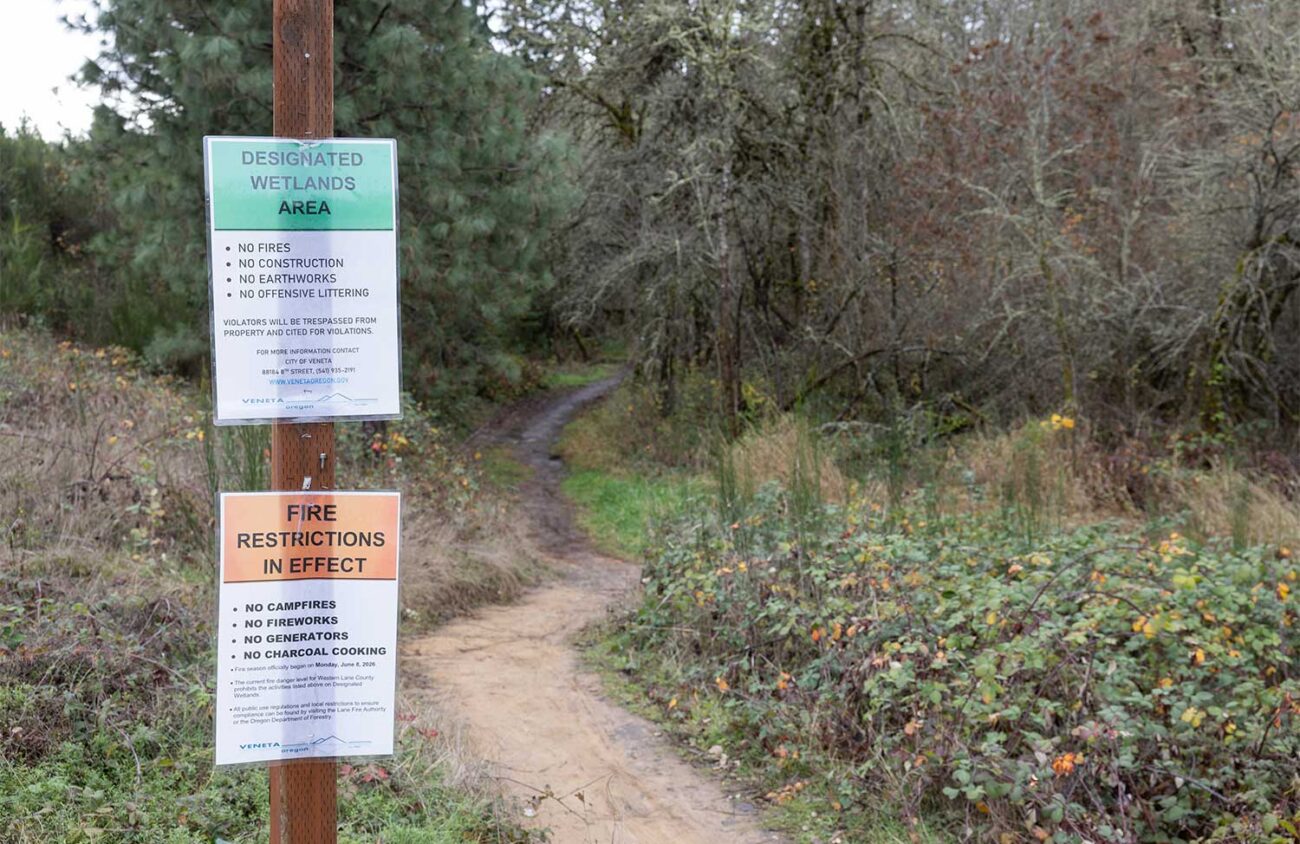
At the entrance to Lot 400, several signs warn campers of the area’s designation as a wetland and encourage them not to start fires, build structures or cause “offensive littering.”
“There’s an oak savanna, a small one, down there that we’re excited about preserving and protecting,” Michel says.
“We view this as a wonderful opportunity to preserve that oak savanna, improve the wetland functioning in that area and improve visibility as you look south as you come through Veneta on Highway 126,” Michel says.
Scientists estimate that about 2 percent of native oak savanna habitat remains in the Willamette Valley compared to presettlement conditions.
DeAnna Townsend, executive director of outreach nonprofit Mid Lane Cares, says she believes the city is acting in good faith by communicating with the local homeless community about its plans for the lot.
“It’s not anybody’s goal to displace anybody from where they’re currently camping at, so there will be some kind of plan in place before the restoration begins,” Townsend says. “Working with the city, they’ve always been very compassionate about everything that they do, so I have faith that something will be in place whether we all get together and partner about it.”
Mid Lane Cares offers various support services for those living in the Fern Ridge area like showers and food. It also supports the Fern Ridge Advocates for the Unhoused Group (FRAUG), which meets every month at the Veneta City Hall.
Michel says the city is considering a transitional housing project in collaboration with Eugene-based Everyone Village to use city-owned property to build shelters for those living homeless in Veneta at Lot 400 and elsewhere. Currently, the city sanctions one three-shelter transitional housing project in collaboration with Fern Ridge Community Services.
“The City Council would need to first consider providing land before taking up consideration of a second transitional housing project,” Michel says.
Michel says the Veneta City Council has not held a public hearing on the process of the wetland restoration because it was not a requirement for the grant.
Townsend says she believes the city is “really good about communicating things that need to be communicated,” but because the project does not directly affect Veneta taxpayers she thinks the project did not need the traditional input process.
Kite says no matter what, she does not want to return to Eugene due to encountering dangerous men while living on the street and experiencing unjust prosecution from the Eugene Police Department.