
Remembering Measure 9
UO prof Henry Alley’s new novel talks Shakespeare, coming out and organizing
by Suzi Steffen
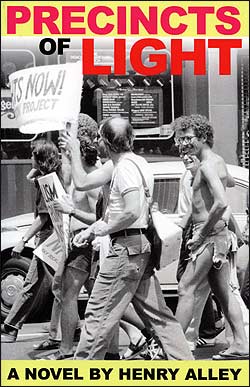 |
Step into Oregon’s recent past with UO professor Henry (Hank) Alley’s new novel, Precincts of Light (Inkwater Press. $22.95). Alley’s multivoiced book centers nominally around Oregon ballot Measure 9, that early 1990s hate-filled attempt to hound LGBT folks out of the state.
The book’s dense prose filters that time through the points of view of several people. Each person — a mother, Eleanor; her two adult children, Harold and Jeanne; her partner, Appleton; and Jeanne’s ex-husband, Samuel, who’s the main antagonist — fits within Alley’s kaledescopic, Shakespeare-filled rendering of the Willamette Valley. Eugene, for instance, is called “Arden,” the green world, and “Capital City” rather obviously serves for an intellectually corrupt Salem.
Perhaps it’s hard to remember now, though not for those who lived through that time in this state, but there was a group called the Oregon Citizens Alliance (called the Oregon Protection Alliance in the novel) that sponsored several anti-LGBT ballot measures throughout the 1990s and the early 2000s.
Measure 9, which was on the 1992 ballot, attempted to add this clause to the Oregon Constitution: “All governments in Oregon may not use their monies or properties to promote, encourage or facilitate homosexuality, pedophilia, sadism or masochism. All levels of government, including public education systems, must assist in setting a standard for Oregon’s youth which recognizes that these behaviors are abnormal, wrong, unnatural and perverse and they are to be discouraged and avoided.”
The measure failed by about 200,000 votes, according to the Oregon Blue Book (http://wkly.ws/l9).
The political turmoil sparked many personal discussions between Oregonians, particularly in families of those who came out in response to the measure. Alley began working on the novel nearly 20 years ago, focusing on one character specifically. Over time, he said in an interview, he realized that his first-person characters needed to change to third-person points of view. “I wrote other books,” he said, “but I kept coming back to this one. I felt a certain amount of commitment to my characters.”
The bad guy of the novel is Samuel Hollingsworth, a professor who has focused time and attention on anything that will earn him money and prestige, who keeps his daughter away from his ex-wife and who secretly funds and helps the Oregon Protection Alliance. But Alley said that he didn’t want only to make Samuel an evil character. “My mentor said, ‘You need to give him a voice.’”
In the “Samuel” portion of the book, Alley portrays a man wounded by his parents’ divorce and trying to get back at his father in whatever way he can find. “He can spot something he feels is beautiful,” Alley said, “but he has to use it to his own ends. He can even take the term ‘diversity’ and use it to his own ends.”
Indeed, much of the book concerns various definitions of and uses for beauty, ranging from Eleanor’s obsessions with collecting various antiques and other objects to Appleton’s love for the forest to Harold’s understanding of male beauty. The clash of ideas — whether coming out and living a full life as a gay man or a lesbian is beautiful or, in the eyes of the Oregon Protection Alliance, an ugly way to destroy families — stands as a background to the entire book, which proceeds chronologically but flashes back in time to previous experiences.
Alley gets so deeply inside his characters’ heads that it can be difficult to sort out what’s happening in the action of the book. The characters, like those of Virginia Woolf or James Joyce, spend more time on their associations and their visual memories than on the urgent scenes unfolding before them.
Coming out, or revealing secrets, pervades the lives of all of the characters. “A lot of them are struggling to bring their inner lives out into the open,” Alley said. “Even Eleanor would rather live in the past, but she’s coming out as a political being.”
The No on 9 campaign galvanized LGBT rights groups in Oregon, including Basic Rights Oregon, but many current Oregonians don’t know about it. “I think it’s important for Oregonians to know about; it’s part of our history and heritage,” Alley said,
The novel “is making a statement about how light can come out of darkness,” he added. “One of the good things that came out of Measure 9 was that closeted people emerged, and people who saw themselves as straight became advocates of lesbian and gay people.”
Henry Alley reads from Precincts of Light at 5 pm Saturday, June 5, at Tsunami Books.