
Did I Like that Movie?
The Skin I Live In is weird as hell
THE SKIN I LIVE IN: Directed by Pedro Almodóvar. Written by Almodóvar and Thierry Jonquet. Cinematography, José Luis Alcaine. Editor, José Salcedo. Music, Alberto Iglesias. Starring Antonio Banderas, Elena Anaya, Roberto Álamo, Marisa Paredes, Jan Cornet. Sony Pictures Classics, 2011. R. 117 minutes. Three and a half strs.
It’s tough to recall a time when reading the word “vaginoplasty” on a screen legitimately made me shudder. Unfortunately, that was probably the desired reaction for Pedro Almodóvar — the acclaimed director, screenwriter and producer of a grip of Spanish films including 2006’s Volver and 2009’s Los Abrazos Rotos — whose most recent work, La Piel que Habito (The Skin I Live In) opens Friday at the Bijou.
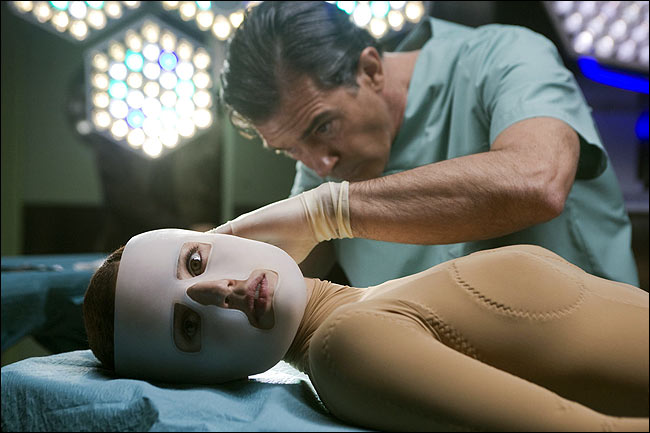
The thriller centers on Dr. Robert Ledgard (Antonio Banderas), a tenured plastic surgeon in Toledo whose wife has died in a fiery car accident. Playing a sort of latter-day Frankenstein, Ledgard attempts to manufacture and apply a fire-resistant synthetic skin to cover a patient’s body. Elena Anaya plays Ledgard’s intriguing patient and new love, Vera Cruz, who seems entirely out of place from the beginning.
Locked in a well-furnished room under constant television surveillance, Vera is the alpha and omega of La Piel que Habito’s twisted, meandering plot. I was forced to ask why she was present — and the fact that the doctor has given her surgery to look just like his wife definitely seemed strange — but it entirely comes down to the way in which Almodóvar tells his stories.
The slow pace of it all makes the suspense build at an undetectable rate. I wish I could say that it leads to some sort of cataclysm, but it really doesn’t. Instead, the story keeps wandering further and further away from what the audience expects of it. Of course, that’s not to say it’s bad; it’s just kind of like being thrown sideways into a river and watching as the shore recedes into the distance. The point is, you’re left with a mystery: “Where the fuck am I being washed away to?”
Visually, the film is striking from beginning to end: It’s violent, beautiful and contains enough sexual imagery to make Sigmund Freud shit a brick. But at the same time there’s an odd lack of depth or dimension to the characters that makes the movie’s midway point a little draggy. It sorts itself out by the end, sort of, but not before a whole lot of long-winded build-up that, quite frankly, could have been omitted.
The acting is perfectly campy at times — a trait of melodrama that should never be forgotten — and there are plenty of dark, comedic moments to keep the anticipation on the rise (case in point: Roberto Álamo’s hulking figure sporting a codpiece with a tiger’s face on it bounding about the house in search of Vera), but again, there’s something empty about it all. In this sense, La Piel que Habito is as stark and flat as it is vibrant and engaging — a strange cocktail of good, bad, ugly and breasts.
There’s no doubt in my mind that every movie buff from here to Barcelona is going to say La Piel que Habito evokes beautiful themes of desire and obsession — themes that juxtapose the creepily tender love story that sits at the film’s heart. And they’d be right, I suppose, but that doesn’t mean we actually need to focus on that kind of twaddle.
At its core, this film is as intriguingly good as any Ernest Hemingway novel, the kind where you can’t put it down but you don’t know why, and that’s what makes it art. I don’t know why, but I have a sneaking suspicion that I liked it.
In any case, I can at least take pleasure in noting that La Piel que Habito is a fairly large step up from Puss in Boots for Antonio Banderas. ew
La Piel que Habito opens Friday, Nov. 18, at the Bijou Art Cinema.