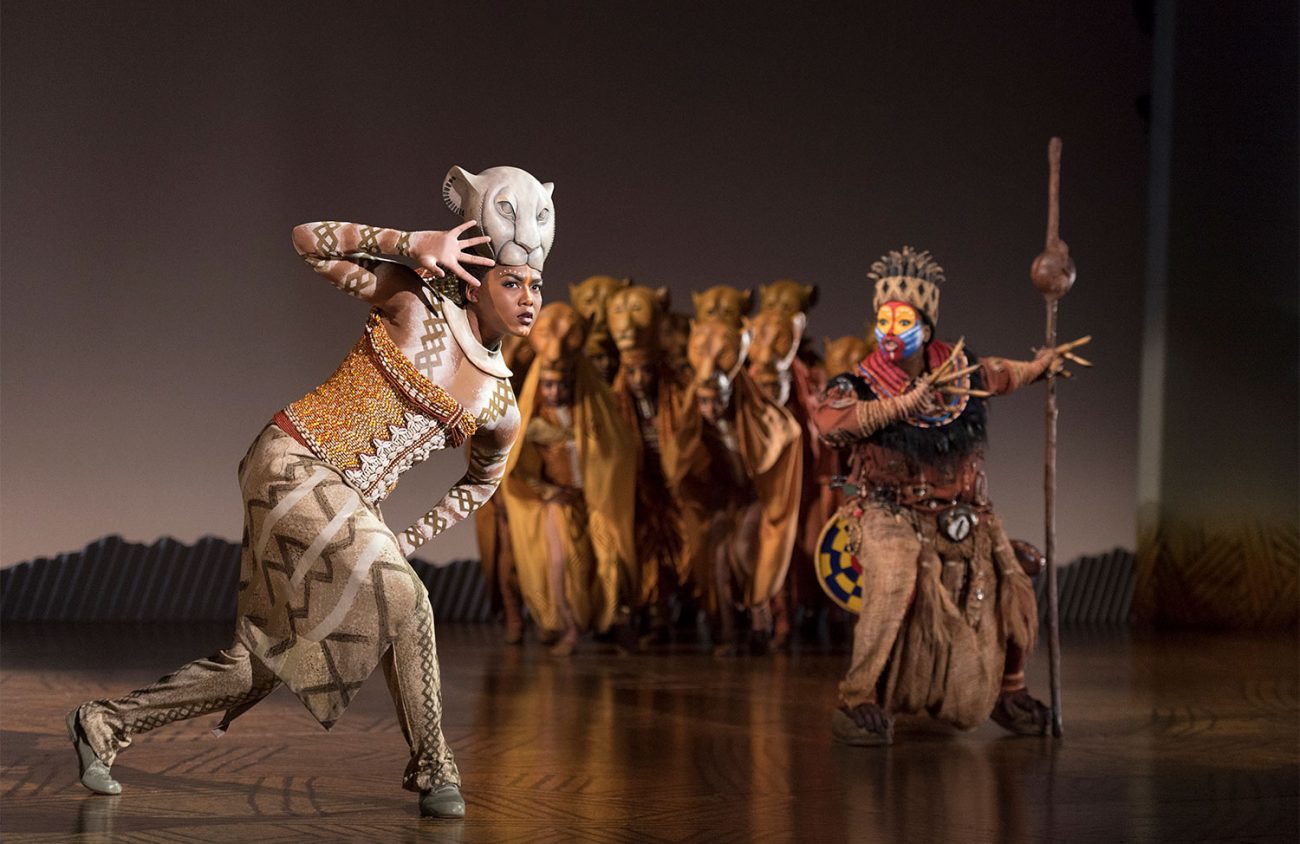
If you’ve seen the Broadway musical The Lion King, then you know that its puppets and masks are some of the most beautiful and complex creations in theater. And if you haven’t seen it and can score some tickets, you are in for a treat.
It would be easy to assume that Michael Curry, the creative mind behind the two-story giraffes, the life-size elephants, the leaping gazelles and the elegant cheetah must have grown up with art.
“I grew up on a faith-healing commune in Grants Pass, Oregon,” Curry says. “We were not exposed to culture. But we were builders and self-reliant people.”
From his studio in Scappoose, Oregon — a tiny community about 30 minutes northwest of Portland — Curry recalls a childhood, minus outside influences, that still afforded creativity.
“My father built his own house,” Curry says. “My grandfather built his own automobile.”
They grew their own food, sewed their own clothes.
And one day, at about age 10, Curry says he started to draw.
“I was what you might call a natural artist,” Curry says. “Self-taught, self-propelled.”
Michael Curry Designs employs 54 full-time artists, currently meeting the collaborative demands of 12 simultaneous worldwide productions. Locally, the company has also done work for Eugene Ballet.
Curry wouldn’t be where he is if it weren’t for one special teacher who recognized his artistic talent and potential.
“My high school ceramics teacher let me draw,” Curry says. She saved his best work, secretly submitting Curry’s portfolio to art schools. When the time came for Curry to graduate in 1976, he had a scholarship to the Pacific Northwest College of Art.
“I started as a sculptor and painter,” Curry says. “My interest in puppetry was born out of trying to find a broader impact for sculpture.”
The Lion King celebrated its 20th anniversary last year, with no signs of stopping.
Curry says it takes 18 months to bring a puppet from idea through creative iterations, “research and development,” and finally to the stage.
“It took 35,000 labor hours to create the 110 characters in The Lion King,” Curry says.
Most of the initial designs for the show were drawn, working with theater-maker Julie Taymor, in just 10 creative days.
Curry recalls that he and Taymor would visit the African Art wing at the Metropolitan Museum of Art in New York, “studying African materiality, ancient art and performance. And then we’d go back to Julie’s loft and draw.”
The costumes, puppets and masks in The Lion King are varied and distinctive, but share a common aesthetic.
“We wanted to do as little as possible to the human, to convey the completeness of the animal,” Curry says.
In the show, human faces are uncovered. Costumes enhance the dance, and Taymor and Curry utilize a variety of global puppeteering traditions to tell this timeless story.
Not bad for a kid from Grants Pass.
Is there anything else he’d like Eugene audiences to know?
“Tell ’em every puppet in the show is built in Scappoose, Oregon,” Curry says proudly.
Catch The Lion King at the Hult Center Wednesday, Jan. 9, to Sunday, Jan. 20. Tickets at HultCenter.org.
A Note From the Publisher

Dear Readers,
The last two years have been some of the hardest in Eugene Weekly’s 43 years. There were moments when keeping the paper alive felt uncertain. And yet, here we are — still publishing, still investigating, still showing up every week.
That’s because of you!
Not just because of financial support (though that matters enormously), but because of the emails, notes, conversations, encouragement and ideas you shared along the way. You reminded us why this paper exists and who it’s for.
Listening to readers has always been at the heart of Eugene Weekly. This year, that meant launching our popular weekly Activist Alert column, after many of you told us there was no single, reliable place to find information about rallies, meetings and ways to get involved. You asked. We responded.
We’ve also continued to deepen the coverage that sets Eugene Weekly apart, including our in-depth reporting on local real estate development through Bricks & Mortar — digging into what’s being built, who’s behind it and how those decisions shape our community.
And, of course, we’ve continued to bring you the stories and features many of you depend on: investigations and local government reporting, arts and culture coverage, sudoku and crossword puzzles, Savage Love, and our extensive community events calendar. We feature award-winning stories by University of Oregon student reporters getting real world journalism experience. All free. In print and online.
None of this happens by accident. It happens because readers step up and say: this matters.
As we head into a new year, please consider supporting Eugene Weekly if you’re able. Every dollar helps keep us digging, questioning, celebrating — and yes, occasionally annoying exactly the right people. We consider that a public service.
Thank you for standing with us!
Publisher
Eugene Weekly
P.S. If you’d like to talk about supporting EW, I’d love to hear from you!
jody@eugeneweekly.com
(541) 484-0519