When a U.S. Air Force B-29 dropped an atomic bomb on Nagasaki on Aug. 9, 1945, killing around 75,000 people and effectively ending the war in the Pacific, Dr. Tatsuichiro Akizuki was less than a mile from the center of the explosion.
But Akizuki, his 20 employees and 70 patients in the Uragami Daiichi hospital didn’t experience radiation sickness. He attributed their tolerance of high levels of radiation to drinking miso soup every day.
After the Chernobyl Nuclear Power Plant disaster in 1986, Europeans bought truckloads of miso from Japan, according to the Japan Federation of Miso Manufactures Cooperative, believing it would reduce their risk of getting cancer. In the 2000s, researcher Hiromatsu Watanabe at Hiroshima University linked eating miso to reduced risks of colon, lung, breast and liver tumors in a population of rats exposed to radiation.
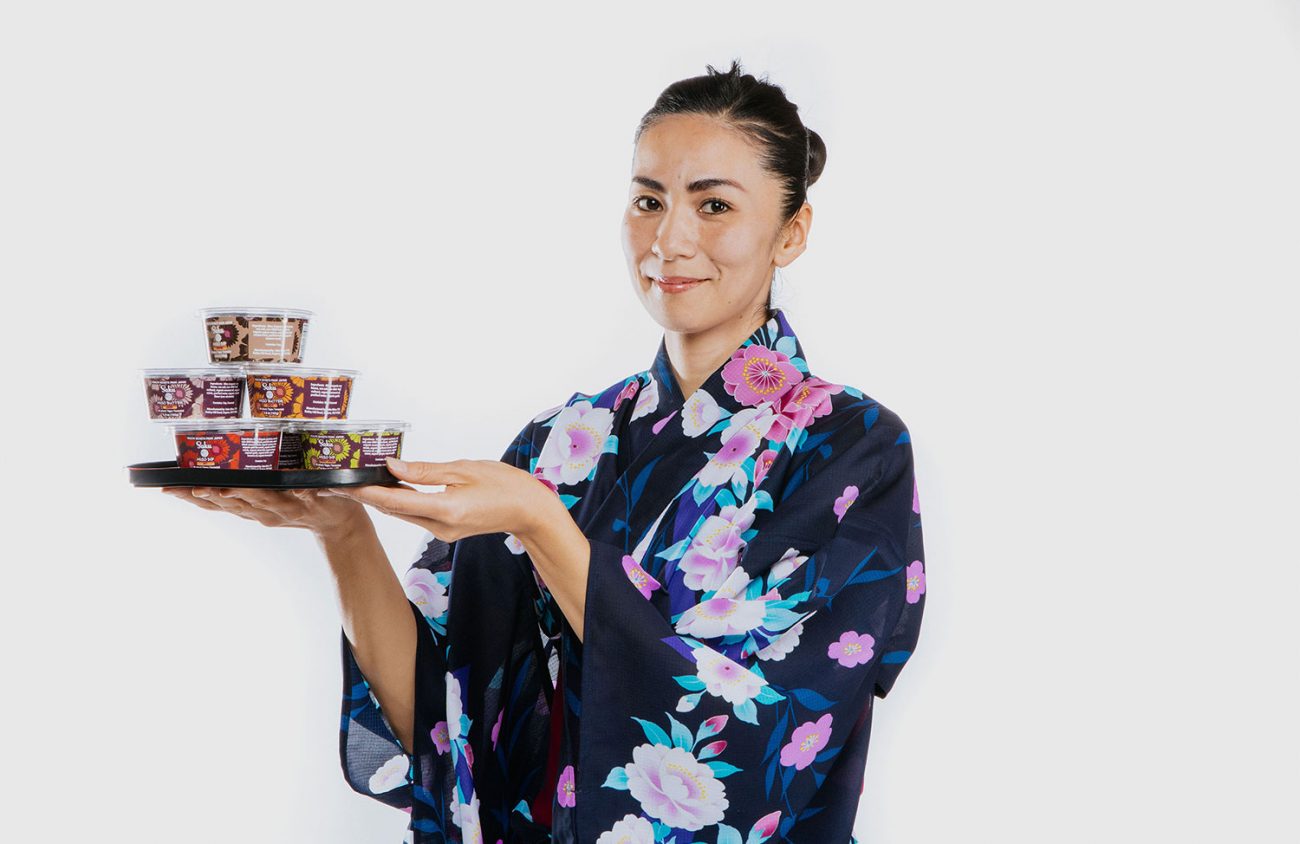
In Eugene, Yuko Smith, the owner of Saku Miso, wants to share the food’s numerous health benefits with Americans. She started selling her miso dips and butters in stores in February.
“I wanted to give people an easy way to eat miso,” she says.
Speaking in a mix of Japanese and English to answer questions, the tall, willowy woman laughs frequently at difficulties in communication.
Smith was born in Kyoto, Japan, and worked as a nurse and nutrition coach there. She moved to Eugene with her American husband three years ago and studied English at Lane Community College. Her plan was to work as a nurse in the U.S. as well. Her Japanese nurse’s license wasn’t valid here, so she decided to start a food business when she finished the English program. Smith comes from a health care background and still works part time as a caregiver, so she wanted her product to be healthy.
Miso is a paste made with soybeans or grains and salt, fermented with the aspergillus oryzae fungus, also known as koji. It’s Japan’s unofficial national fungus, used to make shoyu, sake and the distilled liquor shochu, among other quintessential Japanese foods and drinks.
It also makes miso highly probiotic, as long as you treat it right. Smith says store-bought miso is often mixed with alcohol, which kills the koji. Boiling miso in the process of making soup also cancels its probiotic effects.
“Eating miso raw ensures you get its full probiotic benefit,” she says.
Smith sources her miso from a California company that makes it using traditional techniques, leaving the cultures alive. The ingredients are all organic, except the koji starter, which is made with non-GMO soybeans.
She mixes white, red and black soybean miso to make her products. White miso is fermented for a short period of time. It’s sweet and, Smith says, it’s rich in digestive enzymes like amylase. Red miso is fermented for six months to a year. It tastes sharper, and it’s teeming with live aspergillus oryzae. Black miso is extremely rare, even in Japan. It’s fermented for two to three years and has a deep, complex flavor.
Saku Miso’s dips make eating raw miso easy. They come in spicy, ginger-garlic, teriyaki and coconut flavors. Smith suggests eating them with vegetables or crackers. You can also mix the dips into hot water to make miso soup or ramen broth — just take the water off the heat first to make sure not to kill the koji.
The miso butter, miso mixed with coconut oil, comes in raisin and garlic flavors. Smith suggests spreading the butter on toast.
She says that Saku Miso sales were slow at first because people don’t know much about miso or its health benefits. But when Smith gives out samples in stores, she often sells out. ν
You can buy Saku Miso at The Kiva Grocery, Capella Market, Provisions in 5th Street Market and Market of Choice.
A Note From the Publisher

Dear Readers,
The last two years have been some of the hardest in Eugene Weekly’s 43 years. There were moments when keeping the paper alive felt uncertain. And yet, here we are — still publishing, still investigating, still showing up every week.
That’s because of you!
Not just because of financial support (though that matters enormously), but because of the emails, notes, conversations, encouragement and ideas you shared along the way. You reminded us why this paper exists and who it’s for.
Listening to readers has always been at the heart of Eugene Weekly. This year, that meant launching our popular weekly Activist Alert column, after many of you told us there was no single, reliable place to find information about rallies, meetings and ways to get involved. You asked. We responded.
We’ve also continued to deepen the coverage that sets Eugene Weekly apart, including our in-depth reporting on local real estate development through Bricks & Mortar — digging into what’s being built, who’s behind it and how those decisions shape our community.
And, of course, we’ve continued to bring you the stories and features many of you depend on: investigations and local government reporting, arts and culture coverage, sudoku and crossword puzzles, Savage Love, and our extensive community events calendar. We feature award-winning stories by University of Oregon student reporters getting real world journalism experience. All free. In print and online.
None of this happens by accident. It happens because readers step up and say: this matters.
As we head into a new year, please consider supporting Eugene Weekly if you’re able. Every dollar helps keep us digging, questioning, celebrating — and yes, occasionally annoying exactly the right people. We consider that a public service.
Thank you for standing with us!

Publisher
Eugene Weekly
P.S. If you’d like to talk about supporting EW, I’d love to hear from you!
jody@eugeneweekly.com
(541) 484-0519