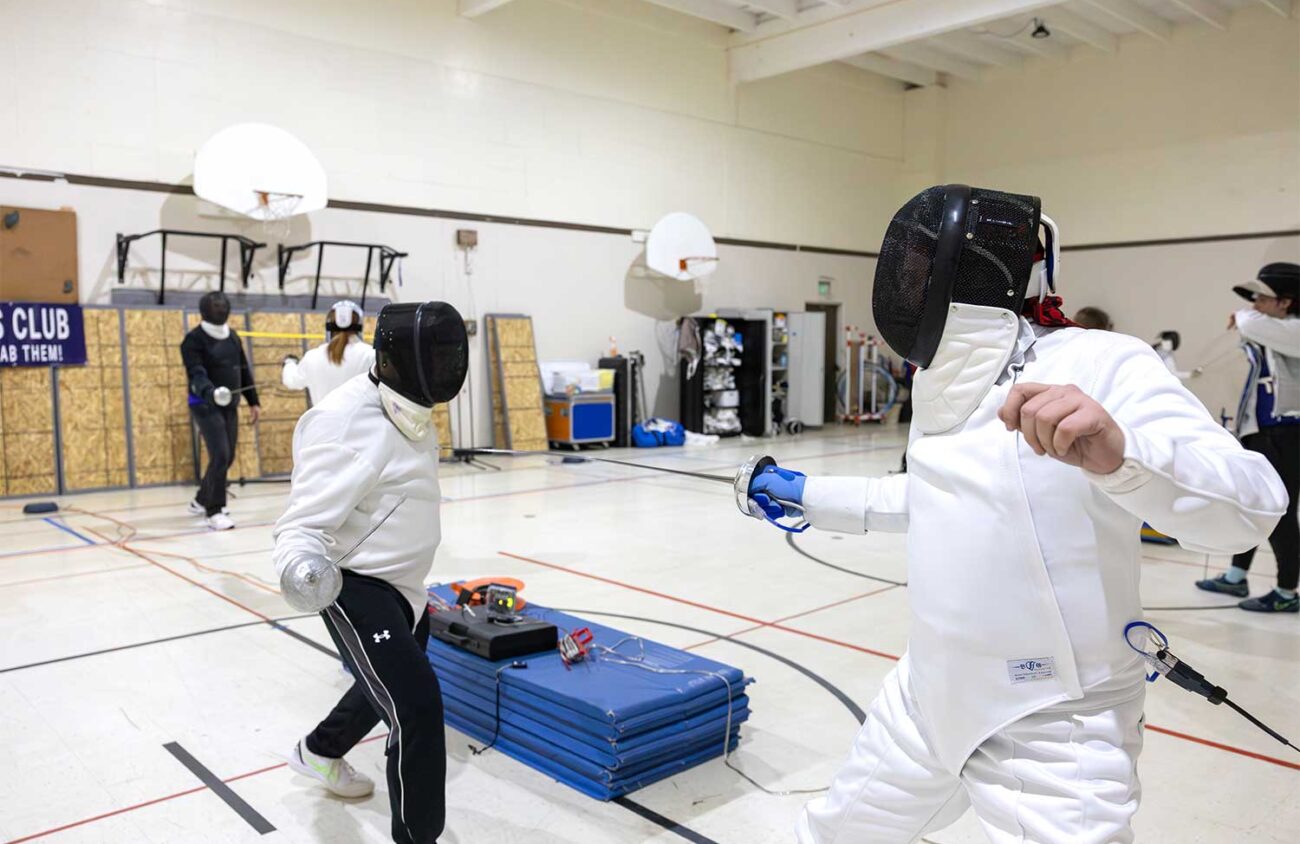
“En garde, ready, fence!” says Mindy Parks, president of the Eugene Fencers Club’s board of directors, as she referees a match. As two fencers fight, their swords clash and buzzers beep inside the small gymnasium of The Village School in south Eugene. Founded in 1976, the Eugene Fencers Club prides itself on making the sport of fencing inclusive, fun and accessible for all.
Lifelong Eugene resident Parks says she started fencing in middle school because she thought, “This seems cool. I like swords, right?” She continued fencing throughout middle school, took a break in high school, then picked it up again in college and “never looked back.” Now, she’s the president of the club. “I was the one who wanted to do it,” Parks says.
Fencing isn’t just hitting someone with a sword, even though it might look like it’s just that. There are three main types of fencing: sabre, foil and épée. Each has its own unique set of rules and techniques. “Foil is the most technical because it has the most rules,” Parks says.
In both foil and épée, the point of the blade must be touched to the opponent to score a point. The manner in which this is achieved varies greatly between the two. Sabre on the other hand, is all about slashing instead of stabbing, but also has complex rules.
Épée has rules that are slightly less complicated. “In épée, everything is a target,” Parks says. That includes the legs, the arms, the head and the chest. If both people hit each other at the same time, they both get the point. “Foil and sabre have what’s called right‑of‑way rules,” club Vice President Jordon Huppert says. “You can only score if you have the right-of-way.”
The right-of-way in fencing determines who receives a point when both fencers land a touch. Priority is given to whoever initiates a correct attack. The other fencer must defend or parry this attack before countering. If both fencers hit each other at the same time, the attacker gets the point if they have a clear priority. Without a clear priority, no point is awarded. If the defender successfully parried the initial attack and hit their opponent, they would receive the point. “I liked the more technical based aspect of foil,” Parks says. “Sabre looked a lot like yelling and slashing.”
Historically, the club was run by Paul McNamara, a longtime fencer. After McNamara encountered some health issues, he left it to coaches John Heberling and Alfred Lara, who created a board of directors. In June 2025, Parks offered to be the president. “We’ve done a lot in the past six months,” Parks says. “We’ve done a few events, we started a new club management software, and I run the social media, doing a lot of the behind-the-scenes work.”
With outreach being a focus, the fencing club has seen an increased interest among the broader Eugene-Springfield area. “We went to Pride this summer and that was a blast,” Parks says.
The club offers classes to all ages. “We’ve had a lot of people go, ‘Oh my gosh. I didn’t know there was a fencing club in Eugene,’ which is funny because the club will be 50 years old next year,” she says.
For some, fencing is regarded as a posh or upper class sport that is generally not inclusive to people with diverse backgrounds. “If you think that’s what fencing has to be, that’s not what we are,” Huppert says. “If you just want to come and learn to fence, it is not prohibitively expensive.”
The club often provides members with the equipment needed to learn and practice fencing at many levels of skill. “We are a group of people from largely diverse backgrounds and populations,” Huppert says. “We’ve got a fairly big age diversity and people within the LGBTQ+ community. Everybody can have a place here.”
Fencing is not a team sport, but is a good alternative for people who’ve tried more traditional sports and didn’t like or succeed at them. “I have said before that it’s a great sport for social anxiety because it’s just you and the other person, and you don’t have to talk to them if you don’t want to,” Parks says.
The fencing club meets every Monday, Tuesday and Thursday. It hosts youth classes, beginner classes, intermediate classes and open fencing days where you can refine your skills. “We are a very welcoming group,” Huppert says. “Sword fighting is way more fun than kicking balls.”
Membership to the Eugene Fencers Club is $70 a month with discounts for additional family members or college students. Annual or six-month membership prices are offered at a discount.