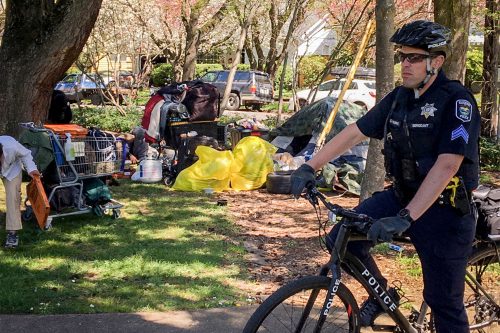
An encampment of unhoused people at West 7th Avenue and Garfield Street was cleared out by Eugene police April 17, after giving 24 hours’ notice. Video taken as the camp was cleared shows Eugene Police Department officers — all without masks and some without gloves — monitoring the clear-out and picking up items as people in the camp quickly packed their belongings.
According to Stop Death on the Streets, a new group dedicated to housing justice in Eugene, this is not the first camp to be cleared since the COVID-19 pandemic hit Lane County. They say it is an escalation of sweeps over the past few weeks in west Eugene.
Guidelines from the Centers for Disease Control and Prevention state that unless people experiencing homelessness can be moved to individual housing units, “do not clear encampments during community spread of COVID-19.” Instead, authorities should encourage social distancing measures and provide hand hygiene materials.
The city of Eugene says its approach is consistent with these guidelines, but Stop Death on the Streets says the city’s approach is not good enough.
Augustine Beard, who has been involved with Stop Death on the Streets for a few months, filmed the clear-out at 7th and Garfield. He’s observed and filmed camps being cleared out before, but this one hit harder, he says, because of the “complete neglect for public safety not only for the unhoused community, but the community as a whole.”
“The first people to interact with people who are living on the streets should not be the police,” Beard says. “They should be social workers and people who are trained to do that.”
The city of Eugene says that its current approach is “intended to control the spread of COVID-19 in our community.” EPD spokesperson Melinda McLaughlin, who responded on behalf of the city as well, confirmed the sweep at 7th and Garfield as well as an earlier sweep at Monroe Park. McLaughlin did not address whether other sweeps had been conducted.
At an April 8 Eugene City Council meeting, City Manager Pro Tem Sarah Medary said neighborhood parks are too small to accommodate both campers and neighborhood residents. “While we’re trying to maintain the health curve, we also can’t have people getting exposed unnecessarily there, either,” she said.
City Councilor Claire Syrett supported Medary’s stance, saying that the parks “really need to be reserved for folks in those neighborhoods to use for getting outside and getting some of the green space activity that they need.”
McLaughlin says Eugene is prioritizing strategies that “reduce the need for people to travel” to meet their basic needs, such as supporting the distribution site at the White Bird Clinic, where people can pick up supplies and get basic medical screenings, and creating temporary shelter sites.
She adds that that encampments are being accommodated “as long as it is being done safely and doesn’t become a private property trespass, constitute criminal behavior, or pose a significant health and safety issue that outweighs the need for the individuals to stay in that place.” Health and safety issues were why the camps at 7th and Garfield and Monroe Park were cleared, she says.
“If it is necessary for city of Eugene staff to engage in camping enforcement due to the above factors, we have a team in place to coordinate this,” McLaughlin continues.
Beard says the people he observed were sheltering in place and practicing social distancing “pretty effectively.”
“This was the safe place for people to be,” Beard says, “and I think people would stay there deliberately for that reason, I think the unhoused community has the whole community’s public safety in mind, and when they choose to set up a site, they were thinking about their safety and other people’s safety.”
McLaughlin says EPD has been briefed on social distancing and the officers practice it as much as they are able. Officers have been given N95 masks, but to conserve them, officers are not required to use the masks, instead recommending they use them only when interacting with someone known to have COVID-19 or with known symptoms of the virus.
No EPD officers have tested positive for COVID-19, McLaughlin says. High-risk exposure to COVID-19 is considered prolonged contact within six feet of someone, she says. “By this definition, the vast majority of contacts both inside and outside the department are considered low risk.”
Beard says that while the officers he observed did appear to care about social distancing, they did not always practice it when interacting with campers.
McLaughlin says Eugene city employees may recommend that people move to designated shelter sites. However, both the permanent and temporary emergency shelters in Eugene are “mostly full, most of the time,” says Erin Grady, who is also involved with Stop Death on the Streets.
The city has opened three temporary shelters in the parking lots of the Amazon, Peterson Barn and Hilyard community centers where people can camp in tents or vehicles. These sites are operated by White Bird Clinic and Carry It Forward, according to the city’s website, and are by referral only. People can be referred from the White Bird distribution site at 341 E. 12th Avenue, which is open daily from 9 am to 5 pm.
Instead, Grady and Beard say, people experiencing homelessness should be allowed to stay in empty apartments or hotel rooms — or left alone.
“We are all only as safe as our most vulnerable, who are not safe,” Grady says.
A Note From the Publisher

Dear Readers,
The last two years have been some of the hardest in Eugene Weekly’s 43 years. There were moments when keeping the paper alive felt uncertain. And yet, here we are — still publishing, still investigating, still showing up every week.
That’s because of you!
Not just because of financial support (though that matters enormously), but because of the emails, notes, conversations, encouragement and ideas you shared along the way. You reminded us why this paper exists and who it’s for.
Listening to readers has always been at the heart of Eugene Weekly. This year, that meant launching our popular weekly Activist Alert column, after many of you told us there was no single, reliable place to find information about rallies, meetings and ways to get involved. You asked. We responded.
We’ve also continued to deepen the coverage that sets Eugene Weekly apart, including our in-depth reporting on local real estate development through Bricks & Mortar — digging into what’s being built, who’s behind it and how those decisions shape our community.
And, of course, we’ve continued to bring you the stories and features many of you depend on: investigations and local government reporting, arts and culture coverage, sudoku and crossword puzzles, Savage Love, and our extensive community events calendar. We feature award-winning stories by University of Oregon student reporters getting real world journalism experience. All free. In print and online.
None of this happens by accident. It happens because readers step up and say: this matters.
As we head into a new year, please consider supporting Eugene Weekly if you’re able. Every dollar helps keep us digging, questioning, celebrating — and yes, occasionally annoying exactly the right people. We consider that a public service.
Thank you for standing with us!

Publisher
Eugene Weekly
P.S. If you’d like to talk about supporting EW, I’d love to hear from you!
jody@eugeneweekly.com
(541) 484-0519