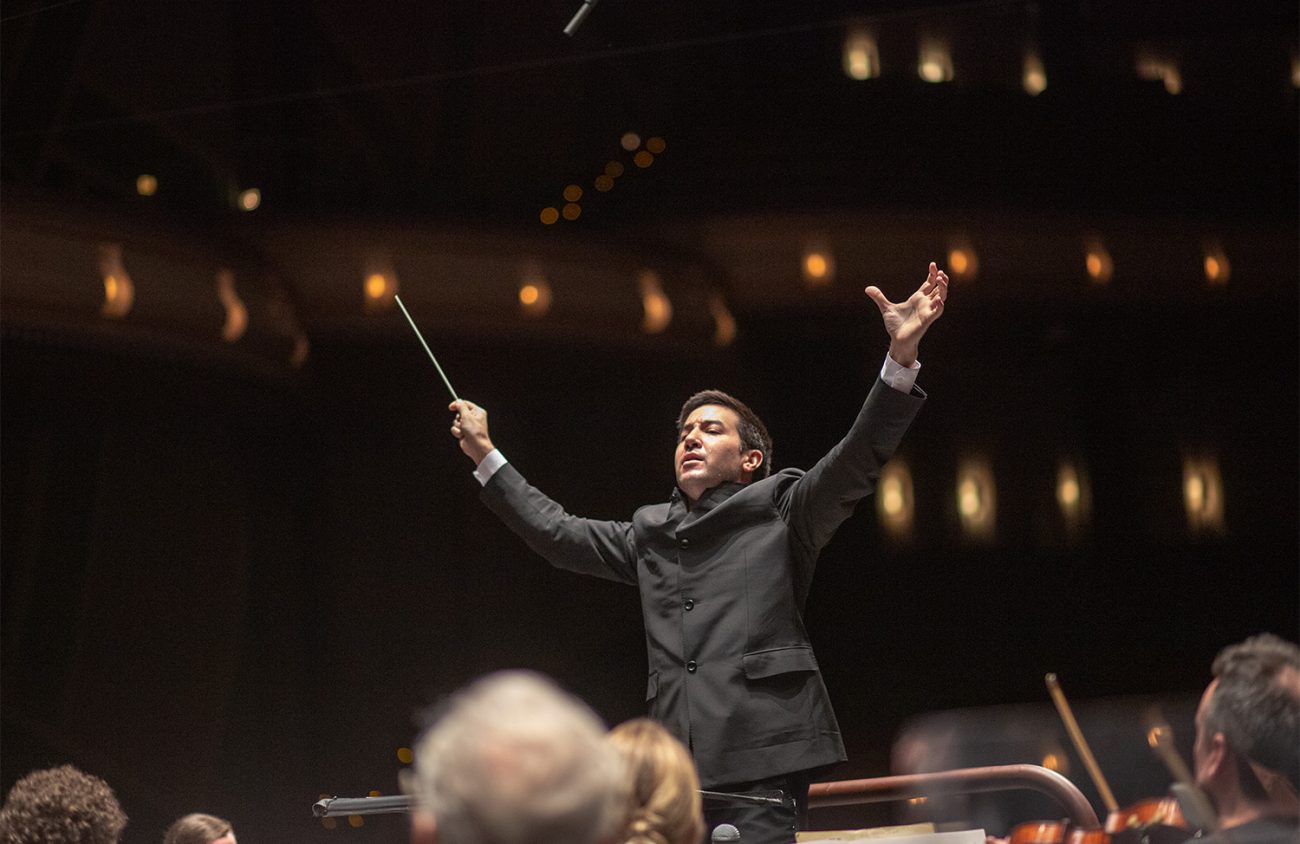
From the strains of “Here Comes the Bride” to Bugs Bunny in operatic costume riding on a white horse singing in “What’s Opera, Doc,” to the phrase “It ain’t over ‘til the fat lady sings,” Richard Wagner’s work is embedded in Western society.
In addition to performing concerts that were postponed and other works, the Eugene Symphony’s 2021-22 season features the German composer’s influential opera Tristan und Isolde. Eugene Symphony’s Director and Conductor Francesco Lecce-Chong says the three-year plan to play one act a year is likely the largest project the organization has ever undertaken. Lecce-Chong says they plan to deconstruct the opera so audiences can appreciate the work, as well as address the composer’s problematic history.
“The idea of this project is taking this work that quite possibly is the most influential piece of Western art,” he says. “If you think about the breadth of what it inspired, from philosophy, literature, stage engineering, not to mention the music that changed everything, this work is really a pivot point in the history of Western art.”
Originally planned to be performed in the 2020-21 season, Tristan und Isolde is a three-act opera based on a medieval romantic story filled with tragedy, love and death. One of the legacies the opera impressed upon Western music is what’s called the “Tristan chord,” a dissonant chord that led to another dissonant chord, a big deal in Wagner’s time when a dissonant chord would normally lead to something harmonically pleasant.
Funded partially by the Hult Center endowment and dipping into revenue from individual patrons, Lecce-Chong says the last time Tristan und Isolde was performed in Oregon was 50 years ago. The concert is drawn out over three years because expecting an audience to sit still and pay attention to a five-hour performance is a big ask, Lecce-Chong says. “Even with me as an avid fan, it’s hard to pay attention,” he adds.
Each act of Tristan und Isolde is about 75 minutes long but can stand alone, Lecce-Chong says. So performing one a year for three years is a way to introduce some of the opera’s leitmotifs (a short musical phrase tied to a person, place or idea), as well as some of the philosophies behind the work and talk about the influence it’s had on Western music.
“My hope is really to give people — and really myself — a chance to appreciate this piece in detail,” he adds. “Otherwise, people don’t have a chance to hear it be performed at all, much less a way to dig into the music and talk about why this piece has had an influence on how we think today and approach the arts.”
Of course, Wagner’s history is complicated. From Wagner’s music being played at Nazi Germany’s concentration camps to the composer himself being anti-semitic, Lecce-Chong sums him up as being the last composer he’d want to have a beer with.
“His own family despised him. He was just a horrible human being,” Lecce-Chong says. “He was so angry and resentful and so insecure about everything. And thank God he was wrong about everything outside of music.”
But, Lecce-Chong says, Wagner’s work has been a huge influence on figures, such as Theodor Herzl, regarded as the father of modern day Israel, to Gustav Mahler, composer and conductor who overcame anti-Semitism from music critics and is seen as one of the greatest interpreters of Wagner’s music. What’s beautiful about Wagner’s work, Lecce-Chong says, is that his work transcended his “tiny, narrow vision of the world.” And Lecce-Chong likes to tell the story of the composer’s controversial past.
“People want to believe the world is black and white, and this is the story that can transcend it,” Lecce-Chong says. “This is the kind of story we need right now.”
Tristan und Isolde Act I is April 21, 2022. Visit EugeneSymphony.Org for more information on future concerts in the 2021-22 season.
A Note From the Publisher

Dear Readers,
The last two years have been some of the hardest in Eugene Weekly’s 43 years. There were moments when keeping the paper alive felt uncertain. And yet, here we are — still publishing, still investigating, still showing up every week.
That’s because of you!
Not just because of financial support (though that matters enormously), but because of the emails, notes, conversations, encouragement and ideas you shared along the way. You reminded us why this paper exists and who it’s for.
Listening to readers has always been at the heart of Eugene Weekly. This year, that meant launching our popular weekly Activist Alert column, after many of you told us there was no single, reliable place to find information about rallies, meetings and ways to get involved. You asked. We responded.
We’ve also continued to deepen the coverage that sets Eugene Weekly apart, including our in-depth reporting on local real estate development through Bricks & Mortar — digging into what’s being built, who’s behind it and how those decisions shape our community.
And, of course, we’ve continued to bring you the stories and features many of you depend on: investigations and local government reporting, arts and culture coverage, sudoku and crossword puzzles, Savage Love, and our extensive community events calendar. We feature award-winning stories by University of Oregon student reporters getting real world journalism experience. All free. In print and online.
None of this happens by accident. It happens because readers step up and say: this matters.
As we head into a new year, please consider supporting Eugene Weekly if you’re able. Every dollar helps keep us digging, questioning, celebrating — and yes, occasionally annoying exactly the right people. We consider that a public service.
Thank you for standing with us!
Publisher
Eugene Weekly
P.S. If you’d like to talk about supporting EW, I’d love to hear from you!
jody@eugeneweekly.com
(541) 484-0519