
MOVIE REVIEW ARCHIVE | THEATER INFO | MOVIE LISTINGS
Oil Change
The case against Chevron in Ecuador
by Jason Blair
CRUDE: Directed by Joe Berlinger. Cinematography, Pocho Alvarez, Michael Bonfiglio, Juan David Pérez and Berlinger. Music, Wendy Blackstone. First Run Features, 2009. Unrated. 105 minutes. 
 |
Watching Crude, the engrossing documentary by Joe Berlinger (Brother’s Keeper, Metallica: Some Kind of Monster), my thoughts went regularly to Michael Moore. Moore, with his bull-in-a-china-shop technique, is documentary cinema’s loudest yeller, whereas Berlinger understands that few stories, if any, can’t benefit from careful observation. Crude is a classic David and Goliath story — one in which a petroleum company flagrantly and systematically poisons the native tribes of Ecuador — yet the film resounds with understatement. Berlinger is an adherent of the “direct cinema” tradition, in which the filmmaker remains unobtrusive and observational, rather than provocative or influential. It’s an approach that allows the most one-dimensional stories to steep so as to better take their flavor. This includes the case of Texaco-Chevron’s contamination of Ecuador, a legacy commonly referred to as the “Amazon Chernobyl.”
The heart of Crude is Pablo Fajardo, a former oil field employee who became a lawyer after witnessing the devastation in his industry. Gentle and youthful despite long hours and repeated setbacks in the case — filed as Aguinda v. Texaco in 1993 — his is outlook almost childlike. His logic is serene in its defiance: “I know I always tell the truth, and if I have to die for it, then I will with pleasure.” His mentor and translator is Steven Donziger, an American lawyer who’s billed as a consultant but who excels at PR and occasionally bullying the opposition. I won’t soon forget Donziger confronting a Texaco lawyer in a cramped office, the men’s fingers lodged in each others’ faces, each calling the other corrupt. The old joke about what to call 100 lawyers at the bottom of the sea (“A good idea”) seems feeble and naïve after watching Crude.
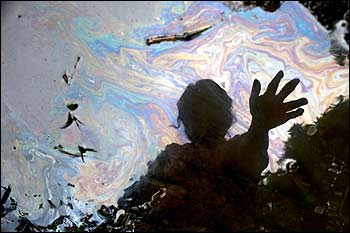
The film is structured around two lines of action, the court proceeding in Ecuador and the efforts by Fajardo and Donziger to raise interest in their case worldwide. Ecuardorian law being somewhat provincial, it’s the court case that packs the most drama, given that legal proceedings are conducted outdoors where the public can assemble and watch. Berlinger is so effective not because he’s unbiased or objective; strictly speaking, he’s neither. While he allows the Chevron lawyers and scientists to make their case, Berlinger has perfected what I’d call the “subtle repudiation” shot. In one example, after Chevron’s chief scientist claims there’s “absolutely no evidence” of elevated health risks in the region, we cut to the court proceedings, where a core sample resembling a chunk of asphalt is pulled from the mucky ground. In another example, the same scientist explains that the full-body rashes, which afflict local infants almost universally, are due to “fecal matter” in the river, after which Berlinger cuts to a petroleum rainbow floating through a kids’ swimming hole.
Berlinger’s techniques give Crude the quality of a thriller, with all the investigative prowess of traditional journalism. He’s as patient as a novelist in his approach to this material, even the material that makes your stomach turn, like the poisoned chickens, a duck in its death throes or the deformed faces of children. Eventually, there’s a bit a good news, including a long Vanity Fair article and some interest by Sting’s wife, Trudie Styler, a founder of Rainforest Foundation. But the case is still mired in legal muck, if you will, with no happy ending in sight.
Crude opens Friday, Feb. 19, at the Bijou. Steven Donziger speaks at the Public Interest Environmental Law Conference at 7 pm Thursday, Feb. 25, in the UO’s EMU Ballroom. For more on Fajardo’s fight with Chevron, see EW‘s 8/13/09 cover story.