
MOVIE REVIEW ARCHIVE | THEATER INFO | MOVIE LISTINGS
The Rock
Fantasy Island this isn’t
by Jason Blair
SHUTTER ISLAND: Directed by Martin Scorsese. Written by Laeta Kalogridis, based upon the novel by Dennis Lehane. Cinematography, Robert Richardson. Music, Robbie Robertson. Starring Leonardo DiCaprio, Ben Kingsley, Mark Ruffalo, Michelle Williams, Patricia Clarkson, Emily Mortimer and Max von Sydow. Paramount Pictures, 2009. R. 138 minutes. 
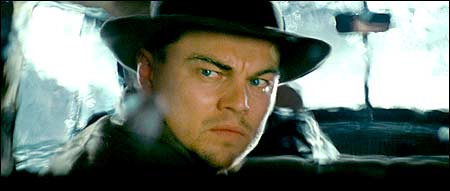 |
With great swipes of heavy cello music, the brooding, frightening Shutter Island opens aboard a ferry sluicing through the fog. Aboard the vessel are Teddy Daniels (Leonardo DiCaprio), a federal marshal, and his new partner Chuck Aule (Mark Ruffalo). Their destination is Shutter Island in the Boston harbor. This being 1954, they’re hooded in fedoras and unable to communicate without cigarettes; this being a psychological thriller, you sense Teddy is the haunted type. Think Jacob’s Ladder meets Vertigo, and you start to get an idea of what’s in store on Shutter Island.
Teddy is visibly seasick and noticeably weary. His first words, spoken to a mirror, are “Pull yourself together,” but Shutter Island conspires against him from the start. The island houses an asylum for the criminally insane, from which a patient, imprisoned for murdering her children, has recently escaped. As the craggy monolith takes shape through the fog, an armed garrison, their faces stony, assembles on the dock to greet the G-men. “The boys seem a little on edge,” remarks Teddy. Welcome to Shutter Island, a place which makes Alcatraz look like a lily pad.
Overseeing the facility is lead psychiatrist Dr. Cawley (Ben Kingsley), a garter snake of a man, as well as Dr. Naehring (Max von Sydow), a sinister figure who undresses Teddy, psychologically speaking, when Teddy refuses a drink. Teddy was present at the liberation of Dachau concentration camp, the images of which haunt him (and the film), causing him nightmares and a tendency toward violence. The missing patient, Rachel Solando (Emily Mortimer), eventually turns up in her cell, but by then Shutter Island has a fresh set of concerns, largely in the person of Teddy. How stable is he? Is his dead wife Dolores (Michelle Williams), who appears to him in dreams — in dreams within dreams, even — a reliable guide, or just a ghost wandering his mind? And is the person responsible for her death, Andrew Laeddis (Elias Koteas), a prisoner on Shutter Island? Armed with these and other concerns, Teddy and Chuck enter the maze of Shutter Island, trying at first to interview low-level staffers and then, when that fails, to canvass the island themselves. By about the film’s midpoint, Teddy is convinced that there’s foul play aplenty, the locus of which is the island’s lighthouse.
Given the many ingredients at work in Shutter Island, to say more would spoil the dish. Martin Scorsese, who directs this adaptation of a Dennis Lehane novel, has made a career of telling stories about dangerous men, but Shutter Island is high technique applied to low-rent material. The screenplay is so riddled with, well, riddles that in order for the film to resolve, several long-winded bouts of exposition are needed just when the film should be steaming ahead. It makes for a heavy, underpowered film experience. True, several fine actors step forward to help clarify matters (Koteas, Patricia Clarkson, Jackie Earle Haley) but in the end, even Kingsley provides lengthy commentary, enlisting a whiteboard for maximum effect. Scorsese also missteps badly by embedding long, lingering images of the aftermath of the Holocaust, the gratuitousness of which is hard to explain or forgive. The images go beyond characterization and atmosphere. In the film’s closing moments, as Teddy faces a final decision, he utters a line that may or may not throw the film’s resolution into doubt: By itself, the single sentence is more challenging and artful than the 30 minutes of chalk talk that preceded it. It’s all a bit messy, if a mess made by a master.