
Under the Façade
Is there historic treasure beneath Taco Time?
By Douglas Card
 |
 |
 |
 |
 |
|
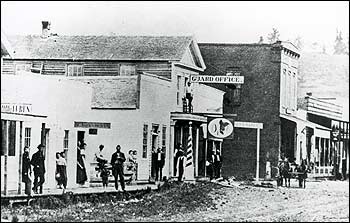
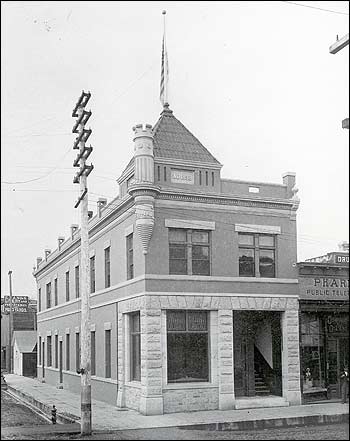
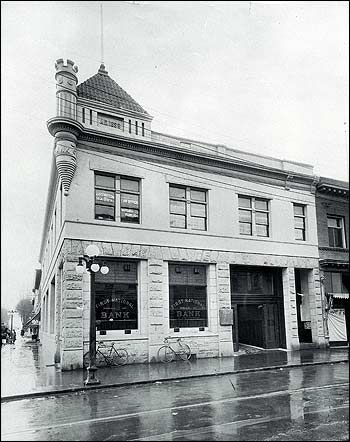
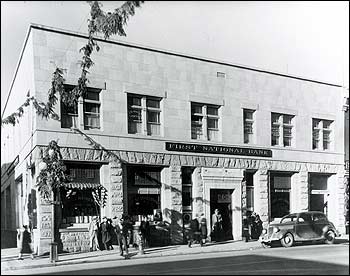
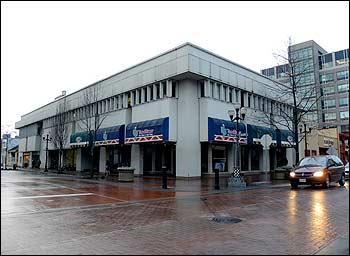
Photos from top to bottom courtesy Lane County Historical Museum: Broadway and Willamette, then Bristow’s Corners, with Bristow’s Brick as mercantile next to the Guard, with IOOF on second floor, c.1871 Elaborate 1898 remodeling by First National Bank, Delos D. Neer, Architect. Bank after 1910-1912 modifications, including expansion into drugstore north Results of UO architect Ellis Lawrence’s stylish 1923 remodeling with a further addition to the north and west Current vacant Taco Time building and the results of the major modernizing of 1966. Photo by Ted Taylor. |
Those who’d like to see more interest and architectural cachet in downtown Eugene may have some buried treasure right under their noses. Beneath the bland façade of the Taco Time building across from Kesey Plaza may lie significant remnants of Lane County’s first brick building and its elaborate remodelings. However, a thorough physically intrusive study is necessary to find out what actually may remain, its condition, and possibilities for reuse or display. This question has become more urgent now that a developer, Steve Master, has developed plans to replace this nondescript building owned by the Roberts family with a modern, fivestory, mixed-use commercial-residential building.
Whatever the physical remains, a review of this building’s past is a recounting of the history of Eugene at this key intersection in the core of downtown. Bristow’s Brick was built in 1866 for the mercantile firm of Bristow and Company in partnership with the Spencer Butte Lodge of Odd Fellows (IOOF), whose lodge occupied the second floor. Such significant historic figures as T. G. Hendricks, E.L. Bristow and J. J. Walton were the leaders of this project. Wallace and Boyard were the builders of this iconic fireproof structure which brought a new sense of permanence and commercial stability to this muddy street of flimsy wooden buildings. It joined the stage stop, the St. Charles Hotel, as well as the Guard newspaper and a harness shop at this busy corner. Other brick buildings soon followed along Willamette. And yet, because of the destruction of urban renewal in the 1960s and ’70s, only the lovely brick Smeed Hotel survived intact from all the 1800s.
In 1898, Hendricks and his partner S.B. Eakins decided to move their First National Bank into this building, and major changes followed. According to the Jan. 8, 1898 Eugene City Guard, “They will take out the front and otherwise improve and modernize the old corner building, converting it into a first class, up to date bank office.” It’s unclear just how much change was actually carried out, but it is obvious the work was well done. The architect, the famous Col. Delos D. Neer, worked with local builder Nels Roney to create a new, partial stone front, added a Romanesque turret and tiled tower, painted the brick overlay to look like stone, partitioned the upstairs into eight rooms and created a dignified bank lobby. The narrow building exhibited the same massing evident in the original Bristow structure.
In approximately 1910-12, the building was enlarged, expanding to the space formerly occupied by a drugstore. Some modifications were made to the original façade, changing some windows and a doorway, but the addition maintained the original style. In 1923 the building was modernized and enlarged again, incorporating existing buildings to the north and west. This remodeling was carried out by our area’s most famous architect, Ellis Lawrence, and included tying the entire new façad together with stone work, surrounding the front door in a more elegant setting, opening up the interior and removing some of the early adornments including the tower and the turret. Still, much of the original style remained.
Finally, in 1966, the venerable building was saved from the destruction of urban renewal, but instead covered over with a new contemporary façade characterizing the building now referred to as the Taco Time building. How much of the original Bristow Brick and historic remodelings remain is a mystery, for the city has yet to do the kind of skilled intrusive study necessary to uncover possible historic or archeologically significant remnants.
The city seems to be unaware that Bristow’s, our first brick building, was built on this site or that it may contain significant remnants, referring in its own historic analyses to the building as the “1898 First National Bank” or just “Taco Time.” To guide their planning, city staff rely on three studies which were carried out in 2007 as part of their West Broadway Development Project. However, all are problematic in both history and methodology.
According to historic preservation consultant Jonathan M. Pincus, “None of the studies are based on a complete historic record. The first two were based only on simple walk-by or walk-through examinations. The third study by [Portland architect] Robert Dortignacq was carefully and professionally conducted, reporting a good body of observations. However he did not have the advantage of a complete, historic documentation as a reference, nor did he have the physical evidence that can only come from an intrusive investigation of the site.”
Pincus believes that there is enough primary historic evidence to suggest that “fragments, skeletal structure and foundations of the Bristow building and historic remodels may exist within the fabric of the existing building.” He advocates “compiling of a clear historic record to guide a materially intrusive archeological and historic study.”
For all of us who care about downtown Eugene, that sounds like a great idea, and we expect that any findings will add to, rather than detract from, the future development on this significant site. But first, What’s under all those façades?
Douglas Card is a Eugene historian and author of From Camas to Courthouse, Early Lane County History.