
Friendship, Hateship, Jealousy, Writing
Love, meet success in The Four of Us
by Suzi Steffen
First of all, get over the Teddy bear.
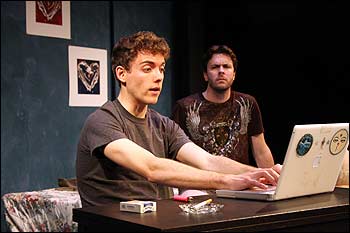 |
Director Craig Willis mentioned the stuffed animal in pre-show publicity several times, and OK, it’s practically a third character in one vivid scene of Itamar Moses’ The Four of Us at the Lord Leebrick Theatre.
But since it’s not a writer, the bear can’t focus on its work to the exclusion of its friends, the way young novelist Benjamin (Patrick Driscoll) can; and it can’t attempt to be happy for its friend’s success in the midst of feeling jealous, as David (Jacob Smith) ends up trying to do after Benjamin’s rocket ride to novelist superstardom.
Benjamin, whose huge advance and stratospheric rise are transparently modeled on the life of novelist Jonathan Safran Foer (whose Everything Is Illuminated, begun when he was 19, came out to wild acclaim just before he turned 25), exudes a delighted satisfaction in his new life. David, who has been working at a summer camp to earn enough money to survive, isn’t quite as delighted as he wants to be.
The play traces the the young men’s friendship forward and backward from the opening scene, in which Benjamin tells David about his advance at a lunch for which David is paying. Much of the piece turns on character: Who are these guys? What are they like? Are they even really friends?
The last query hits hardest. The audience watches David’s need for his friend’s feedback and approval, and his obvious disappointment when Benjamin looks at him like the subject of an insect study. Benjamin, as David says to him in a painful moment, doesn’t seem to need external approval or feedback, at least not from David.
But this is David’s perception, one that several scenes call into question. The playwright dangles hints in front of the audience, requiring those watching to keep track of what’s said versus what’s portrayed. Every scene refers to another one (or two) in a neat little package.
Amusing insidery details — Benjamin calls his fiction workshop writing teacher “Celeste” (by which we know that Foer called Joyce Carol Oates by her first name), and the boys make fun of backpackers in Prague, where they’re spending a summer — set an atmosphere of privileged young men trying to make inroads in two competitive professions. Those professions both require the lonely work of writing, but Ben’s work by nature has to be far more solitary than David’s, as David points out a couple of times. Plays are collaborative productions, and playwrights have to juggle far more to see their work into the world than do novelists.
Or so Moses wants us to believe. Who’s lying? Who’s constructing a fictional world? Who’s the better friend? The twist that comes near the end of this no-intermission piece calls every bit of characterization into question, and the sweet final scene, which tidily answers questions and ties up loose ends, is just so much more fiction.
Both actors deal well with the witty material. Eugene audiences have watched Driscoll mature over the past few years, and though I would have liked a Benjamin with more compassion, that’s part of what Moses wanted audiences to feel. Smith, about to leave Eugene for grad school, gives us a sweet, open young David, the left-behind friend who turns out to have some bite.
The play was a bit slow on opening night, partly because of a clever set by Steen V. Mitchell that demands a fair bit of scene changing work from the two actors. No doubt that will change with time.
Snappy dialogue doesn’t conceal real pain and need. Moses’ self-referential script makes for a light work that still addresses concerns about friendship, work and growing up, separately, together. The Four of Us runs through March 27 at the Lord Leebrick Theatre. Tix at lordleebrick.com or 541-465-1506.