Have you ever listened to a song and, without even realizing it, started tapping your toes? Have you ever been brought to tears through music? Most of us can probably answer “yes.”
There’s a science, and a whole profession, built around the reason why.
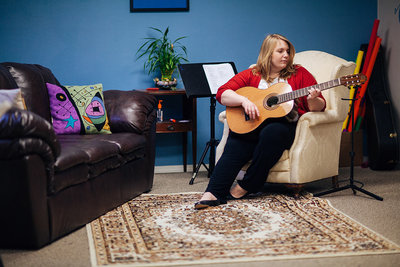
I’m in the cheery downtown studio of Danielle Oar, a board-certified music therapist and owner of Refuge Music Therapy, LLC in Eugene.
“The core central to music therapy,” Oar says, “is that, as an allied health profession, we use evidence-based intervention and research to utilize the neurological perception of music and its inherent aesthetic experience.”
Music connects to the very essence of what makes us human, she says.
Oar notes how memorizing lyrics encourages development in the language centers of our brains and how hearing a song engages memory through the prefrontal cortex. Music’s rhythmic patterns assist with cognitive processing and logic, and its emotional resonance touches our feeling center, the limbic system.
“Before we’re even conscious of what’s going on in the music, we’re aware of it — across all regions of our brains,” Oar says.
THE POWER OF MUSIC
Music therapists understand music theory, but they also delve into the psychology of music, Oar says.
Emily Jensen, also a board-certified music therapist, concurs. Jensen has worked with various populations, utilizing music therapy for 15 years.
“The opportunity to effectively facilitate change in a client’s physiology, behavior or emotional state through this powerful secondary agent is truly awe-inspiring,” Jensen says.
“Music has an innate power to organize our thoughts, to socialize us, uniting us with one another,” she says. “The mastery and practice of musical skill-building provides an individual with a sense of achievement that, in my experience, transfers into many other aspects of leading a healthy and happy life,” Jensen adds.
A typical clinical music therapy session lasts about 55 minutes and is offered to a mix of individuals and groups. The work includes ongoing assessment and documentation to identify strengths and opportunities.
Some insurance carriers cover music therapy, and Oar says that, with new state licensure requirements in 2016, she hopes the number of insurance providers recognizing the profession will increase.
EMOTION UNLEASHED
“When you have an emotional reaction to music,” Oar asks, “where do you feel it? How do you know you feel it?”
These are questions people like Oar have been asking for a long time.
Some of the earliest references to music therapy are several hundred years old, with its earliest proponents looking to music as a means to treat disease in institutional settings.
But the work gained traction in the last century, notes Emily Ross, assistant professor and clinical coordinator of music therapy at Marylhurst University.
“In the 1940s, with the influx of soldiers returning from the war, musicians would go to veteran hospitals to play and found that music had a unique ability to help veterans open up, connect with others and begin to process their experience,” Ross says.
“However,” she continues, “the musicians were not equipped with the knowledge or training to contain all this emotion that the music unleashed. Hence the concept of cross-training people in psychology and music was born.”
Music therapy provides an alternative to more traditional talk therapy and can be adapted across the lifespan.
“My practice works with all ages and abilities,” Oar says. “From the beginning of life to the end of life, from neonatal, to children with autism, early childhood, teens.”
Oar works with people with mental health issues such as depression and schizophrenia, as well as clients living with Parkinson’s, dementia, terminal illness and pain.
But do we need to attend a music therapy session to reap the rewards of music?
A VITAL MEDIUM
Across town, music is used recreationally in a popular program offered through the city of Eugene’s Adaptive Recreation program. In Melody Makers, says class founder and co-teacher David Helfand, “the goal is to make music accessible to everyone, regardless of skill level, where everyone is in the band.”
Adds Helfand’s co-teacher Zoe Demant: “I believe that music speaks a universal language, one that everyone can participate in on some level no matter their ability. It is a strengths-based class. We focus on what people can and want to do, rather than their challenges. The other powerful thing about music is the community that it creates.”
Another local group, Strings of Compassion, is a musical and clinical service that uses harp and voice to serve the needs of people who are terminally ill, receiving comfort care or on hospice. Offered through PeaceHealth Sacred Heart Medical Center, Strings of Compassion provides trained, certified Music-Thanatology (the union of music and medicine in end of life care.)
Members of the Music-Thanatology Association International (MTAI) in vigils play in the hospital, patient homes, nursing homes and foster care homes, free of charge.
Whether it’s playing in the middle-school band or attending the symphony, music is a vital medium, and many take great pleasure and even healing in listening to or playing music.
And for some, working with rhythm and melody with a supportive and caring guide like Oar or Jensen can be a lifeline.
SHARED RHYTHM
Back in her cozy studio, Oar takes me on a tour of some of the tools of her trade. Tucked away on shelves are shakers, drums and bells. A guitar is propped against the wall. Tidy and unobtrusive, the instruments are available but not overwhelming.
“The room is set up for sensory sensitivities,” Oar says.
Kneeling on the floor, Oar gently taps a drum, describing how she and a client might work together to establish a shared rhythm. She begins to sing. On the surface, it’s a simple remedy to use rhythm and the human voice in a call-and-response pattern.
“I have been so moved by music, and I just know that there’s more than what the brain perceives,” Oar says. “That’s where music is felt, and that’s the space in which I work.”
Find more information about Danielle Oar’s practice at refugemusictherapy.com. Emily Jensen is focusing on opening a new business with her husband and is not taking new clients at this time. For more on Music-Thanatology go to mtai.org.