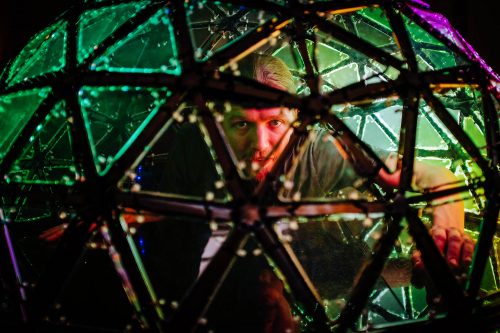
Made of almost 200 illuminated glass panels lined with 120 specialized lights, the “Radiance Dome” is approximately 40 feet across and 20 feet tall. It’s crystal clear when the lights are off, but when the lights flicker on, it glows in swirling psychedelic patterns.
Yona Appletree and Wayne Skipper, co-founders of Eugene art-tech fusion company Light at Play, just came back from famed alt-culture gathering Burning Man, where they displayed the dome. Their work has appeared around the country, from Nevada to Washington, D.C., and soon it may appear in front of local cannabis shops.
Appletree and Skipper say they have been going to Burning Man together for many years and were looking for a way to give back to the community that was “beautiful” and “in the spirit of Burning Man.”
As software developers, they came up with the idea for Light at Play. “We have something called electric tie-dye that we do on the surface,” Skipper explains. He says their pieces are made of panels that are edge-lighted to create the glowing effect.
Appletree adds that light emitting diode (LED) art is generally “blinky, flashy and really bright.” Instead, they wanted to take a softer approach to the large, slightly industrial art that Burning Man is known for.
“We thought, how can we take this epic scale, combine it with our software and engineering knowledge, and our Eugene roots?” Appletree says. Not only have they created the Radiance Dome, but they’ve also made smaller orbs that are more transportable.
Appletree and Skipper created software that responds to music, which allows musicians to play the giant orb like it’s an instrument.
“Certain musicians who are masters of their craft are able to see the effect of their music on the orb or the dome and play it together, and it has a particularly beautiful effect,” Skipper says.
The Radiance Dome went over well with free-spirited Burners when it debuted at the week-long Nevada desert art fest three years ago. “[There were] thousands of people standing around saying, ‘oooh, ahhh,’” Skipper recalls.
This year, they also set up a stage next to the dome with one of their orbs at the top, which they say could be seen from almost any place in the festival.
“At Burning Man, we had some amazing cellists and violinists play,” Appletree says. He describes watching the musicians perform and seeing people’s reactions as they watch the effects on the dome and the orb in real time, noting, “I think that’s pretty magical.”
So what’s next for the Light at Play duo? They say they’re thinking of looking into signs for dispensaries. “The whole electric tie-dye thing, I think, is a powerful metaphor for the cannabis industry,” Skipper says.
They say Light at Play is open to collaborations with artists and organizations, since their goal is to fund the art through their business and have the business support the art.
“So much of Eugene’s history has been about the hippie movement and tie-dye,” Skipper says. “In my mind, this is kind of like the torch being passed to the new generation, using new technology as a medium for doing the same kinds of things like making beautiful patterns and lights. It’s like part of the history that we have here.”
Check out Light at Play’s work at lightatplay.net.