Oregon State Sen. Jeff Kruse updates his email newsletter weekly. On Feb. 3, the Roseburg Republican wrote that he wanted to focus on the executive order issued by President Donald Trump on immigration. “The reaction to the order by the media, special interest groups and many politicians is a perfect example of the campaign of misinformation and lies being waged against this administration,” he writes.
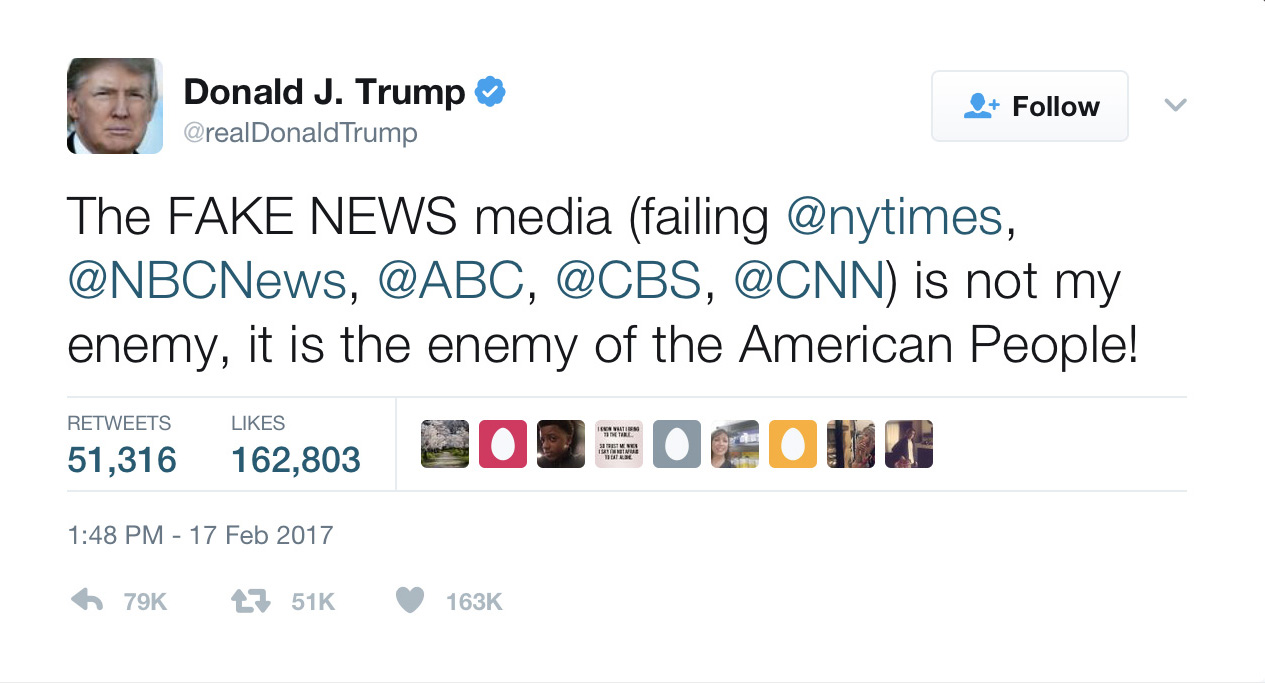
Kruse is not alone in his rhetoric, Trump has lambasted the media ad nauseam at a national level. On Feb. 17, the president tweeted, “The FAKE NEWS media (failing @NYTimes @CNN @NBCNews) and many more is not my enemy, it is the enemy of the American people. SICK!” He later deleted the tweet, according to The New York Times.
University of Oregon Professor Tim Gleason says journalism is important to a democracy because “to have an informed public and informed voters, one needs to have journalists who are finding information and reporting that information — especially if you’re serving a watchdog function in terms of government activities and things that are being done that will impact the public otherwise it’s very difficult for us to make informed decisions.”
Gleason echoes The American Press Institute’s guide to The Elements of Journalism, which states, “The purpose of journalism is thus to provide citizens with the information they need to make the best possible decisions about their lives, their communities, their societies and their governments.”
Eugene Weekly interviewed Sen. Kruse to learn more about his view of the media. He says, “There is no such thing as unbiased because everybody’s got a built-in bias. If you don’t have a bias, you aren’t thinking.”
Kruse says some stories get covered and some don’t. “I do think that a lot of the mainstream media do tend to lean relatively far to the left on a lot of issues,” he says.
In his newsletter, Sen. Kruse writes that the initial executive immigration order wasn’t “a ban on Muslim immigration.” He explains: “Basically what it was, was a temporary ban from people coming from seven specific countries from coming in to the United States until we had a better vetting process and that was all it was. It wasn’t an attack on Muslims.”
Media coverage of the executive order detailed how the travel ban was implemented — it happened while people were in route to the U.S. — and gave detailed accounts from people with proper immigration forms who were detained from international flights at airports with no warning.
Covering the order and its aftermath is another necessary function of journalism. “It must serve as an independent monitor of power,” according to The Elements of Journalism. “Being an independent monitor of power means ‘watching over the powerful few in society on behalf of the many to guard against tyranny …’”
Politicians denouncing news is dangerous and corrosive to democracy, Gleason says. “Certainly presidents and many public officials are frequently not happy with reporting and the work that journalists do, but there’s a difference between arguing or disputing the facts of a story and, as the president has been doing, really trying to undercut the legitimacy of journalism in general,” he says.
Asked about what he sees as a possible solution to the way mainstream media cover news, Kruse says he doesn’t know, citing First Amendment rights that entitle anybody to say anything they want.
Kruse says, “I think from my perspective a lot of the stuff I see on TV and I read in papers anymore I basically take with a grain of salt, and I’m assuming it’s not hard news.”
For journalists to address the distrust repeated by politicians, Gleason recommends following best practices and the ethical standards of the profession. “And continue to believe at the end of the day organizations that are credible and continue to work to be credible will be believed and there’s really not very much else one can do,” he says.
Resources on Fake News
The Eugene Public Library has tips on how to discern fake news
at eugene.libguides.com/fake-news.
And the UO School of Journalism and Communication lays out
its advice here: bit.ly/2nq9SnG.