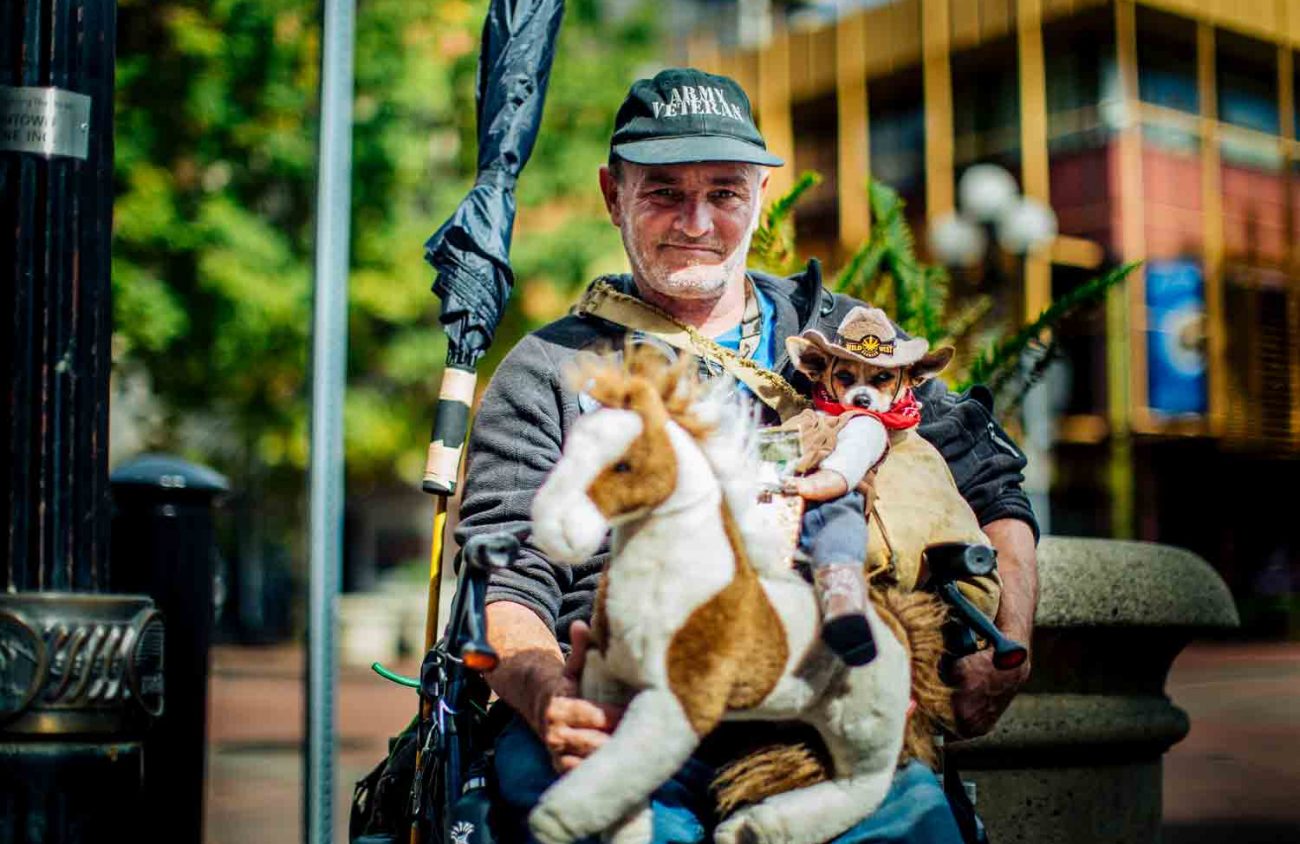
Robert Wilson has been homeless off and on for 25 years, with none but a small dog to keep him company and keep away the demons of PTSD and anxiety that haunt him.
A veteran who served in the Army in the ’80s, Wilson, 54, is a short man with bright, worried eyes and a friendly, if nervous, demeanor. “I couldn’t be outside or talk to strangers without her,” he says of his Chihuahua, Chica. The dog is dressed as a cowboy, shivering slightly inside his coat.
Wilson busks for a meager living in downtown Eugene with Chica, but since the dog ban was implemented April 10, he’s had police officers question him and tell him he needs to leave the area. “I haven’t had one complaint in 20 years, and now they’re saying I can’t be here downtown making a living.”
Employees at Voodoo Doughnut and Sizzle Pie both tell EW that they adore Chica, and that the dog brings in more business.
Skylar Gibson at Sizzle Pie says there are “more problems than dogs” in downtown Eugene. Voodoo employees agreed, adding that Chica drew more customers into the store, and that drug addicts are more of an issue than the little dolled-up Chihuahua.
“Chica’s like a little local celebrity. She’s really well loved,” Wilson says as a few women come up to scratch her ears. Wilson became housed in the winter via a program called Vet LIFT at St. Vincent DePaul’s that helps homeless veterans get off the street, but he’s still very low income.
“The cops said I can come through here to do business, but I can’t stay here all day,” he says. “They told me I had to pretty much go, and I said I wanted a ticket or for them to arrest me so I could see my day in court, but they wouldn’t do that either.”
He says, “The officer was actually polite about it, I could tell he didn’t exactly enjoy doing his job.”
Wilson adds that, with the dog ban, he feels discriminated against “based on someone else’s behavior.”
The dog ban in the downtown area is a controversial attempt to clean up downtown, but it may also create problems with the American Disabilities Act when it is enforced in cases where the status of the dog is unclear.
Wilson says he can’t leave the house without Chica due to his severe anxiety. Having the dog with him grounds him. “She senses when I’m having panic attacks and licks my hands and face to focus my attention away from whatever it is that’s bothering me.”
The dog ban ordinance does say the ban does not apply to “a dog assisting an individual with a disability,” meaning that the ordinance is in compliance with ADA regulations. It does not, however, clearly outline what qualifies as a disability or as a service dog, leaving a difficult line for the police to walk when it comes to enforcement.
Washington-based attorney Adam Karp, whose specialty is in animals and pets, says the line between emotional support dogs and service animals is “admittedly a gray area.” PTSD is covered under the ADA, he says, and animals can be trained by their owners to perform those functions.
The ADA states that a service dog must be permitted to accompany its owner wherever they go, and staff can only ask two questions regarding the animal: Is it a service animal, and what task has the animal been trained to perform?
Animals don’t need to be officially certified as service animals to qualify, but they must be under control and housebroken. If the animal meets these criteria, then it has the right to be anywhere a member of the public would be permitted.
Eugene police spokesperson Melinda McLaughlin says the ordinance uses the ADA definition of a service animal, and she clarifies that officers are only meant to ask those two permitted questions.
When asked if PTSD qualifies as an exemption for disability with the dog ban downtown, McLaughlin wrote in an email, “Companion animals and therapy dogs do not qualify as service animals.”
Not every dog with an owner with disabilities falls under the ADA designation, and Karp says that Chica may not qualify. “There have been cases where dogs are trained to make physical contact and maintain physical proximity to make sure the person is re-centered,” Karp says. “You have to provide training that sets the animal apart from an ordinary pet,” he says, and Chica likely doesn’t fit the bill.
Other dogs may be a different story. Jeremy Roberts has had his German shepherd for about six months, and he considers it to be a disability service dog.
Like Wilson, Roberts has disabilities that are not immediately visible. “I’ve been diagnosed with PTSD and Asperger’s,” he says, adding that he had three significant brain injuries during his childhood.
Roberts has a light Southern accent and a thick beard. The police stopped him and his dog downtown on the afternoon of May 2, which he says triggered his PTSD. “I keep telling them I’m scared, that I’m getting sick, and asking if I’m being detained.” Roberts says he was asked to prove the dog was a service animal, but didn’t know how to do so in the throes of his PTSD.
Roberts admits that he yelled at the police and became aggressive during this episode. He has trained his dog himself, and says, “When I react to things he pays attention and watches, and he’ll get up in my lap and ground me if I’m not doing good.”
The German shepherd even guided him home when he had a dissociative episode, he says.
Attorney Karp says these actions likely qualify the dog as a service animal under the ADA, though he adds that “an animal in training is not a service animal.”
The ordinance itself lists service dogs as an exception to the rule, so long as they are licensed with the city. Dog licensing costs $12-$42 a year depending on the dog’s age and spay/neuter status — an amount that might be prohibitive for those living on the street with disabilities.
McLaughlin writes in an email, “The city works in partnership with a pro bono organization who will provide a free dog license if the owner is unable to pay the required fee.”
Other disabled citizens with service dogs say they have had few issues with the ban, perhaps because their disabilities are more obvious to the average viewer.
Megan Smith says she often busks in Kesey Square and by the bus station with her seeing-eye dog. She plays a ukulele to earn money and promote her band, Charming Tempests.
“I think you run into problems if you don’t have a visible disability,” she says, adding that she hasn’t had any police talk to her about the ban, likely because her dog wears a clearly labeled harness.
Under the current law, Robert Wilson likely can’t legally spend time downtown with his small dog buttoned up inside his shirt. Wilson says, however, that the law isn’t just. “I served my country. I earned the right to be down here with my service dog,” he says. “Anyone who says America is a free country hasn’t been homeless.”