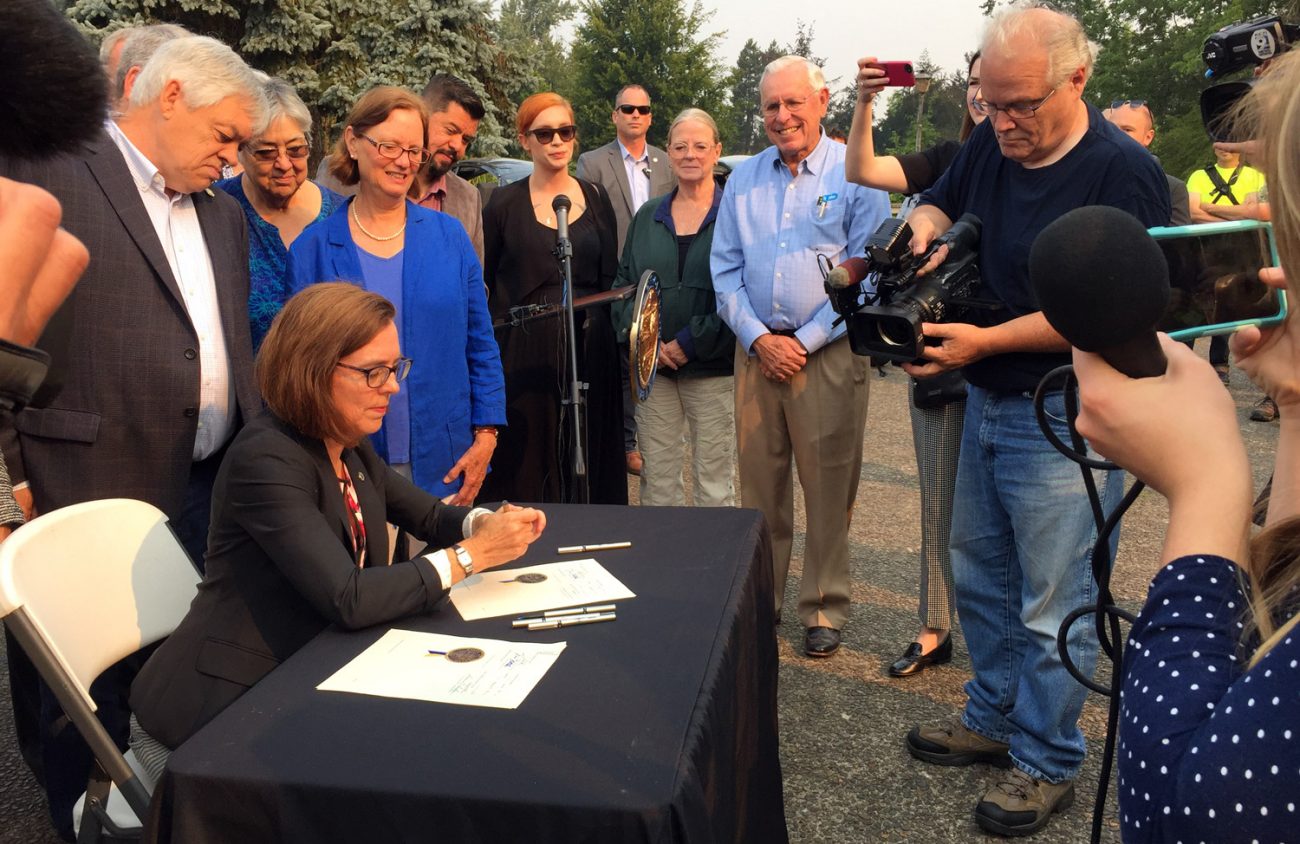
Gov. Kate Brown and several local lawmakers gathered Aug. 29 in Eugene’s Alton Baker Park to address a crowd about the passage of the transportation package — House Bill 2017. It’s the first time in the state’s history that funding will be dedicated to statewide public transportation; one aspect of the bill focuses on electric cars.
Brown thanked local and regional officials for their efforts during the 2017 legislative session and said she was excited that Republicans and Democrats came together to pass the $5.3 billion package.
Over the next 10 years, the comprehensive package will invest in a number of infrastructure improvement projects aimed at curbing traffic congestion as well as improving roads, bridges, sidewalks and bikeways.
Public transportation will expand in both rural and urban areas, and electric vehicle rebates will be available to low and middle-income families, according to a statement by the governor’s office.
“We see public transit as a way to lift families out of poverty, as a vehicle to lift families out of poverty — and to provide better and more enhanced access to public transit is a really good thing,” Brown told reporters at the park. “Cities and counties also will be getting nice checks in the mail as well, so they can continue their road improvements that they’re working on.”
However, six to seven families living in their vehicles parked in the Alton Baker lot were not addressed at the bill’s signing.
The transportation package will designate more than $100 million each year to improve public transportation, and funds will be distributed to Native American tribal governments, counties and transit districts that create transportation improvement plans, according to Oregon Department of Transportation documents.
Brown thanked the Lane County Transit District for its work partnering with Tesla Inc. on bringing electric buses to Oregon. Currently, ODOT is part of the West Coast Green Highway — a designation for the 1,350 miles of I-5 from British Columbia to Baja California equipped with charging stations every 25 to 50 miles.
An estimated 16,000 jobs will be created through ODOT projects from 2018 through 2025. Furthermore, cities will receive funding for local transportation projects, increasing local employment opportunities.
According to an HB 2017 allocation document, Eugene will receive $3.8 million for local projects; Springfield will see $1.4 million in funding and Cottage Grove will get $228,000. In all, Lane County will receive $8.2 million in transportation funding per year over the next 10 years.
Approximately $12 million of the transportation package is allocated to the electric vehicle rebate program, according to Forth, an organization that advocates for electric vehicles. Jeanette Shaw, Forth’s director of government relations, spoke at the bill signing. “We’re extremely excited about the groundbreaking and the investment in the transportation infrastructure and in particular Oregon’s new rebate for electric vehicles,” she said.
The electrical vehicle rebate runs between $1,500 and $2,500 dollars, depending on the size of the vehicle’s battery pack and the electric range. The average range of an electric vehicle is approximately 80 miles — however, newer electric cars can drive on one charge for more than 200 miles, according to Forth.
Shaw said Forth is talking with PacifiCorp power company about installing more charging stations in Oregon and throughout the U.S. And she added, “We just received a grant through Washington [WSDOT] to put more chargers up the I-5 corridor.”
Funding for the new package will be derived from three new taxes as well as increases in vehicle registration fees and a gas tax. Right now, Oregonians pay a gas tax of 30 cents per gallon. In 2018, the gas tax will increase by another four cents and incremental increases of two cents every two years until 2024.
Electric vehicle registration will increase incrementally until 2024, when drivers will pay around $115 annually, because EV cars won’t contribute to the gas tax.
“In addition, the weight-mile tax on heavy trucks will increase to ensure that trucks pay their fair share for their wear and tear on the roads,” according to ODOT documents.
Oregon State Sen. Lee Beyer, who represents Springfield, said that a group of 14 legislators came together and worked on the bill.
“What you are looking at is the largest, most comprehensive transportation package that’s ever been passed by the state of Oregon,” he said. “It addresses climate issues with the electric cars and also with the buses. We’ve never had a funding source for transit; we do now from the state level. We’ve also addressed the seismic issues.”
Improvements made to highways and bridges by ODOT will be earthquake resilient, according to ODOT.
Safe Routes to Schools will receive a new source of funding through the package. Safe Routes is a program that upgrades walkways and bikeways for students walking and biking to school. It will receive $10 million annually, and eventually, will be funded at $15 million per year.
“This is a significant investment and making sure that children have safe paths to get to school whether it’s elementary or middle school,” Brown said.