If there is a God, and if he is indeed all-knowing and all-powerful and all that, what must he think of the human race and its endlessly disastrous experiments in free will?
Personally, I woulda pulled the plug by now. But I imagine God, in his terrifying grace, also possesses a fantastic sense of humor — something cosmic and pained, in which the comic and tragic sensibilities are inextricably intertwined, inspiring a laughter full of tears.
Charlie Chaplin? Hilarious! Nazis? Total slapstick! Nagasaki? I couldn’t stop laughing! Trump? Don’t even get me started! Will you people never learn? You’re killing me!
But, seriously, can we draw the line at Stalin? I mean, The Great Dictator was one thing, but upwards of 50 million Russians executed? That’s pushing the envelope a bit, isn’t it? Even God might turn his face from Uncle Joe’s treachery.
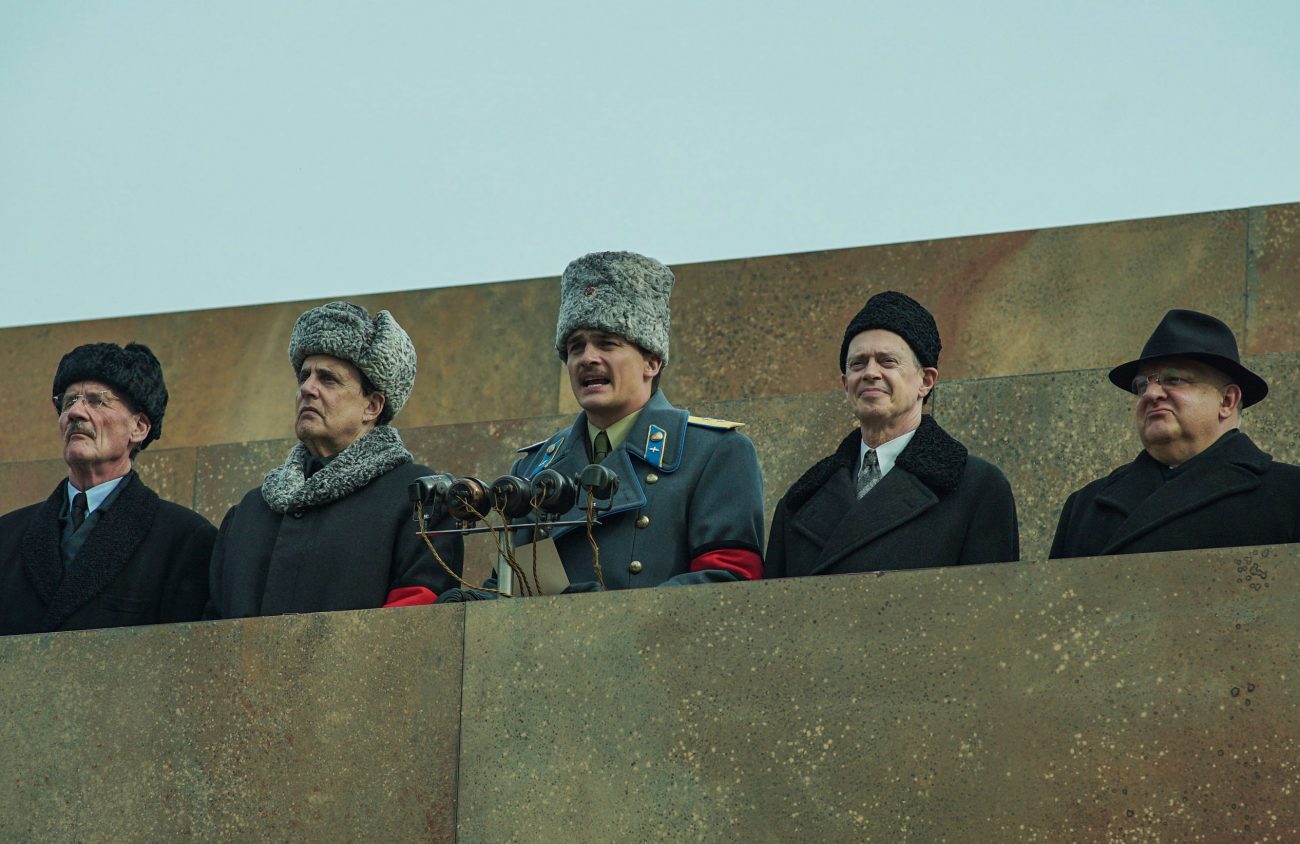
It is this cringe-worthy transgression of taboo that makes The Death of Stalin by director Armando Iannucci so bracing — and so brilliant and timely. The darkest and most absurd of political satires, the film dares to parody the murderous jockeying for power that took place among the Central Committee after Joseph Stalin (Adrian McLoughlin) was laid low by a massive cerebral hemorrhage.
The movie is brutal and unflinching, and it is hilarious, in a laughter-of-the-gods sort of way. Iannucci, who also co-wrote the film, takes a detached and slightly documentarian view of the proceedings, the better to depict the petty and childish and genocidal behavior of grown men who — driven by all manner of selfishness and fear — will do absolutely anything to maintain their status in a political system that treats human life as a mere inconvenience in a grander equation of power.
If, indeed, humor is all about risk, then The Death of Stalin takes the greatest of risks: to make us laugh amid the totalizing fear of a totalitarian regime run amok as a small clutch of tyrannical bureaucrats, themselves terrified, inflict terror on one another and the population at large. This is black humor at its blackest and best. It shoots a taproot down to our deepest humanity, and it does so, ironically enough, by revealing the hellish sources of our own inhumanity.
The film is exquisitely written, smart and biting, and the veteran cast offers a master class in restrained chaos. Steve Buscemi is damn near perfect in the unlikely role of Nikita Khrushchev, a devious oaf; Jeffrey Tambor, as the installed puppet Malenkov, is wonderful as the strangled and completely ineffective conscience of the film; and it’s pure pleasure to watch Monty Python alum Michael Palin bring his satirical edge to the portrayal of Molotov.
In a sense, The Death of Stalin does for political terror what Blazing Saddles did for racial intolerance, substituting for Mel Brooks’ Borsht Belt antics the kind of withering, wonky slapstick that Kubrick brought to Dr. Strangelove. These three films, in fact, are all equal in their power to peel back the layers of power to reveal the brutish, infantile and all-too-human tendency to go to any lengths (including global annihilation) to preserve a lie so flimsy and weak it can only be laughed at.
Is this starting to sound familiar?
Power fears nothing more than being found laughable, and therefore absurd, and therefore without any viable foundation. Chaplin understood that when he parodied Hitler. Laughter plays tug-of-war with our sense of powerlessness, wresting a shred of dignity from the overwhelming forces of destruction. Nothing will screw you more than losing your sense of humor, no matter how dark and tragic. Laughter gives us back to ourselves, by showing us ourselves as we are. Even on the gallows.
The Death of Stalin does this in the most tragic and heartbreaking of ways, but it does something more. Laughter — that cosmic, divine laughter of God — gives us a shock of recognition. It bursts forth and zaps our deepest powers of empathy, revealing a fragility and vulnerability that we all share in common. When we laugh, we sense the truth, and how far we are from it. That is the tension that explodes. It demolishes what is fake in the stories we tell ourselves.
“This is how people get killed, when your story don’t fit,” Buscemi tells Stalin’s daughter (the wonderful Andrea Riseborough).
And then, near the end of the movie, a Russian functionary in the back of a car says: “I’ve had nightmares that make more sense than this.”
It’s at the intersection of these two quotes that The Death of Stalin plants itself — where uncomfortable truth, that most valuable of commodities, becomes so forbidden that its expression can kill you.
If that isn’t hilarious, I don’t know what is. (Bijou Art Cinemas)