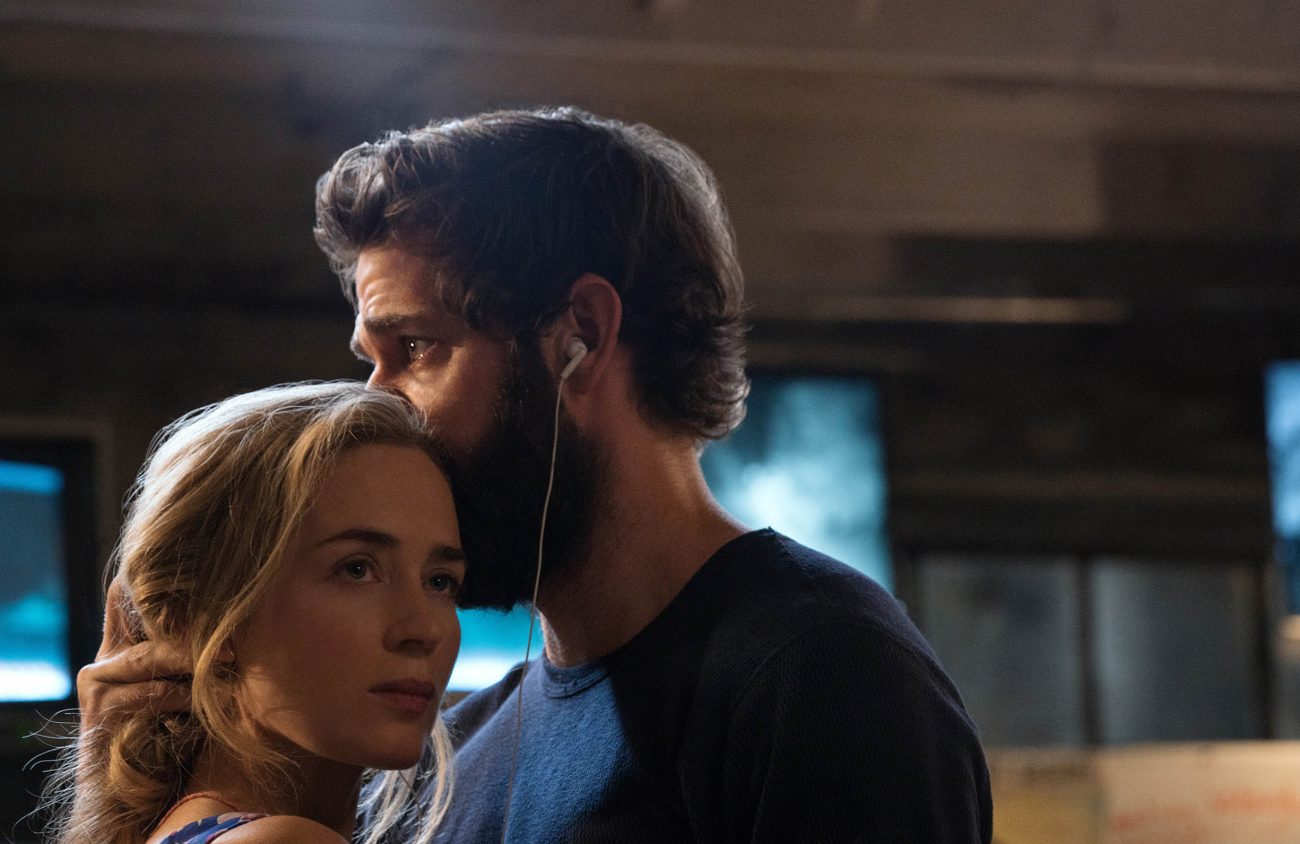
The first third of director John Krasinki’s horror film A Quiet Place is smart and plenty creepy, but it had me wondering: Why all the hype?
As the story of a lone family struggling in absolute silence to survive Earth’s takeover by a gaggle of blind extraterrestrial monsters who hunt exclusively by sound, the movie’s opening scenes are taut and well-paced, revealing Krasinski’s directorial talent for manufacturing suspense (he also stars as Lee). They are also pretty standard genre boilerplate, familiar to anyone who’s endured the survivalist tensions of a zombie flick.
Of course, it’s a nice twist on a familiar theme that Lee’s wife, Evelyn (Emily Blunt), is pregnant and, you know, babies make lots of noise. Infants are so inconvenient when you’re trying to kick the apocalypse. The clock’s ticking.
And then, about a third of the way into A Quiet Place comes a sequence of events — an epic piling up of horrible circumstances — so nerve-wracking that I spontaneously lost all suspension of disbelief. It was agonizing and terrifying and excruciating and so much fun. And it reminded me of why I love horror films.
And I’m not going to tell you a damn thing more about it, except this: Blunt, who is easily one of the best actors working in movies today, carries the scene with a raw, visceral force I haven’t seen since Mia Farrow went to term in Rosemary’s Baby. Talk about a labor of love.
And still, this middle sequence, and Blunt’s exquisite performance in general, don’t entirely explain the near-universal raves being received by the film. Because, unpopular as it might be to point out, the movie is riddled with flaws: inconsistencies (how silent do you have to be, a little or a lot?), improbable behavior (how long you going to tug on that laundry bag, sister?) and, in general, plot holes and leaps of logic that baffled even a credulous knucklehead like myself.
But none of that matters, and I think I’ve figured out why. First of all, it’s hard to imagine a couple that emanates more good will than the married couple of Krasinski and Blunt. They seem to be the antidote to Harvey Weinstein’s Hollywood: genuinely decent people who also happen to be phenomenally talented artists possessed by impeccable taste.
Secondly, and more importantly, Krasinski’s movie bucks the party line of horror films, in a very important way. Whereas so many scary movies are rooted in a backhanded, ironic breed of cynicism — what’s more monstrous in monster movies than the people trying to survive the monsters? — A Quiet Place appeals to the better angels of our nature.
The movie inverts the all-too-human atmosphere of distrust and betrayal that drives everything from King Kong to Aliens to Jaws to The Walking Dead, substituting it with an essentially humane vision in the face of an annihilating threat. The family at the center of A Quiet Place sets aside differences and bonds together for the common good, and their actions speak to sacrifice instead of rivalry, unity instead of division, all in the face of the worst loss imaginable.
Did I just call A Quiet Place a feel-good horror film? Yes. It is, despite significant faults, a wonderfully effective thriller, but it also works at the level of salutary mythology, re-establishing the deepest bonds of family (and humanism, and humanity itself) in the face of an overwhelming evil intent on picking people off one by one (all because of the “sound” they make).
It’s no wonder, these dark and dastardly days, that such a story is packing theaters. (Broadway Metro)