Fifty percent of people who are released back into Lane County from the Lane County Jail or the state prison are homeless when they re-enter society, Paul Solomon, executive director of Sponsors Inc., says.
“Housing is one of the fundamental elements in a person’s success re-entering the community post-incarceration,” Solomon tells Eugene Weekly. Sponsors is hoping to make that transition easier with a 10-unit tiny house project next spring.
Sponsors is a nonprofit organization focused on transitional housing and services for local people who have served time in Oregon prisons and Lane County jail. The organization has been around since 1973, its housing services beginning in 1988.
“We now have 20 buildings on seven sites with over 200 units of transitional, long-term and permanent housing for people with criminal histories,” Solomon says. Sponsors offers wraparound services such as drug and alcohol treatment, parenting classes, a veterans’ program and more.
This 10-unit tiny house project not only will serve more people in Sponsors’ programs but could offer a blueprint for other similar housing projects as well.
Solomon says Sponsors has been in conversation with Homes For Good — Lane County’s housing authority, in charge of Section 8 housing vouchers for the area — on using this project to inspire other low-income housing.
“They’re interested in using this as a potential prototype that could be rolled out on a larger scale as well,” Solomon says of Homes For Good.
“We are amazed at Sponsors Inc.’s affordable tiny home housing project and we hope to do similar tiny home projects across Lane County in response to the affordable housing crisis in our community,” Homes For Good Executive Director Jacob Fox says. “Homes for Good is always looking for new ways to serve our community and our partnership with Sponsors Inc. has catalyzed innovative approaches to how we provide housing opportunities for people with criminal histories.”
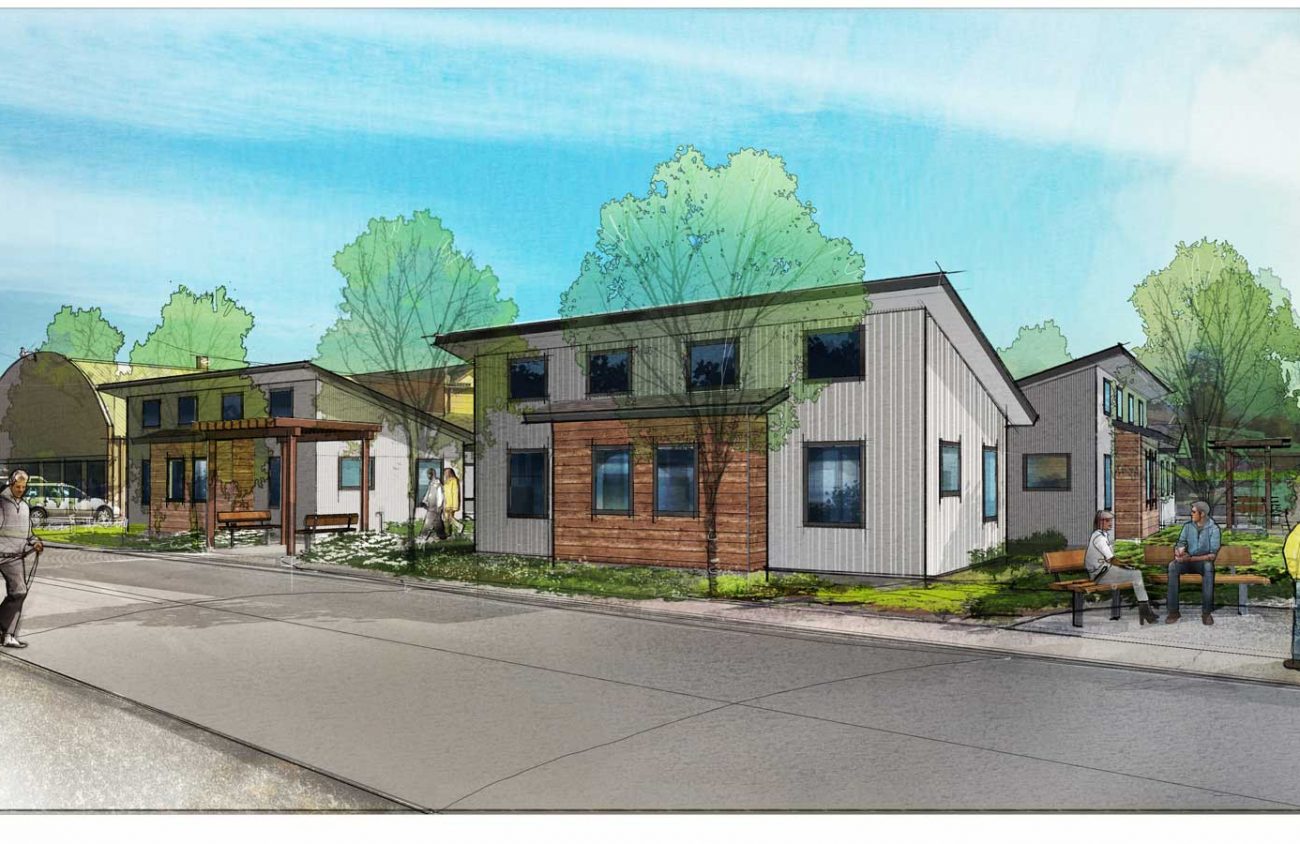
Sponsors’ 10-unit tiny home project will be made up of five duplexes, as shared walls reduce costs for features like plumbing, Solomon explains. Each house will be 270 square feet with single occupancy. The housing will serve people who have completed the organization’s transitional housing program.
The project will be directly adjacent to Sponsors’ main office on Highway 99 on a lot that the organization already owns. Since it will be so close, Sponsors services and staff will be accessible to tiny house renters, Solomon says.
The tiny home project was a new idea for the organization, Solomon says. “We’ve done big apartment buildings and those are great, but they take a long time to build. They’re very expensive and they’re restrictive,” he says.
For example, Solomon says last year Sponsors constructed a 54-unit apartment complex in west Eugene in partnership with Homes For Good. “It’s an amazing project,” he says, but income restrictions make it so that some people don’t qualify.
“One of the things we’ve found is that we have people barely making over minimum wage who aren’t qualifying to get in because they make too much money,” Solomon says.
The tiny home project will not use any federal funding, to avoid any such income restrictions.
Enlarge

Nir Pearlson Architect, Inc.
The project already has about two-thirds of the total funding secured, Solomon says, with some grants still pending. Sponsors needs another $75,000 to fully fund the project. It recently launched a capital campaign and is accepting donations from community members.
Solomon says rent pricing is still being discussed for the project, but the units will probably go for $300-$350. As part of that price, renters will be building equity for a future down payment or security deposit.
“A hundred dollars a month of that money will be put into an equity pot, so that when a person is ready to move after two or three years, they should have a few thousand dollars that they can draw on,” he says.
Solomon says housing is the most compelling need for those getting out of prison; he speaks from experience, as someone with a criminal background who has had issues with housing in the past.
“If we provide a modest investment in their success early on, it goes a long ways towards stabilizing folks, getting them to a place of self-sufficiency and ultimately out of the criminal justice system,” Solomon says.
Without these services the outcome for people is “pretty predictable,” he says — mostly ending up back in custody, in environments that led to their incarceration in the first place, or homeless.
He adds: “A project like this has the potential to significantly make a dent in recidivism and homelessness rates in Lane County.” ν
For more information on this upcoming tiny home project, visit sponsorsinc.org.