New Zealand-born pop star Lorde, who has written Billboard-topping songs like “Royals” and “Green Light,” has synesthesia, a condition that makes her see specific colors when certain notes are played, according to a 2017 interview with The New York Times. She uses the condition to guide her as she writes the songs visually through color.
Before Lorde, Alexander Scriabin, who also had synesthesia, dreamt of soaking an audience with color and sound. The Eugene Symphony, in collaboration with Eugene-based Harmonic Laboratory, will attempt to realize the Russian composer’s dream for the first time in the U.S.
“As far as I know, this is the first time it’s been attempted at this scale,” Jeremy Schropp, who’s co-director of Harmonic Laboratory and resident musician, tells Eugene Weekly. “It’s a pretty significant performance.”
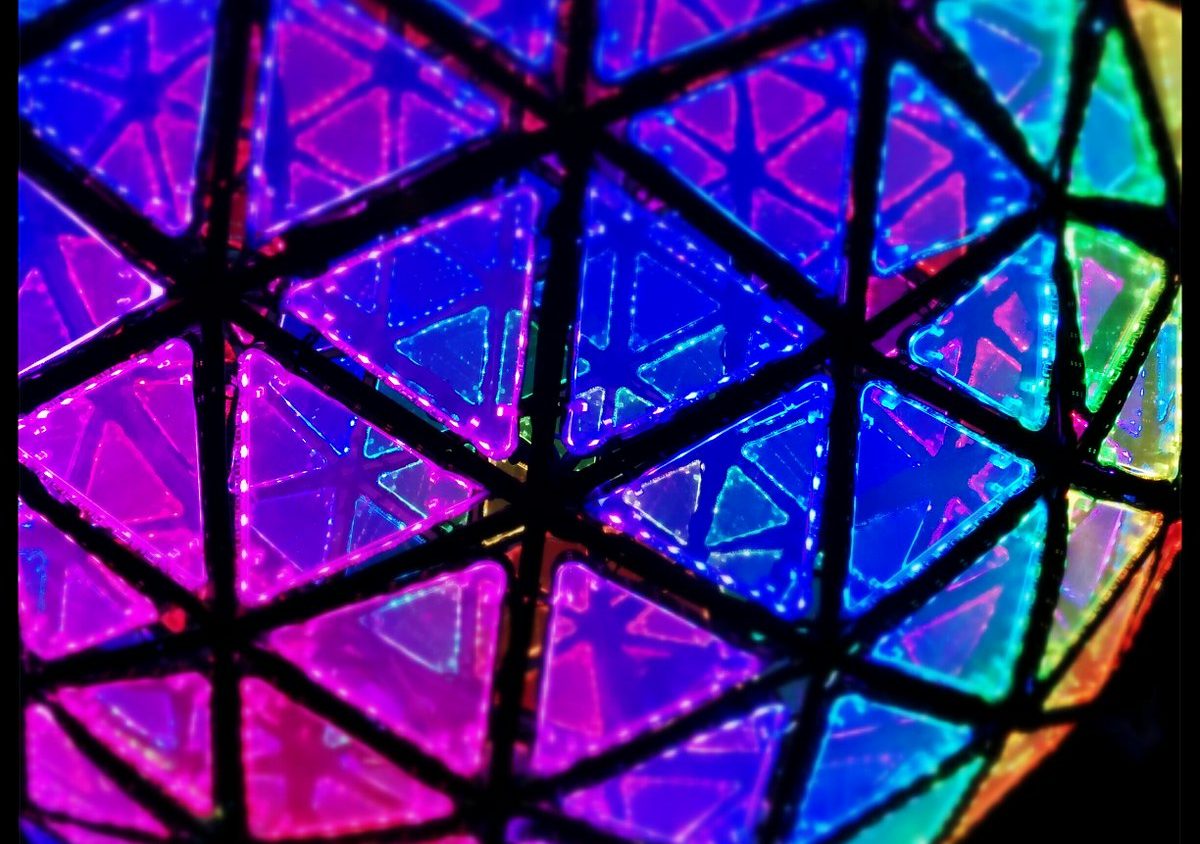
Schropp will join the Eugene Symphony to play the Radiance Orb, which isn’t some Star Trek type of instrument. The Radiance Orb is a free-standing art installation created by Light At Play, made up of 35,000 individually addressable LEDs. It’s essentially a color organ. Schropp will play from a keyboard which, instead of sound, will project light from a seven-foot orb, bathing the audience in colors as envisioned by Scriabin.
“We’re creating systems that never have been used collectively together before,” Schropp says.
Scriabin developed a color for each note in the 12-tone chromatic scale. To illustrate his vision, the first half of the melody to “Twinkle, Twinkle, Little Star” would be seen by Scriabin as: plain red (C), plain red, grass green (A), grass green, orange (G).
Harmonic Laboratory based the color scheme off of a color palette developed for a score in Paris in 1913 and worked with Eugene Symphony Musical Director and Conductor Francesco Lecce-Chong to update the score to include dynamics and articulations.
Schropp says he worked with Yona Appletree of Eugene-based Light at Play to develop code to incorporate musical elements beyond just sound. From a ROLI Seaboard Rise 25 MIDI keyboard, Schropp can manipulate light projected on the Radiance Orb based on dynamics such as loudness or softness.
The Eugene Symphony will perform two of Scriabin’s works — Prometheus: The Poem of Fire and the Poem of Ecstasy — with the Radiance Orb being used fully. However, Lecce-Chong says the light is subtle, so don’t expect a Disneyland-like experience.
The concert will also feature six other familiar classical music pieces, including Edvard Grieg’s “Morning” from Peer Gynt, Claude Debussy’s “Clair de Lune” and short works by Felix Mendelssohn, Federic Handel, Arvo Pärt and Gunther Schuller.
While the orchestra plays those works, the concert hall will be lit up with visual artwork by students from elementary to college-level grades who created their work inspired by a composition’s color.
The combination of emerging technology with classical music is a way to introduce classical music to those who may feel unsure about the art form. And introducing new audiences to classical music is what Lecce-Chong is so good at, Schropp says.
“Projects like these are intended to broaden the audience for the symphony and bring nontraditional attendees in,” he says. “We’re seeing a lot of interest from friends of mine in the tech community who would never have gone to the symphony.”
The Eugene Symphony will perform The Color of Sound at 7:30 pm Thursday, April 18, at the Hult Center.
UPDATED: 4:45 pm Friday, April 12