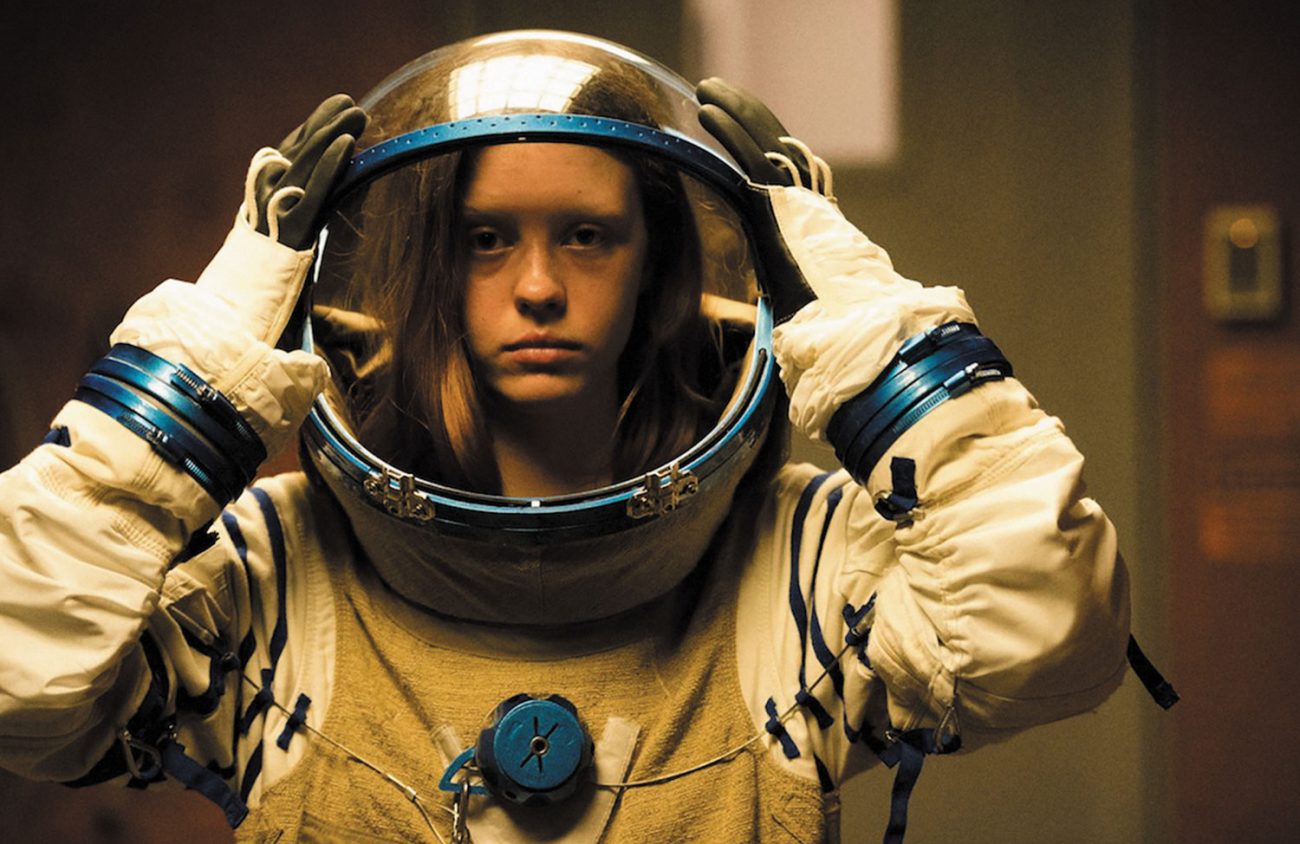
As far as I can tell, there’s nothing in the universe darker and more glorious and fucked-up than a human being. We are such singular creatures — so like angels, so devil-borne. Witness, for instance, Claire Denis’ latest movie, High Life, in which a galactic penal colony full of rapists and murderers traveling at 97 percent the speed of light toward a black hole replicates, with all the malevolent redemption of myth, the story of creation.
Denis’ film defies all categorization: If it’s a sci-fi movie, so is Terrence Malick’s Tree of Life, and if it’s horror, so is David Lynch’s Mulholland Drive. These comparisons, while perhaps apt, don’t capture the macabre, crypto-religious weirdness of Denis’ vision, which is like a nastier, more cynical but no less profound reformulation of the cosmological ontology explored by Stanley Kubrick in 2001: A Space Odyssey.
High Life opens on a humid scene of vegetation in a hothouse; the camera pans languorously over rich black soil and deep green leaves before landing for a final shot of an empty boot, suggesting the Garden of Eden just moments after eviction. This scene sets the loneliness of the vast and vacated spaceship, which now contains only Monte (Robert Pattinson) and his infant daughter Willow.
“Don’t drink your own piss,” Monte coos to the baby. “Don’t eat your own shit … it’s called a taboo.” In other words, Monte — who must report daily to keep the ship’s 24-hour life support system running — is in the lonely business of reiterating the ancestral rules of humanity for his daughter. They are a culture, and a universe, of two. All else is void. Tabula rasa.
So far, pretty standard sci-fi stuff. But soon we learn, in a series of flashbacks and fever dreams, exactly what brought Monte and Willow to their present situation. This ramshackle spaceship was full of death-sentence convicts sent on a suicide mission to discover whether energy can be extracted from the rim of a black hole. Quite literally, they have been jettisoned into another existence. As a professor being interviewed in a flashback puts it: “We’ll be bone dust while they’re still hurtling though space.”
But it gets even weirder: The crew is being guinea-pigged by Dr. Dibs (Juliette Binoche), a kind of Joseph Mengele/Nurse Ratched megalomaniac who is harvesting sperm and injecting into viable females in order to create a perfect being, i.e. Willow. And even this doesn’t quite capture the disconcerting strangeness of Denis’ film, which combines the insular focus of sexual psychodrama with the ambitious reach of mystical revelation. High Life is claustrophobic and dizzyingly expansive — not simply in equal measure, but all at once.
It’s unlike anything I’ve seen in a long time. Like Malick, Denis shoots for the stars, existentially speaking, and it’s invigorating to see such a talented filmmaker gaze unabashedly into the abyss of being, while simultaneously subjecting her art to the warp and woof of cosmological inquisition. She is helped in this endeavor by a series of fantastic performances from her cast. Pattinson, whose Twilight aura grows tantalizingly dim with each successive movie, is becoming a wonderful portrayer of broody anti-heroes, and Binoche is creepy-sexy as a sadistic Frankenstein type. Mia Goth as Willow’s mother Boyse and Andre Benjamin as the convict Tcherny are both strong, as well.
Unlike Malick, however, Denis saves herself from undue pretentiousness by grounding her work in trivial vulgarities and everyday grit. There is a lot of lowlife in High Life, which works to disarm your disbelief for the outrageous vastness of her enterprise.
And what is that enterprise? I can only suggest a possibility: to subject the human soul to a crisis of life and death, and see how it responds. After all, aren’t we all just lost in space? Denis makes literal this figurative truth, sending it out into an orbit of breathless possibility, and the results are mind-blowing. (Broadway Metro)