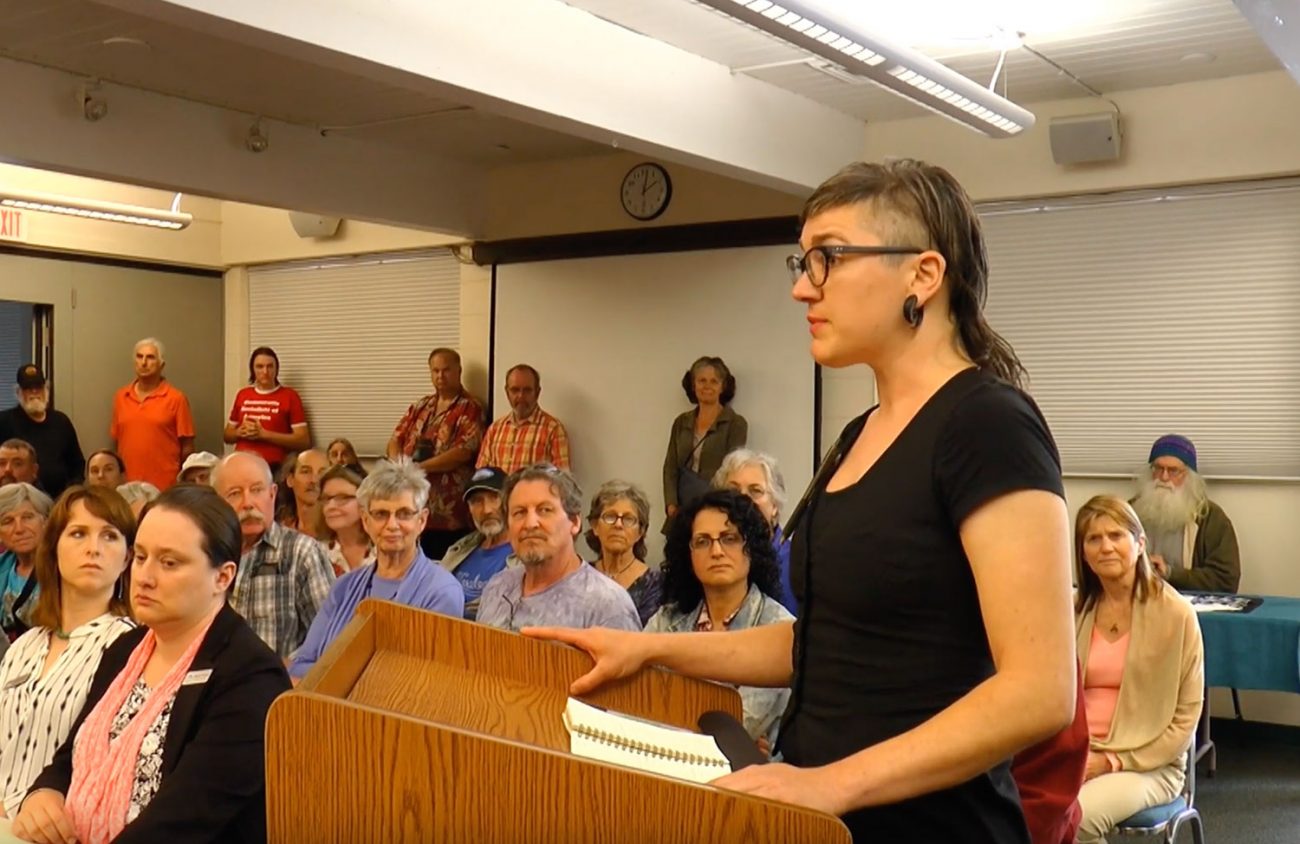
Homes for Good, Lane County’s housing agency that connects low-income people with affordable housing, is under fire. In 2017 it sold property to Evergreen Housing Development, a Seattle-based company that plans to develop market-rate apartments in the Willamette Greenway.
Jacob Fox, executive director of Homes for Good, says backing out of the contract would result in a lawsuit and may be a slippery slope that sets a precedent about whom the agency could and couldn’t sell property to.
The sale of the property will support future development, Fox adds. However, opponents of the sale want Homes for Good to find a way to terminate the contract because the area has enough market-rate housing as it is, and the organization should seeks ways to build more affordable housing.
“Fair housing requires objectivity and a lens of equality,” Fox says. “In the context of affordable housing, this idea that people can say ‘We don’t want other people in our neighborhood’ for me is a slippery slope and is concerning.”
Jacqueline McClure, a spokesperson for Greenway Guardians, a collective aiming to end over-development on the Willamette Greenway, says that when the property was listed on the market in 2017 (and sold three weeks after its listing), the agency didn’t conduct any public outreach — neither the Whiteaker Community Council nor the River Road Community Organization was contacted.
Under Oregon law regarding such corporations, Homes for Good can buy and sell land and is exempt from real estate laws that apply to public bodies — laws requiring, for instance, a hearing be held for public comment.
The organization says it works with a range of governmental agencies to develop affordable housing. Finding money for affordable housing is partly why Homes for Good had to sell the property in 2017.
Homes for Good originally purchased the land in 1997. When Fox took over as executive director in 2013, he says, the organization conducted an analysis of the property. It is in a flood zone, so using federal funds for affordable housing is a lengthy process.
Also, the site is not close to public services, such as grocery stores, social services or a transit line. To receive tax credits for affordable housing, projects are assessed through their proximity to those services.
In future property acquisitions, Fox says, the agency now has the staff to ensure that housing developments would be near social services.
The property, located on Lombard Street near River Road, is 3.59 acres of undeveloped land. The developer filed applications to construct a 94-unit, market-rate, multi-family apartment complex. The development would include a leasing office, a maintenance building and other improvements like a parking lot, according to Eugene Planning Commission documents.
Greenway Guardians say the development would prevent direct access to the Ruth Bascom Riverbank Path System and remove dozens of heritage trees.
Rodney Bohner, an assistant planner for city of Eugene, says there aren’t any heritage trees on site and the access to the bike path is informal.
This isn’t the first time Evergreen Housing Development has purchased land and developed in Eugene. The company bought Ecco Apartments and later sold it to a California-based housing company in 2016 for $31 million. That apartment complex was built with federal funding, with the requirement that household incomes are below 60 percent of the area median, according to The Register-Guard.
Sam Gottlieb, CEO and founder of the company, tells Eugene Weekly there is no intent to sell the River Road property. Rents at the Lombard development would range from $1,100 to $1,400, with an average of $1,240. The apartments will feature units with one bedroom and one bathroom, and units with two bedrooms and two bathrooms.
Gottlieb says he’s aware of the opposition to the project, but says people who need housing don’t go to meetings or litigate — they vote with their feet.
“We believe that Eugene needs more housing in the price range we are building,” he says via email. “We will continue to make every effort to meet the needs of the market.”
McClure says the apartment complex wouldn’t be affordable and that there are enough market-rate housing choices in Eugene. Rather than selling the property, she says there are several creative ways to solve issues like housing the homeless.
“It could be through tiny houses, small villages, affordable apartment complexes,” she says. “I think it’s going to take us all coming together with agencies like Homes for Good, the city and the public to provide affordable housing for people in need.”
Fox says Homes for Good is providing more affordable housing than ever before and that all income levels need housing.
“We think market rate housing creates what we call ‘naturally occurring affordable housing,’” he says. “When people move from an older apartment into a newer apartment, it creates new affordability.”
He adds that because Eugene has the second-tightest housing market in the U.S. according to a 2018 report by Realtor.com, the city needs more housing units — no matter the price range.
“We think the more housing, the better,” he says.
Because of the company’s track record of profiting off the Ecco Apartments, Homes for Good had good reason to breach the contract, says McClure.
Fox says the Homes for Good board of directors could direct him to do that, but it would be an “extremely irresponsible decision.”
“This is a legally binding purchase agreement,” he says, adding that the buyer would sue, increasing legal fees. “Our lawyer and our broker are of the mind that a judge would absolutely require us to finish the sale and would require us to cover the buyer’s legal costs,” Fox adds.
When the Homes for Good board of directors approved the sale in 2017, it OK’d using the money for future property acquisitions as well as building a new administrative building. However, Fox says, he doesn’t want to use it for administrative purposes and that a new administrative building has been secured through other funding.
“The proceeds would be flexible if the board wanted us to consider using it, we could,” he says. “I want to reinvest it in affordable housing.”