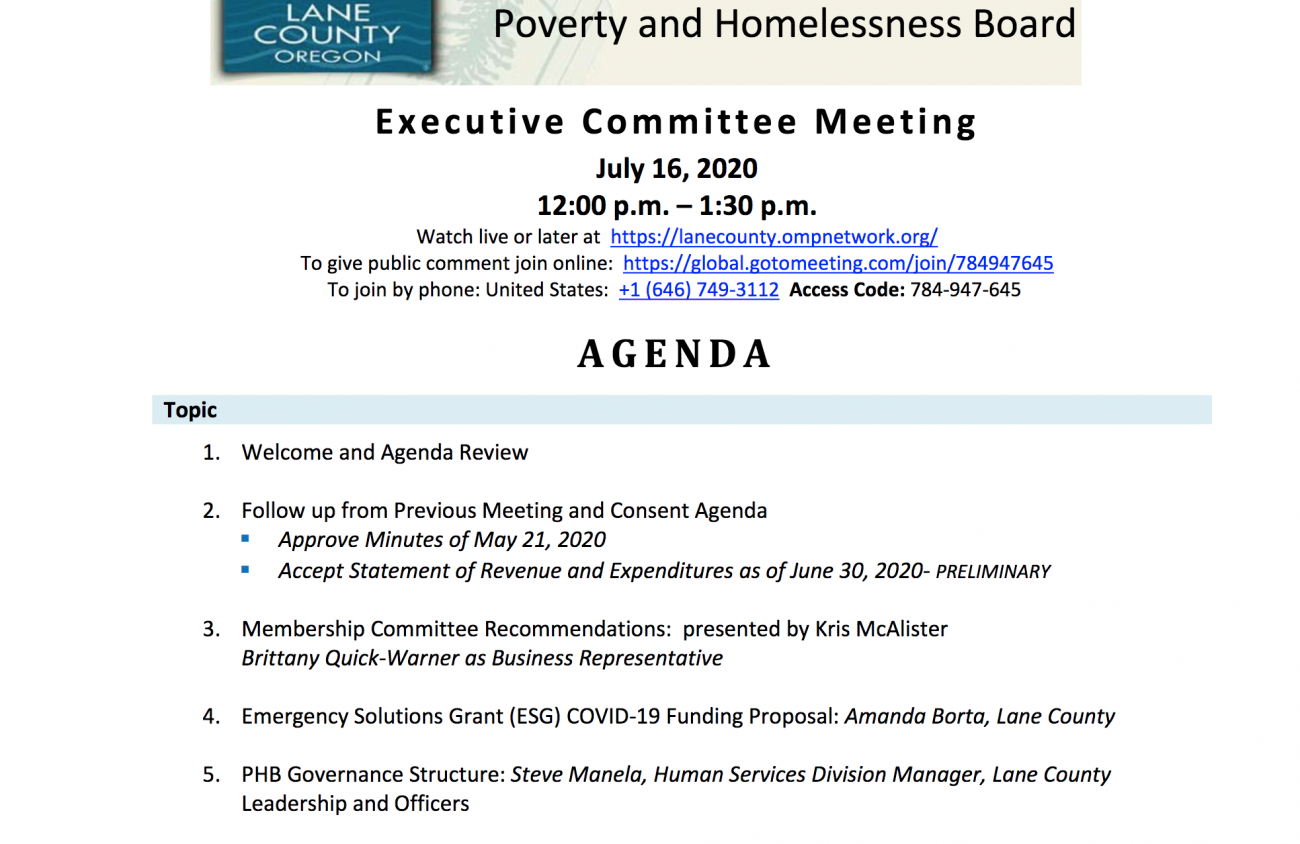
Members of the Lane County Poverty and Homelessness Board (PHB) discussed how to use federal money for unhoused people during the pandemic and plans for helping the population make it through the winter at their July 16 meeting. The Egan Warming Center, a program administered by St. Vincent DePaul that carried the brunt of warming services in Eugene, will not function with physical-distancing measures, so the county needs another plan to keep people safe on cold winter nights.
The PHB is composed of one-third elected officials, one-third representatives for the low-income population in Lane County and one-third people involved in business, religion, education or other important sectors of the community.
Its purpose is to serve the needs of homeless and low-income residents of the county. Its responsibilities include strategically fighting homelessness, allocating federal money and conducting the annual Point in Time Count. It appears the PHB and the county do most of the significant government work in fighting homelessness and poverty in this area. The city of Eugene does not have a large budget to address homelessness and poverty and generally works with the board to support the county’s work on these issues. Eugene Mayor Lucy Vinis serves on the board.
The meeting was live streamed through the Lane County website and a video of it can be found on the Lane County website here.
At the meeting, Kris McAlister was unanimously appointed as the new chair for the board, after Patrick Walsh stepped down from all of his roles on the board. McAlister has the voting board position of currently or formerly homeless consumer (of services.) He’s also the co-director of Carry it Forward, a nonprofit that provides services for homeless people. Walsh was the chair since the board’s inception six years ago and had the voting board position representing business. Some board positions do not vote.
The board unanimously appointed Brittany Quick-Warner, the president and CEO of the Eugene area Chamber of Commerce, as Walsh’s replacement for the business position.
But the bulk of the meeting was focused on the federal money for homeless people and preparing to help the population through inclement weather during the pandemic.
Federal Emergency Solutions Grant Money
Amanda Borta, a program services coordinator for Lane County Health and Human Services, presented a report on new Emergency Solutions Grant money from the United States Department of Housing and Urban Development (HUD). She said the funds are to be used to “prevent, prepare for and respond to the coronavirus pandemic among individuals and families who are homeless or receiving homelessness assistance.”
The money flows through the state of Oregon before reaching county coffers. Borta said the first round of this money, a little under $1 million, will be available to the county soon. The second round, which has been given to the state but not yet allocated to the county, will be about $7 million.
HUD’s requirements on how the money can be used have not been released, Borta said, but she expects it will be mainly used to alleviate the suffering that homeless people in Lane County have experienced due to the pandemic, through care and services.
She said the county would prioritize single adults, the largest demographic in the Lane County homeless population. She proposed that most of the money go toward street outreach, emergency shelter, rapid rehousing and homelessness prevention.
Street outreach could include things like case management and emergency health and mental health services, she said.
Emergency shelters are 250 beds below normal capacity because of social distancing measures, Borta said, so increasing capacity should be a priority. Money for emergency shelter could go toward care, services and supplies at shelters, as well as hotel and motel vouchers for elderly homeless people and others who are at high-risk of harm if they contract the virus.
She said the federal money going into rapid rehousing could potentially go into rental assistance, utility bills and security deposits, although she isn’t sure if the HUD requirements will allow this.
As far as prevention goes, she said that the money would probably go toward supportive services for people at the brink of homelessness, but not rent relief. There was a separate federal coronavirus relief program that granted about $7 million toward rental assistance in Lane County.
Borta said some of the money could potentially go toward creating more units of permanent housing for homeless people in Lane County, like Conestoga huts, prefabricated housing units. But the money would probably have to go toward the services and care side of these types of places. It could also go toward creating more safe camping zones like those created by the city of Eugene at the beginning of the pandemic.
Based on how long money normally takes to get from the state to county level, the funds will probably be available in a couple of months, said Steve Manela, the Human Services division manager for the county.
Preparing for Winter
Sarai Johnson, the joint housing strategist for Lane County and the city of Eugene, presented a report on what needs to be done to keep the homeless population safe during inclement weather without the Egan Warming Center.
Providing shelter during cold winter days while maintaining safe distancing measures will be extremely difficult, Johnson said. But with this new funding, she said she also sees potential to create a much better system than the one that the county currently uses.
Johnson said about 3,000 people use homeless services in Lane County in a month, and about 9,000 use them in a year.. So there needs to be a lot more warming capacity for cold winter nights.
Johnson said shelter options mentioned by Borta, like safe tent and car camping locations and motel and hotel vouchers could help fill the shelter deficit. She also said that lower-risk “congregate” shelters, where many people sleep under one roof, would be necessary to provide necessary shelter, although she admitted that this wasn’t a great solution during a pandemic.
To realistically make safe sleeping tent or car villages a viable solution, Johnson said city policy would have to change to allow sites that house up to 40 people. Current policy only allows six tents per location. Safe sleeping locations would cost the county about $20 to $36 per bed per night.
Housing people in hotels and motels should only be reserved for desperate situations and people who are in a lot of danger from coronavirus, because it would cost $65 to $85 per bed per night, Johnson said.
She said lower-risk congregate shelters would cost about $49 to $85 per bed per night. To make this work, the county would have to find large, underutilized indoor spaces, and work with the city.
Johnson stressed that temporary solutions like hotel vouchers are expensive, and don’t add anything to the housing infrastructure of the Lane County government. She said that the best use of money, in the long run, would be building permanent housing like tiny homes, Conestoga huts and stackable prefabricated housing units. There would be huge up-front costs to building these types of units, but spread out over 15 years of use, it would only cost the county $27 to $38 per bed night, she said.
Board members, including Mayor Vinis, agreed that the focus should be to find sites for temporary and permanent housing in Lane County over the next few months.
The next all-member meeting is Aug. 20, the executive committee meets Sept. 17.