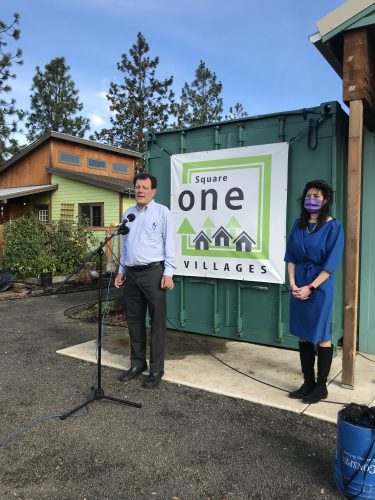
Hours before Nicholas Kristof came to Eugene, the New York Times published his farewell essay. The essay was the now-former columnist’s reflection on his decades of working at the newspaper and why he was leaving it behind to make a run for the Oregon governor’s office.
In the essay Kristof writes about tragedies across the world as well as the ills his old schoolmates in Yamhill have faced — suicide, drug abuse and homelessness. For the 15 minutes he spoke with reporters during his Eugene visit on Oct. 28, he discussed these issues that many Oregonians face and argued that electing the same political leadership won’t change anything. The newly minted candidate didn’t provide any concrete solutions while criticizing current Democratic leadership in Salem, but in two days he’s raised a significant amount of cash.
“One-quarter of the kids on the No. 6 school bus have passed away,” he said, referring to the bus he took in grade school. “There are No. 6 school buses all throughout the state.”
Kristofs’s public visit took place at SquareOne Villages in Eugene, which provides tiny homes for those in need of housing. After receiving a tour of the facility by Executive Director Dan Bryant, Kristof met with a handful of Eugene-area reporters for a brief press conference, taking only one question from each of the three reporters who showed up.
Kristof said he’s running as a Democrat, and not as an independent unaffiliated candidate like state Sen. Betsy Johnson, because he identifies with the political party. He’s running in the Democratic primary, he said, because the party has the right ideology to address the state’s challenges, such as homelessness and public safety.
Kristof is joining a race against two high-level Democratic Party politicians: House Speaker Tina Kotek and state Treasurer Tobias Read, both of whom have years of experience in Salem. Kristof said that if Oregonians want someone who is a career politician or lobbyist, they can vote for them, but as a journalist, he’s worked with people trying to better their lives.
“We know the system has been rigged against ordinary Oregonians, and we’re not going to change that if we send the same folks time after time to Salem and somehow expect different answers,” he said. “It’s a real challenge in this state with homelessness, with issues of public safety, with issues of public education. But also it’s an opportunity if we learn from folks who are providing examples of a way forward, then we can begin to make real differences.”
Kristof is one of two Democrats seeking the party’s nomination who lives in Yamhill County; the other is Yamhill County Commissioner Casey Kulla. In 2020, Kristof wrote Tightrope: Americans Reaching for Hope about his hometown and the economic challenges it now faces.
Although Kristof’s family has had a 20-acre farm in Yamhill County for decades, he, his wife and mother purchased 115 acres of land near his family farm for nearly $1 million in cash. The family plans to use it for a vineyard.
Shortly after purchasing the property, Kristof sued his neighbor over access to an easement. The lawsuit, filed in Yamhill County Circuit Court, has been underway for more than six months, generating more than 500 pages of court documents. Kristof’s lawyer told Eugene Weekly that rights to the easement go back to 1959. The defendant’s lawyer said the Kristofs are unhappy with their highway access and are trying to use the court to gain access to the property they don’t have rights to.
On Oct. 29, the day after his Eugene visit, Kristof’s campaign reported in a press release that it had received $105,434 in contributions in the two days of the campaign. In the time since the 2020 general election Read has received $172,411. And according to OreStar data, Kotek has raised $244,440 since January 2021.
Kristof’s campaign has 30 days to disclose the names of donors and the amount they donated, according to Oregon law. In the Oct. 29 email, Kristof’s campaign reported that it had 910 donors.
In his Oct. 28 speech, Kristof didn’t mention any specific solutions to problems that Oregon faces, and he also said he doesn’t have a magic wand to make them go away. He doesn’t believe in “silver bullets” — instead he said he prefers “silver buckshot.” But he said the political ruling class doesn’t have solutions either and have been helping create some of the state’s problems.
The challenges Oregonians face today are a reflection of the political system’s failure to address fundamental problems, he said. People in Oregon don’t look at issues in Portland and throughout Oregon and think the state has great governance, he said. “People believe Oregon can and know it can be better,” he added.
In the 15-minute press conference, most of Kristof’s questions were related to COVID-19. He said that he’s “been writing about COVID since it began and has spent time in hospitals.”
He added, “I have a long record on COVID policy that is there for people to see. We have to follow the science. That means vaccinations, and that means masks.”
Gov. Kate Brown has implemented mask and vaccine mandates, which has been at times unpopular with rural communities. But Kristof said the state’s problem is related to political divisiveness and trust. “There is an urban-rural divide here, and I know that from friends of mine in Yamhill who I deeply care about, yet who refuse to get vaccinated,” he said.
As a liberal Democrat from a rural area, he added, he’s in a position where voters will rather listen to him instead of the two other Democrats from metro areas.
“I think this state needs new vision and leadership to try and address the challenges that we face in this state. And to knit this state together again,” he said. “With that leadership and vision, we can provide a better future for the kind of folks who have been helped by SquareOne Village and for the kids who are getting on the No. 6 bus all over this state, every day, these days.”