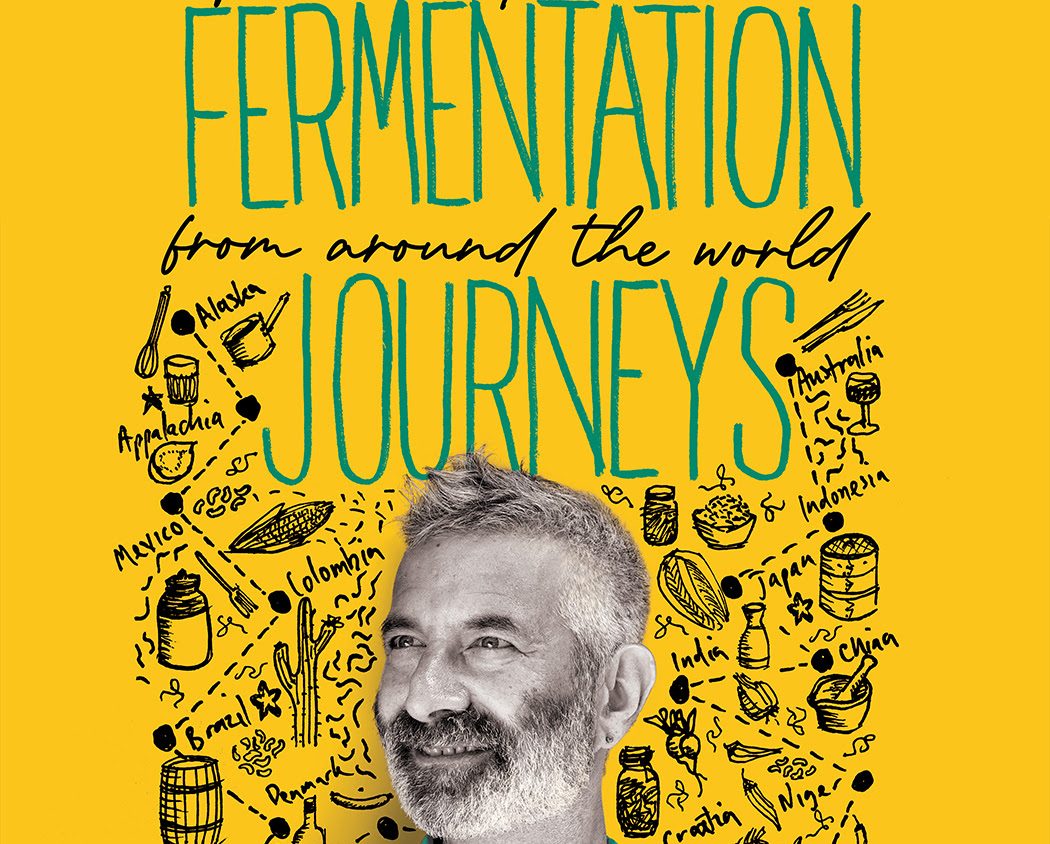
Sandor Katz’s most recent book, New York Times-bestseller The Art of Fermentation, came out in 2012. He took the halt in traveling brought on by the pandemic as an opportunity to finally write about his food- and education-driven travels at his home in Tennessee. In the last decade, his passion for learning about food and educating people about its vast possibilities has led him all around the globe — from a forest coffee farm in Mococa, Brazil, to an apartment window decorated with sausages in Chengdu.
Katz’s new book Fermentation Journeys, released Nov. 9, is as much a story of people and places as it is a map of the expansive array of fermentation practices he has learned and taught. He aims to demystify fermentation, which he describes as “a vast array of distinct processes that developed in different places.” Katz will be in Eugene for a book launch Dec. 1, at Marché restaurant. That event is sold out but he is also doing a book signing with Oregon authors Kirsten and Christopher Shockey, who have written several books on fermentation. That event is 2 pm to 4 pm, also on Wednesday, Dec. 1 at Down to Earth, 532 Olive Street.
Food is what teaches him the history of each place he travels, and he shares his ever-growing knowledge of the functions of food in his recipes and stories. “My primary interest is helping people to see how accessible these processes are, and how you can do them without any special equipment. Just using improvisation with things you already have in your kitchen,” he tells Eugene Weekly in a Zoom interview.
Katz’s recipes encourage people to experiment with food, not just follow a recipe word for word. “I don’t view these as recipes that need to be followed by the teaspoon full,” he says. Instead, they’re “guidelines to introduce people to processes that I hope they will play with or experiment with. Experiment with different vegetables, with different seasonings.”
He first learned about the world of fermentation from books. “I learned to make sauerkraut from The Joy of Cooking. Then I found more specialized books; William Shurtleff and Akiko Aoyagi’s The Book of Tempeh.” As his knowledge of food grew, so did his web of connections, and soon he began teaching about fermentation.
“My approach to teaching about fermentation began to be formed the first time I was invited to teach a fermentation workshop, which was in 1998,” he says. “I spoke in Tennessee at a place called the Sequatchie Valley Institute.” The event, “Food for Life,” brought cooks and educators together to teach and learn different food skills and practices. Katz says he was struck by how many people had fear around the bacteria in fermented food, and began gearing his teaching toward dismantling the notion that everything has to be controlled.
“It’s easy for people to imagine that they have to control all these factors, but part of the work that I do trying to demystify this process for people is just helping them realize that they don’t have to control everything.” Katz explains that people have been fermenting for hundreds, in some cases thousands, of years with simple equipment.
While Katz primarily travels to teach, he finds great joy in the “serendipity of travel,” sans agenda.
In 2016, Katz travelled to China with friend Mara King. “Now it happens that on the first day where we left ourselves free to adjust to the time change and get our bearings, we ended up having a really wonderful chance encounter.”
Walking in the city of Chengdu, Katz and King’s curiosity got them a lunch invitation with a woman named Mrs. Ding. “She actually had sausages hanging outside of her window” outside of her ground floor apartment window, he says, “and I just had to take pictures of it. And she saw me taking pictures and came out and started talking to us.” Katz says a lively conversation ensued, and Mrs. Ding invited them in for lunch and conversation about her unique window ornaments, just one of her many fermenting projects.
Though perhaps more planned out, the encounters Katz writes about in Fermentation Journeys have this same vitality, fueled by a love of food’s intricacies and nuances. In his chapter “Beans and Seeds” Katz includes an essay from Felipe Croce, who is a member of the family who owns and runs Fazenda Ambiental Fortaleza in Brazil, the forest coffee farm where Katz participated in a fermentation workshop. Croce talks about how fermentation practices can “influence the flavor in the cup.”
With seven chapters organized by food category, each includes a variety of perspectives from different people and countries. Katz’s passion for the diversity of fermentation comes through in his recipes, where he often offers multiple options and suggests that you decide what’s ripe enough or salty enough.
“The joy of home-cooking — and the reason why it’s great to ferment stuff yourself — is you can make it the way you like it,” he says. “And the only way to discover that is by experimenting.”
To accompany Katz’s book launch, Marché’s chefs and bartenders have put together a fermentation inspired four-course tasting menu and cocktails, including a roasted oyster with fermented hot sauce and sauerkraut chocolate cake for dessert.
An Evening with Sandor Katz is 6 pm on Wednesday, Dec. 1 at Marché, 296 E. 5th Ave. $60 per person. Reservations can be made at MarcheRestaurant.com/Events. Beverages and books available at the event. Earlier that day Katz and Oregon fermentation authors Kirsten and Christopher Shockey will be signing books from 2 to 4 pm at Down to Earth.