A 2020 Lane County construction bidding process that encourages equity and created more diversity at construction sites is under review by the now conservative-leaning Board of County Commissioners.
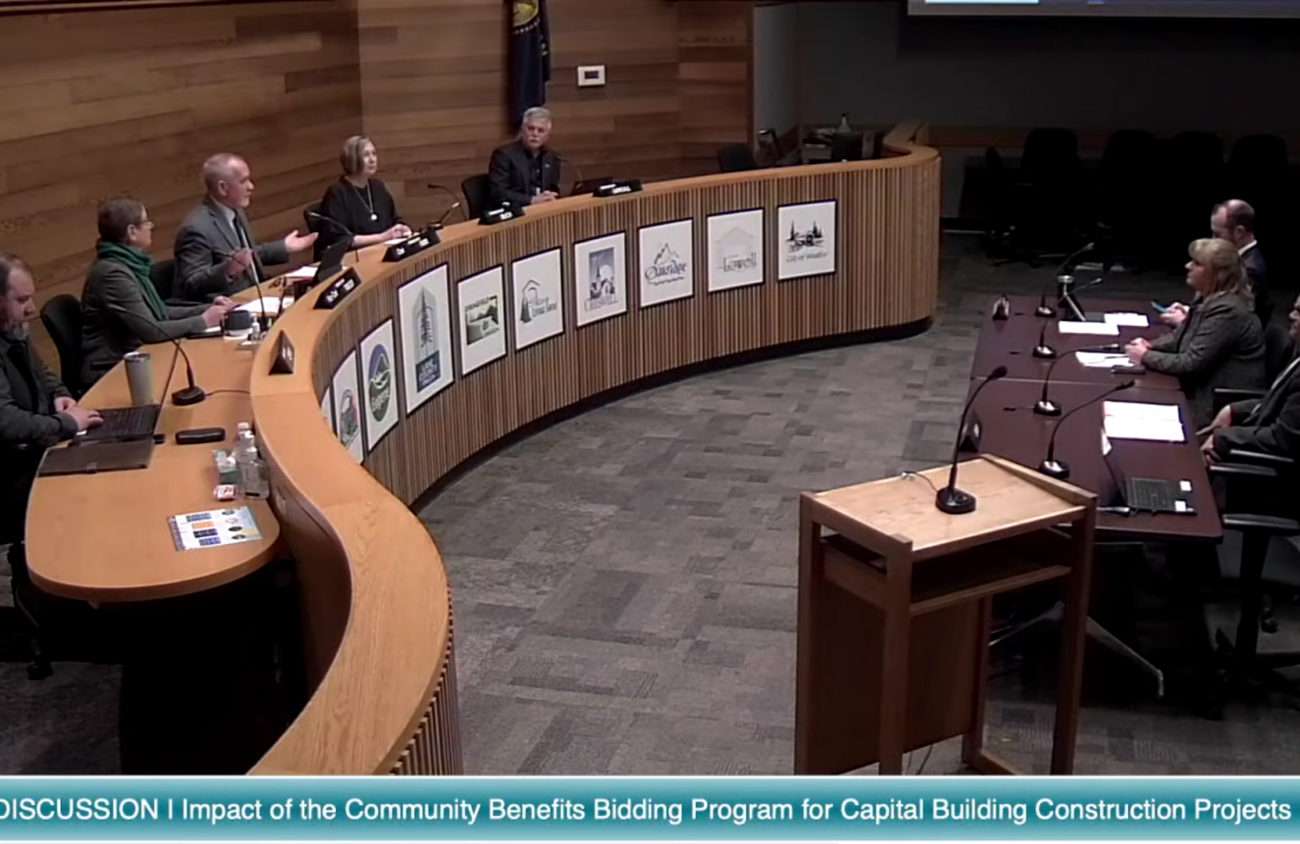
At a March 21 Lane County commission meeting, county staff presented research on the community benefits agreement, which requires that contractors meet certain criteria to bid and win county projects that cost more than $500,000.
At the meeting, Shawn Waite, Lane County’s facilities and capital improvement manager, said the program has resulted in minimal cost increases and all contractors have been in compliance with the program.
Conservative county commissioners advocated for raising the limit of the community benefits agreement, from projects costing $500,000 to $1 million, citing inflation and small business support. The liberal board members defended the program, saying it is friendly to small businesses, and to raise that amount — which the board just lowered last year — would require board time that could be best used in other ways.
The community benefits agreement was spearheaded by former-commissioner Joe Berney, who had made the protocol a campaign pledge when running for his Lane County commission seat in 2018. The program was celebrated by Oregon unions, which said it provided nonunion workers with benefits similar to what labor organizations offer. In 2022, Berney lost re-election to conservative David Loveall by a narrow margin.
The community benefits agreement program requires contractors to pay a living wage, offer full time family health insurance, have apprenticeship programs for underrepresented communities and follow climate friendly practices. In October 2020, Lane County Board of County Commissioners passed it unanimously.
At the March 21 meeting, the current conservative-leaning board re-examined the program.
Chair Pat Farr, who supported the program in 2020, said that revisiting past board decisions isn’t unheard of. “Inquiring minds like mine have more questions,” he said. “I don’t think this matter is over.”
Commissioner Heather Buch said that the board voted last year to lower the threshold to $500,000 after hearing from staff that it had been successful. “I would not support adjusting that,” she said after newly elected conservative Commissioner Ryan Ceniga suggested raising it to $1.5 million. To have discussions about raising it would be a waste of time, she added.
Waite said the Lane County board requested an analysis of the community benefits agreement program to gauge its efficiency at a March 7 board meeting. Her March 21 report examined four aspects of the program: cost comparison of past and future projects, verification of apprenticeships and job training, checking health insurance requirements, and impact of projects in the 2024 budget year.
The community benefits agreement program was used in five projects since the board implemented it in October 2020, Waite said. The project costs ranged from $800,000 to $10.3 million. The only project that came in over the bid was the Lane County Adult Corrections Security Management System, she said. “This was not a surprise to our staff, as we’re seeing inflationary factors in technology systems to be substantial,” she added.
Waite said that hiring union contractors for these projects did not result in a higher project cost. “However nonunion contractors, there was a 3 to 5 percent markup,” she said.
The project has resulted in more diversity in the construction workplace, Waite said. For the first time, a woman ironworker worked on a Lane County project.
Waite said that smaller companies and nonunion contractors are having trouble meeting the county’s community benefits agreement requirements, such as offering an apprenticeship program.
The county’s 2023 through 2027 capital improvement plan estimates there will be six projects that require contractors to meet its community benefits agreement plan, but that many more could meet the financial threshold due to rising construction costs.
Loveall said the county should raise its CBA threshold from $500,000 to $1 million, so that local contractors can continue building county projects. But he said that he and other commissioners don’t want to rebuild the program. “It was to look at how much things are costing and how small businesses can get into the game,” he said.
Buch said that it’s not true that small businesses can’t bid for projects related to CBA. “As long as they’re working toward their apprenticeship programs, they have their proper insurance — which we would want for any business bidding for projects here at the county — they can participate,” she said. “No matter how small they are. I want that to be clear because what’s being presented is that they aren’t able to participate, and that’s not true.”