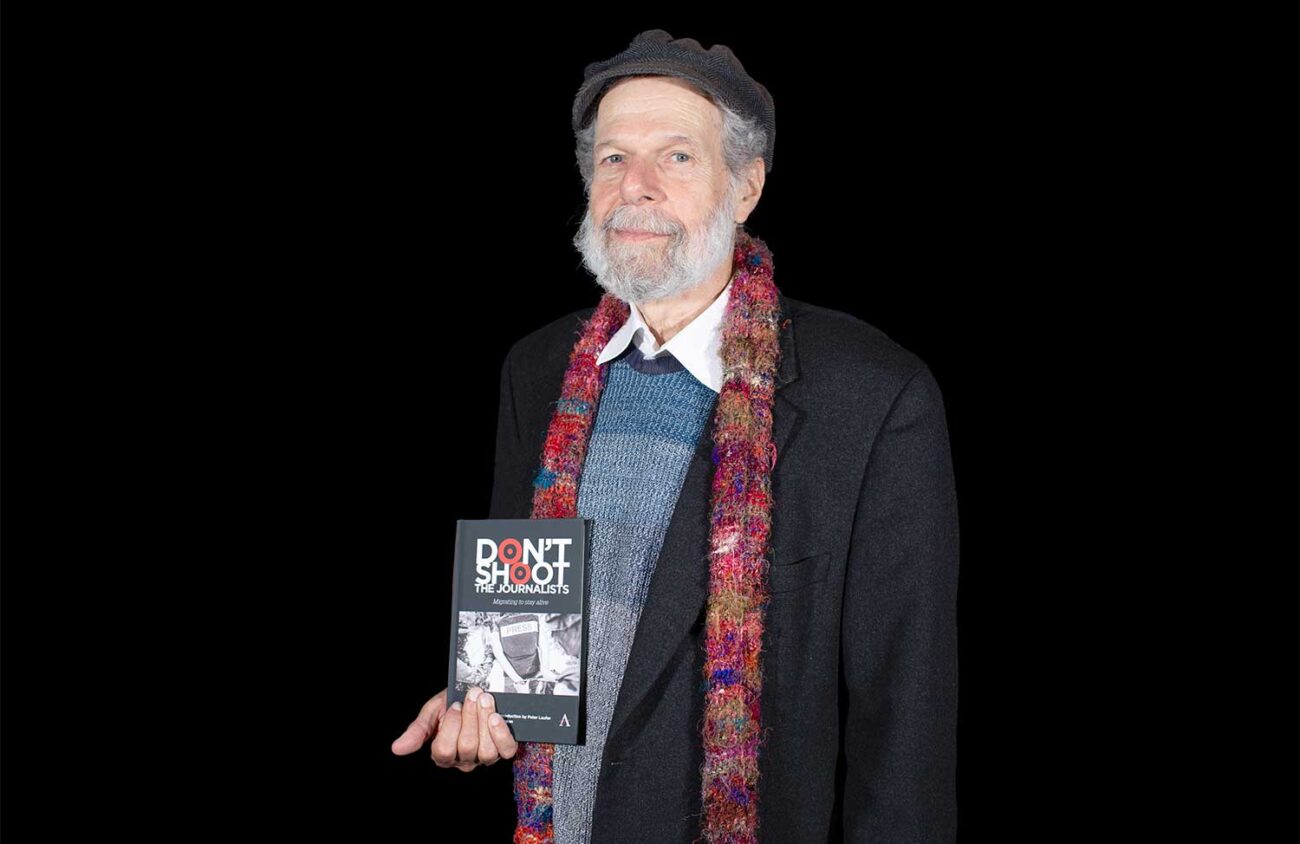
In the early 1970s, Peter Laufer’s family home was set on fire in an arson attack, resulting in his mother’s legs being severely burned. “It was a wake-up call,” Laufer says.
After that attack, Laufer, now a journalism professor at the University of Oregon, was faced with a choice: continue his work in journalism as a morning news reporter for KSAN San Francisco, or pull back and stay quiet.
He chose the first option. “I think that when we feel compelled to figure out what’s going on in the world, it’s a matter of how we’re going to do it, not if we’re going to do it,” Laufer says. At the time, Laufer says the radio station was known for its alternative and opinionated angles. It was his reporting on topics like the Vietnam War and counter culture that Laufer says was likely responsible.
According to the Committee to Protect Journalists, 2024 was the deadliest year for journalists since it began gathering data in 1992, with at least 124 dead. Nearly 70 percent of the 124 were killed by Israel in the Gaza war. Laufer says there is a “universality of trying to shut us up.”
In April 2024, the UO hosted the “Extra! Extra! Don’t Kill the Messenger” symposium featuring speakers from various backgrounds, including journalists from Mexico, Venezuela and Zimbabwe. The purpose, Laufer says, was to critically examine how journalists are being placed under increased pressure from violence, exile and state officials. “It became so clear how we’re all in it together globally,” he says. It was the stories told during this symposium that inspired him to create the book: Don’t Shoot the Journalists: Migrating to Stay Alive.
The book is a collection of entries from 20 authors, with many telling the story of how they experienced and dealt with forces who actively tried to silence them. It also includes a foreword by Iranian-American journalist Jason Rezaian, who was held in an Iranian prison for more than a year.
Two journalists who were originally intended to speak at the symposium were unable to make it due to visa issues: Youmna El Sayed from Gaza and Baktash Siawash from Afghanistan. Laufer says another reason he edited the book was to feature the important stories these two journalists had to tell. “This was a method that transcended visas,” he says.
In El Sayed’s entry, she writes of her experience as a reporter in Gaza and how she eventually was forced to flee the city due to Israeli bombardment. “That label that carried the word PRESS, I assumed, guaranteed my safety,” she writes. “But I was completely mistaken.”
In another entry, American journalist Jeff Kamen tells the story of how he was beaten by white supremacists in Grenada, Mississippi, in 1966 during the Civil Rights movement. “He told that story with great power and emotion,” Laufer says.
Laufer says that as journalists are being suppressed worldwide, it’s more important than ever to educate a new generation of journalists about the real danger which comes with the profession, while at the same time teaching the importance of the work journalists do. “The reality is that holding up a press card is no longer a sign of immunity — it’s often a target.”
In May 2020, Eugene police threw a tear gas canister into the chest of a Eugene Weekly reporter covering a Black Lives Matter protest. The reporter, Henry Houston, was holding up his press badge.
Laufer continues, “If there’s an oldest profession, we’re the second oldest profession. There will always be a need and a desire to know what’s going on.”
Peter Laufer will speak at the Build A Better Journalist Conference hosted by the Society of Professional Journalists Oregon Pro Chapter on Oct. 18. Find tickets on SpjOregon.com.